With a focus on actionable insights and strategic value, The Business Research Company’s 2026 market reports include market attractiveness scoring, total addressable market sizing, company benchmarking matrices, interactive Excel dashboards, deeper supply chain intelligence, emerging startup tracking, and granular product-level insights.
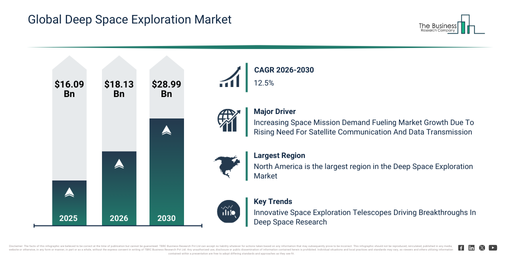
Deep Space Exploration Market Size Forecast Points To $28.99 Billion In Revenue By 2030
The deep space exploration market has experienced swift expansion recently. Its valuation is projected to increase from $16.09 billion in 2025 to $18.13 billion in 2026, exhibiting a compound annual growth rate (CAGR) of 12.7%. Historically, this growth stems from several factors, including heightened investment in robotic planetary missions, which has boosted the need for deep space communication systems. Other drivers are the advancement of navigation and tracking technologies crucial for interplanetary spacecraft, the expansion of earth observation and satellite programs establishing a technological foundation for deep space systems, improvements in power supply units like radioisotope generators that facilitate extended missions, and international collaborations among space agencies fostering accelerated scientific data collection and exploration efforts.
The deep space exploration market is projected to experience swift expansion in the coming years. Its valuation is anticipated to reach $28.99 billion by 2030, demonstrating a compound annual growth rate (CAGR) of 12.5%. This projected growth during the forecast period stems from several factors: the escalating requirement for autonomous navigation systems in future crewed and uncrewed missions beyond the moon; increased commercial involvement in deep space initiatives, thereby boosting demand for communication and tracking services; the creation of advanced deep space communication networks facilitating high-bandwidth data transfer; the rising deployment of robotic exploration apparatus for missions targeting asteroids, Mars, and outer planets; and significant progress in robust power and propulsion technologies that enable prolonged interplanetary operations. Key trends identified for this period encompass a heightened demand for deep space robotic endeavors, the proliferation of public-private collaborations in space exploration, increased capital allocation for interplanetary communication infrastructure, the broader deployment of reusable spacecraft and rover platforms, and a significant rise in advancements related to lunar and Mars surface mobility.
Get A Free Deep Space Exploration Market Sample Covering Drivers, Trends And Key Players:
Deep Space Exploration Market Driver Analysis: Key Factor Supporting Revenue Growth
The anticipated rise in demand for space missions is projected to stimulate the expansion of the deep space exploration market. These missions are defined as deliberate undertakings or ventures that dispatch spacecraft into space for purposes such as exploration, scientific investigation, or leveraging outer space resources. A key factor contributing to this escalating demand for space missions is the escalating requirement for satellite-based communication services, as both governmental bodies and private enterprises aim to broaden worldwide internet access and improve data transfer capabilities. Furthermore, space missions are vital for deep space exploration, enabling the deployment of spacecraft and probes designed to collect essential data concerning remote celestial objects and cosmic occurrences situated beyond Earth’s orbital path. Illustratively, figures from January 2025, provided by the US-based non-profit organization Space Foundation, show that 259 launches occurred in 2024, averaging one launch every 34 hours, which signifies a five-hour increase in frequency compared to 2023. Consequently, the heightened need for space missions is unequivocally fostering the expansion of the deep space exploration market.
Deep Space Exploration Market Segmentation Framework: Major Segments At A Glance
The deep space exploration market covered in this report is segmented –
1) By Component: Spacecraft, Launch Vehicles, Rovers, Space Probes, Other Components
2) By Mission Type: Manned Missions, Unmanned Missions
3) By Application: Moon Exploration, Transportation, Mars Exploration, Orbital Infrastructure, Other Applications
4) By End-User: Government, Commercial, Other End-Users
Subsegments:
1) By Spacecraft: Manned Spacecraft, Unmanned Spacecraft, Orbital Spacecraft, Interplanetary Spacecraft
2) By Launch Vehicles: Expendable Launch Vehicles, Reusable Launch Vehicles, Heavy-Lift Launch Vehicles, Medium-Lift Launch Vehicles
3) By Rovers: Autonomous Rovers, Remote-Controlled Rovers, Hybrid Rovers
4) By Space Probes: Flyby Probes, Orbiter Probes, Lander Probes, Atmospheric Probes
5) By Other Components: Satellite Systems, Space Telescopes, Deep Space Communication Systems, Navigation And Guidance Systems
Latest Deep Space Exploration Market Developments And Emerging Trends
Leading companies operating within the deep space exploration market are concentrating on introducing novel solutions, including space exploration telescopes, to enhance the identification and examination of distant celestial bodies and exoplanets. A space exploration telescope functions as a space-based optical instrument, designed to acquire high-resolution images and data from remote celestial objects, free from atmospheric interference. For example, in March 2025, the National Aeronautics and Space Administration, a US-based space agency, deployed the SPHEREx space telescope with the goal of mapping the sky using 102 infrared colors over a planned two-year mission. SPHEREx is set to collect data on more than 450 million galaxies and over 100 million stars within the Milky Way, generating a comprehensive 3D map of the cosmos to investigate the universe’s origins, the history and evolution of galaxies, and the existence of water and organic molecules, which are crucial components for life in our galaxy. SPHEREx aims to illuminate cosmic inflation, the swift expansion that occurred immediately after the Big Bang, and offer fresh perspectives on how the universe and planetary systems evolved.
Which Companies Are Shaping The Deep Space Exploration Market?
Major companies operating in the deep space exploration market are The Boeing Company, Lockheed Martin Corporation, Northrop Grumman Corporation, L3Harris Technologies Inc., Airbus Defence and Space GmbH, Space Exploration Technologies Corp., Blue Origin LLC, Thales Alenia Space SAS, Maxar Technologies Inc., Sierra Nevada Corporation, Relativity Space Inc., Rocket Lab USA Inc., Firefly Aerospace Inc., Axiom Space Inc., Impulse Space Inc., ispace Inc., Astrobotic Technology Inc., Vast Space LLC, Pan Galactic Ltd., WeSpace Technologies Co. Ltd.
Dive Deeper Into The Deep Space Exploration Market With The Full Report:
Deep Space Exploration Market Regional Distribution: Where Is Revenue Concentrated?
North America was the largest region in the deep space exploration market in 2025. The regions covered in the deep space exploration market report are Asia-Pacific, South East Asia, Western Europe, Eastern Europe, North America, South America, Middle East, Africa.
Reach Out To Our Team:
The Business Research Company: https://www.thebusinessresearchcompany.com/
Americas: +1 310-496-7795
Asia: +44 7882 955267 & +91 8897263534
Europe: +44 7882 955267
Email us at: marketing@tbrc.info
Follow us on:
LinkedIn: https://in.linkedin.com/company/the-business-research-company
YouTube: https://www.youtube.com/channel/UC24_fI0rV8cR5DxlCpgmyFQ
Global Market Model: https://www.thebusinessresearchcompany.com/global-market-model

Wasay has over a decade of experience in market research, data modelling, and analytics, with prior experience at GlobalData and Decision Tree Consulting Services. At The Business Research Company , he leads research operations across syndicated studies, customized consulting engagements, and the Global Market Model platform. His professional experience includes supporting organizations such as Boston Consulting Group, KPMG, and Ernst & Young. Wasay holds a degree in Electronics and Communications Engineering, postgraduate management qualifications from International Management Institute Belgium and Indian School of Business and Entrepreneurship, and completed the Integrated Program in Business Analytics from Indian Institute of Management Indore.