The Business Research Company’s 2026 market reports combine market attractiveness scoring, total addressable market sizing, company benchmarking matrices, interactive Excel dashboards, deeper supply chain intelligence, emerging startup tracking, and granular product-level insights to deliver research that is more actionable and strategically valuable.
Deep-Space Communication Market Value Projected To Grow At A 10.4% Compound Annual Growth Rate Through 2030
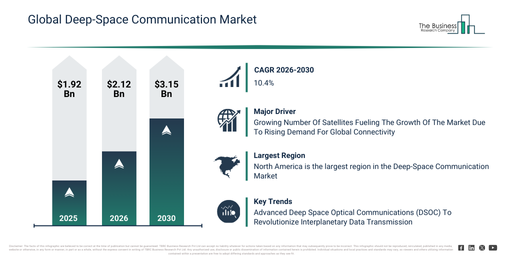
The deep-space communication market has experienced swift expansion recently. Projections indicate its value will rise from $1.92 billion in 2025 to $2.12 billion in 2026, demonstrating a compound annual growth rate (CAGR) of 10.4%. Historically, this expansion is linked to several factors: a rise in deep-space missions needing long-distance signal transmission infrastructure, advancements in low-noise amplifiers and tracking receivers for detecting faint signals, the growth of planetary exploration programs boosting demand for telemetry and data relay systems, the early integration of demodulators and sophisticated modulation techniques for reliable communication, and global cooperation in deep-space networks improving mission planning and navigation support.
The deep-space communication market is projected to experience substantial growth in the coming years, reaching $3.15 billion by 2030, with a compound annual growth rate (CAGR) of 10.4%. This expansion over the forecast period is driven by several factors, including the increasing necessity for high-bandwidth communication to facilitate data-intensive deep-space missions. Other contributing elements are the growing demand for autonomous navigation support systems integrated with communication networks, the creation of advanced telemetry units for extended interplanetary probes, the proliferation of commercial deep-space endeavors boosting the need for dependable communication services, and improvements in signal processing technologies enhancing long-range data transmission efficiency. Key trends anticipated during this period encompass a heightened demand for high-gain antennas, the expansion of deep-space optical communication, the broadening of interplanetary data relay networks, an escalating requirement for radiation-hardened communication electronics, and a greater deployment of deep-space telemetry networks.
Evaluate The Deep-Space Communication Market Report Before You Buy With A Free Sample:
Deep-Space Communication Market Growth Driver Analysis For The 2026–2030 Forecast Period
An increase in the number of satellites is anticipated to fuel the expansion of the deep-space communication market moving forward. Satellites are artificial objects deployed into orbit around Earth or other celestial bodies, designed to carry out specific functions like communication, navigation, Earth observation, scientific research, and military surveillance. The proliferation of satellites stems from the growing need for global connectivity via satellite-based internet services, particularly as ground infrastructure frequently struggles to reach isolated and underserved regions. Deep-space communication facilitates satellites by ensuring dependable data transfer across immense interplanetary distances, thereby maintaining uninterrupted contact with Earth-based stations. It is crucial for supporting satellite navigation, telemetry, and control activities, which in turn boosts mission success and operational effectiveness in space exploration. For example, in May 2024, the National Space Operations Centre (NSpOC), a UK-based government agency, reported that the count of active satellites in orbit reached over 9,000 as of April 2024, with some forecasts indicating that by 2030, there could be more than 60,000 active satellites in space. Consequently, the rising volume of satellites is propelling the growth of the deep-space communication market.
Deep-Space Communication Market Segmentation Breakdown: Primary And Secondary Categories
The deep-space communication market covered in this report is segmented –
1) By Component: Transponders, Antennas, Transceivers, Modulators, Other Components
2) By Technology: Radio Frequency Communication, Optical Communication, Other Technologies
3) By Application: Space Exploration, Earth Observation, Satellite Communication, Other Applications
4) By End-User: Government And Military, Commercial, Other End-Users
Subsegments:
1) By Transponders: Radio Frequency (RF) Transponders, Optical Transponders, Microwave Transponders
2) By Antennas: High-Gain Antennas, Low-Gain Antennas, Phased Array Antennas, Parabolic Reflector Antennas
3) By Transceivers: RF Transceivers, Optical Transceivers, Software-Defined Transceivers
4) By Modulators: Analog Modulators, Digital Modulators, Frequency Modulators, Phase Modulators
5) By Other Components: Amplifiers, Oscillators, Filters, Waveguides
Deep-Space Communication Market Industry Trends: New Developments From Leading Companies
Leading companies within the deep-space communication market are concentrating on developing innovative solutions, such as laser-based optical communication systems, to enhance data transfer rates and expand communication distances in space. These laser-based optical communication systems utilize lasers to transmit data as light beams instead of radio waves, thereby enabling higher data rates, extended communication ranges, and more efficient bandwidth use for deep-space missions. For instance, in September 2025, the National Aeronautics and Space Administration (NASA), a US-based federal government agency, successfully concluded its Deep Space Optical Communications (DSOC) technology demonstration aboard the Psyche spacecraft. The experiment showcased that laser-based communication could reliably send and receive data over hundreds of millions of miles, achieving data rates comparable to household broadband and establishing new records for deep-space communication. This significant milestone highlights the potential of optical communication systems to support future missions to Mars and beyond, allowing for quicker transmission of high-definition images, scientific data, and real-time video from distant spacecraft.
Who Are The Top Competitors In The Deep-Space Communication Market?
Major companies operating in the deep-space communication market are RTX Corporation, Honeywell International Inc., Thales Group, Echostar Corporation, L3Harris Technologies Inc., Elbit Systems Ltd., ST Engineering Ltd., SpaceX Corp., General Dynamics Mission Systems Inc., Viasat Inc., SES SA, Aselsan A.S., Maxar Technologies Holdings Inc., Iridium Communications Inc., Cobham Ltd., Calian Group Ltd., Gilat Satellite Networks, Continental Electronics Corporation, Campbell Scientific Inc., ND SatCom GmbH, Intellian Technologies Inc., Quasar Satellite Technologies.
Access The Deep-Space Communication Market Report For Complete Segment-Level Analysis:
Which Region Leads The Deep-Space Communication Market, And Which Regions Are Covered?
North America was the largest region in the deep-space communication market in 2025. The regions covered in the deep-space communication market report are Asia-Pacific, South East Asia, Western Europe, Eastern Europe, North America, South America, Middle East, Africa.
Reach Out To Our Team:
The Business Research Company: https://www.thebusinessresearchcompany.com/
Americas: +1 310-496-7795
Asia: +44 7882 955267 & +91 8897263534
Europe: +44 7882 955267
Email us at: marketing@tbrc.info
Follow us on:
LinkedIn: https://in.linkedin.com/company/the-business-research-company
YouTube: https://www.youtube.com/channel/UC24_fI0rV8cR5DxlCpgmyFQ
Global Market Model: https://www.thebusinessresearchcompany.com/global-market-model

Wasay has over a decade of experience in market research, data modelling, and analytics, with prior experience at GlobalData and Decision Tree Consulting Services. At The Business Research Company , he leads research operations across syndicated studies, customized consulting engagements, and the Global Market Model platform. His professional experience includes supporting organizations such as Boston Consulting Group, KPMG, and Ernst & Young. Wasay holds a degree in Electronics and Communications Engineering, postgraduate management qualifications from International Management Institute Belgium and Indian School of Business and Entrepreneurship, and completed the Integrated Program in Business Analytics from Indian Institute of Management Indore.