The Business Research Company’s 2026 market reports are designed to deliver research that is more actionable and strategically valuable. Key offerings include market attractiveness scoring, total addressable market sizing, company benchmarking matrices, interactive Excel dashboards, deeper supply chain intelligence, emerging startup tracking, and granular product-level insights.
Which Factors Will Shape The Defense Aircraft Materials Market Size Through 2030?
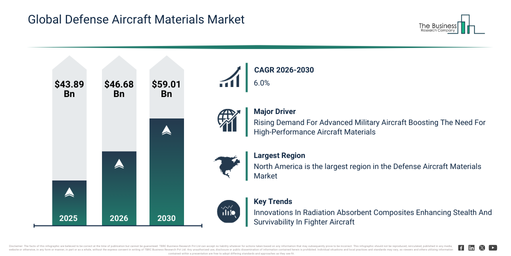
The defense aircraft materials market has shown significant growth over recent years. It is anticipated to expand from $43.89 billion in 2025 to $46.68 billion in 2026, demonstrating a compound annual growth rate (CAGR) of 6.4%. This growth observed in the past can be attributed to the increased use of lightweight composite materials for improved aircraft maneuverability and fuel efficiency, a rising demand for high-temperature alloys in advanced military engine components, the expansion of stealth aircraft programs requiring radar-absorbing materials and coatings, progress in metal matrix and ceramic composites enabling more robust structural components, and the growth in defense procurement programs stimulating the production of specialized aircraft materials.
The defense aircraft materials market is projected to experience robust expansion over the coming years. It will grow to $59.01 billion in 2030 at a compound annual growth rate (CAGR) of 6.0%. This growth during the forecast period stems from several factors, including the increasing demand for next-generation materials essential for hypersonic and high-performance military aircraft, a surge in investment in multifunctional coatings that provide thermal, radar, and corrosion protection, the expanding application of additive manufacturing for creating lightweight and intricate aircraft components, the increased production of unmanned combat aerial vehicles which drives the need for advanced structural materials, and the development of sustainable and energy-efficient material solutions for modernizing defense aviation. Key trends emerging during this period encompass a heightened demand for lightweight and ultra-high-strength materials, the increasing embrace of stealth-enhancing materials, broader utilization of ceramic matrix composites, continued expansion of additive manufacturing techniques, and a greater integration of multi-functional materials.
Request A Free Defense Aircraft Materials Market Sample To Support Your Strategic Planning:
What Is Propelling The Defense Aircraft Materials Market Toward $59.01 Billion By 2030?
The expanding need for cutting-edge military aircraft is anticipated to fuel the expansion of the defense aircraft materials market in the future. These sophisticated military aircraft are high-technology combat planes featuring stealth capabilities, precise systems, and enhanced speed, essential for contemporary defense operations. This surge in demand stems from escalating geopolitical tensions, as nations prioritize achieving aerial superiority, readying themselves for advanced warfare, and improving quick response capabilities in volatile areas. Defense aircraft materials, including aerospace superalloys and advanced composites, are vital for boosting the performance, resilience, and survival potential of advanced military aircraft. They achieve this by enduring extreme temperatures, decreasing overall weight, and improving both fuel efficiency and maneuverability. As an illustration, in January 2024, the U.S. Department of State, which manages the nation’s foreign policy and international relations, reported that military equipment and services valued at $80.9 billion were transferred in 2023. This represents a 55.9% rise from the $50.9 billion transferred in fiscal 2022. Consequently, the heightened need for advanced military aircraft is a key factor propelling the expansion of the defense aircraft materials market.
What Are The Key Segments And Subsegments In The Defense Aircraft Materials Market?
The defense aircraft materials market covered in this report is segmented –
1) By Material Type: Aluminum Alloys, Steels, Titanium Alloys, Composites
3) By Application: Transport Aircraft, Combat Aircrafts, Military Cargo, Helicopters, Other Applications
4) By End-User: Military Organizations, Defense Contractors, Government Agencies
Subsegments:
1) By Aluminum Alloys: 2xxx Series Aluminum Alloys, 7xxx Series Aluminum Alloys, High-Strength Aluminum-Lithium Alloys, Heat-Treatable Aluminum Alloys
2) By Steels: Stainless Steels, High-Strength Low-Alloy (HSLA) Steels, Maraging Steels, Tool Steels
3) By Titanium Alloys: Alpha Titanium Alloys, Beta Titanium Alloys, Alpha-Beta Titanium Alloys, Titanium Matrix Composites
4) By Composites: Carbon Fiber Reinforced Polymers (CFRP), Glass Fiber Reinforced Polymers (GFRP), Aramid Fiber Composites, Ceramic Matrix Composites (CMC)
Defense Aircraft Materials Market Trends Behind The 6% CAGR Forecast
Leading companies in defense aircraft materials are focused on developing innovative solutions, such as carbon-fiber 3D printing materials, to enhance aircraft performance, reduce weight, and improve fuel efficiency. Carbon-fiber 3D printing materials are composite filaments or powders created by combining a base material (like nylon, PLA, or polyamide) with short carbon fibers. These fibers enhance the strength, stiffness, and durability of the printed parts while ensuring they remain lightweight. For instance, in June 2024, the Defense Research and Development Organization (DRDO), an India-based government agency, introduced FS6130CF-F, a new high-performance carbon-fiber-reinforced PA6 material, intended for use with Farsoon’s industrial flight 3D printing systems. This material is fully compatible with the Flight HT403P-2 (dual-laser) and Flight HT/ST252P high-temperature laser PBF platforms and is now available in both the US and European markets.
Major Companies Profiled In The Defense Aircraft Materials Market Report
Major companies operating in the defense aircraft materials market are Airbus SE, General Dynamics Corporation, SABIC (Saudi Basic Industries Corporation), Northrop Grumman Corporation, Honeywell International Inc., Safran S.A., Thales Group, Toray Industries Inc., Evonik Industries AG, Kobe Steel Ltd., Alcoa Corporation, Celanese Corporation, Teijin Limited, Novelis Inc., Howmet Aerospace Inc., Elbit Systems Ltd., Kaiser Aluminum Corporation, Hexcel Corporation, SGL Carbon SE, Tex Tech Industries Inc.
Explore The Business Research Company’s Complete Defense Aircraft Materials Market Report:
Where Does The Defense Aircraft Materials Market Generate The Most Revenue?
North America was the largest region in the defense aircraft materials market in 2025. Asia-Pacific is expected to be the fastest-growing region in the forecast period. The regions covered in the defense aircraft materials market report are Asia-Pacific, South East Asia, Western Europe, Eastern Europe, North America, South America, Middle East, Africa.
Reach Out To Our Team:
The Business Research Company: https://www.thebusinessresearchcompany.com/
Americas: +1 310-496-7795
Asia: +44 7882 955267 & +91 8897263534
Europe: +44 7882 955267
Email us at: marketing@tbrc.info
Follow us on:
LinkedIn: https://in.linkedin.com/company/the-business-research-company
YouTube: https://www.youtube.com/channel/UC24_fI0rV8cR5DxlCpgmyFQ
Global Market Model: https://www.thebusinessresearchcompany.com/global-market-model

Wasay has over a decade of experience in market research, data modelling, and analytics, with prior experience at GlobalData and Decision Tree Consulting Services. At The Business Research Company , he leads research operations across syndicated studies, customized consulting engagements, and the Global Market Model platform. His professional experience includes supporting organizations such as Boston Consulting Group, KPMG, and Ernst & Young. Wasay holds a degree in Electronics and Communications Engineering, postgraduate management qualifications from International Management Institute Belgium and Indian School of Business and Entrepreneurship, and completed the Integrated Program in Business Analytics from Indian Institute of Management Indore.