Market attractiveness scoring, total addressable market sizing, company benchmarking matrices, interactive Excel dashboards, deeper supply chain intelligence, emerging startup tracking, and granular product-level insights are among the key offerings featured in The Business Research Company’s 2026 market reports, designed to deliver more actionable and strategically valuable research.
Defense Electronics Market Growth Outlook: How Much Bigger Will The Market Be By 2030?
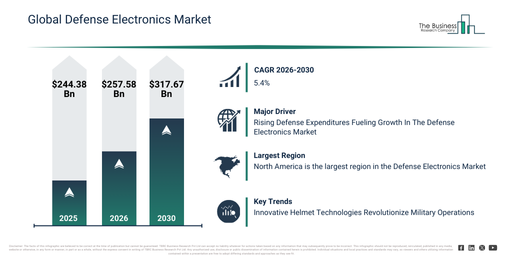
The defense electronics market has experienced robust growth in recent years. It is projected to expand from $244.38 billion in 2025 to $257.58 billion in 2026, demonstrating a compound annual growth rate (CAGR) of 5.4%. Historically, this growth can be attributed to the increasing adoption of GPS-enabled guidance and geolocation systems that strengthen precision mission capabilities, the rising deployment of infrared and radio frequency remote controls across defense platforms, a heightened demand for radiation-hardened electronics necessary for space and high-radiation missions, the expansion of system integration services enabling complex defense electronics architectures, and sustained defense modernization programs driving the procurement of advanced electronic components.
The defense electronics market is projected to experience robust expansion over the coming years. By 2030, this market is anticipated to reach $317.67 billion, exhibiting a compound annual growth rate (CAGR) of 5.4%. This anticipated growth during the forecast period stems from several key factors: progress in AI-enabled defense electronics that boost autonomous and decision-support capabilities, increased capital directed towards space-based electronic systems leading to higher demand for radiation-hardened components, a heightened emphasis on robust and cyber-secure electronics bolstering future defense platforms, the rise of multi-domain operations necessitating the integration of interoperable electronic systems, and expanding global defense budgets facilitating the long-term acquisition of sophisticated electronics and related services. Key trends projected for this period involve the broadening of radar and electro-optical systems, increased uptake of simulation and training software, enhanced incorporation of GPS and geolocation devices, an uptick in demand for maintenance and repair services, and improvements in system integration capabilities.
Request A Free Defense Electronics Market Sample From The Business Research Company:
How Is The Key Growth Driver Influencing The Defense Electronics Market?
Rising defense spending is anticipated to boost the expansion of the defense electronics market in the coming years. Defense expenditure, also known as military spending or the defense budget, signifies the financial resources a government or country dedicates to military and defense operations. Within these defense expenditures, a segment of the budget is usually allocated for defense electronics, encompassing electronic equipment such as air defense radars and communication systems. For example, as reported in October 2025 by the UK Parliament’s House of Commons Library, a UK-based government administration, defense spending, detailed in the 2025 Spending Review, is forecasted to hit USD 83.3 billion (£62.2 billion) in 2025/26 and then increase to USD 98.2 billion (£73.5 billion) by 2028/29. This represents an average yearly real-terms growth rate of 3.8% during this timeframe. Consequently, elevated defense expenditures are fueling the growth of the defense electronics market.
Defense Electronics Market Segmentation By Category: What Does The 2026 Report Cover?
The defense electronics market covered in this report is segmented –
1) By Component: Hardware, Software, Services
2) By Equipment Type: C4ISR Systems, Weapon Systems, Electro-Optical And Infrared (EO Or IR) Systems, Military Simulators, Radar Systems, Sonar Systems, Avionics, Electronic Warfare, Other Equipment Type
3) By Platform: Airborne, Marine, Land, Space
Subsegments:
1) By Hardware: Avionics Systems, Radar Systems, Communication Equipment, Electronic Warfare Systems, Sensors And Imaging Systems
2) By Software: Simulation Software, Command And Control Software, Cybersecurity Software, Maintenance And Support Software, Data Analysis And Processing Software
3) By Services: System Integration Services, Maintenance And Repair Services, Training And Support Services, Consulting Services, Managed Services
How Are Industry Players Changing The Defense Electronics Market Landscape?
Major companies operating in the defense electronics market are focusing on developing innovative products, such as helmet-integrated artificial intelligence (AI) command systems, to enhance battlefield situational awareness and streamline real-time decision-making. These helmet-integrated AI command systems are advanced headgear that embed AI-powered sensors, displays, and communication tools directly into a soldier’s helmet. They help by providing situational awareness, prioritizing threats, reducing equipment load, and enabling faster, more informed battlefield decisions. For instance, in October 2025, Anduril Industries, Inc., a U.S.-based defense technology company, launched EagleEye, a suite of AI-powered vision products for soldiers. This suite includes helmets, visors, and glasses, which overlay critical battlefield information, such as teammate locations, onto real-world surroundings to enhance situational awareness. The system operates on Anduril’s AI platform, Lattice, and integrates augmented reality components developed in collaboration with Meta Platforms, Qualcomm, OSI, and Gentex, signifying a notable progression in military electronics and tactical augmented reality capabilities. This initiative represents a culmination of founder Palmer Luckey’s experience in virtual and augmented reality, drawing on technology he helped develop at Oculus, now repurposed for defense applications.
Defense Electronics Market Global Key Players And Competitive Overview
Major companies operating in the defense electronics market are Raytheon Technologies Corporation, The Boeing Company, Lockheed Martin Corporation, General Dynamics Corporation, Mitsubishi Electric Corporation, Honeywell International Inc., Northrop Grumman Corporation, BAE Systems plc, Safran S.A., Thales Group, L3Harris Technologies Inc., Leonardo S.p.A., Textron Inc., Rheinmetall Electronics GmbH, Elbit Systems Ltd., Serco Group plc, Indra Sistemas S.A., Saab AB, Airbus Defence & Space GmbH, Rafael Advanced Defense Systems Ltd., Bharat Electronics Limited, Hensoldt AG, LIG Nex1 Co. Ltd., Ultra Electronics Holdings plc, Kratos Defense & Security Solutions Inc., Terma A/S, Tata Advanced Systems, Samsung Techwin Co. Ltd., Data Patterns Ltd., Rockwell Collins Inc.
Explore Comprehensive Defense Electronics Market Coverage In The Full Report:
Regional Analysis Of The Defense Electronics Market: Where Is The Industry Concentrated?
North America was the largest region in the defense electronics market in 2025. The regions covered in the defense electronics market report are Asia-Pacific, South East Asia, Western Europe, Eastern Europe, North America, South America, Middle East, Africa.
Reach Out To Our Team:
The Business Research Company: https://www.thebusinessresearchcompany.com/
Americas: +1 310-496-7795
Asia: +44 7882 955267 & +91 8897263534
Europe: +44 7882 955267
Email us at: marketing@tbrc.info
Follow us on:
LinkedIn: https://in.linkedin.com/company/the-business-research-company
YouTube: https://www.youtube.com/channel/UC24_fI0rV8cR5DxlCpgmyFQ
Global Market Model: https://www.thebusinessresearchcompany.com/global-market-model

Wasay has over a decade of experience in market research, data modelling, and analytics, with prior experience at GlobalData and Decision Tree Consulting Services. At The Business Research Company , he leads research operations across syndicated studies, customized consulting engagements, and the Global Market Model platform. His professional experience includes supporting organizations such as Boston Consulting Group, KPMG, and Ernst & Young. Wasay holds a degree in Electronics and Communications Engineering, postgraduate management qualifications from International Management Institute Belgium and Indian School of Business and Entrepreneurship, and completed the Integrated Program in Business Analytics from Indian Institute of Management Indore.