
The Business Research Company’s 2026 market reports combine market attractiveness scoring, total addressable market sizing, company benchmarking matrices, interactive Excel dashboards, deeper supply chain intelligence, emerging startup tracking, and granular product-level insights to deliver research that is more actionable and strategically valuable.
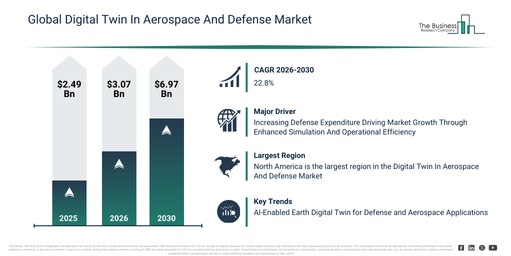
Digital Twin In Aerospace And Defense Market Revenue Forecast: $3.07 Billion In 2026 Rising To $6.97 Billion In 2030
The digital twin in aerospace and defense market has experienced substantial expansion in recent years. It is projected to expand from $2.49 billion in 2025 to $3.07 billion in 2026, exhibiting a compound annual growth rate (CAGR) of 23.3%. The market’s historic growth is largely due to several key factors, including the increasing integration of simulation tools to refine the precision of aircraft and defense system designs. Additionally, the growing application of digital models for predictive maintenance and comprehensive lifecycle management has played a crucial role. This expansion is further supported by the extended implementation of real-time performance monitoring through sensor integration across defense assets, the strategic use of digital twins for effective mission planning and training to bolster operational readiness, and the development of digital replicas for engines and spacecraft to optimize intricate systems.
The digital twin in aerospace and defense market is projected to experience rapid expansion over the coming years. This market is set to reach $6.97 billion by 2030, demonstrating a compound annual growth rate (CAGR) of 22.8%. This anticipated growth stems from factors such as the increasing integration of artificial intelligence and machine learning to improve digital twin analytics and automation, the escalating need for fleet-wide digital twin platforms for streamlined asset management, the broadening application of digital twins in space systems including satellites and deep-space vehicles, the greater utilization of immersive training environments driven by real-time digital twin data, and the creation of sophisticated multi-domain digital twins that support joint military operations and enhance system interoperability. Key developments expected during this forecast period involve the increasing embrace of mission-ready digital twin models, enhanced usage of lifecycle management and predictive maintenance, the expansion of multi-domain operational simulations, deeper integration into spacecraft and satellite operations, and a higher demand for digital twin-enabled supply chain optimization.
Free Sample Report: Digital Twin In Aerospace And Defense Market Size, Trends And Forecast To 2030:
Digital Twin In Aerospace And Defense Market Growth Catalyst: What Is Creating New Demand?
The future expansion of the digital twin in aerospace and defense market is anticipated to be driven by rising defense spending. This expenditure represents the financial resources a country’s military dedicates to acquiring, restocking, and sustaining its arsenal of armaments, including bullets, shells, and missiles. The rise in defense budgets stems from escalating geopolitical tensions, as countries enhance their military capabilities to safeguard national sovereignty, deter potential adversaries, update weapon systems, and uphold strategic influence amidst an unstable global landscape. Such spending facilitates the advancement of digital twin technology within the aerospace and defense sector, fostering continuous investment in advanced simulation, integrated real-time data solutions, and comprehensive lifecycle management instruments. As an illustration, the UK Parliament’s House of Commons Library, a UK government body, reported in October 2025 that defense spending detailed in the 2025 Spending Review is projected to reach USD 83.3 billion (£62.2 billion) in 2025/26, subsequently climbing to USD 98.2 billion (£73.5 billion) by 2028/29, indicating an annual average real-terms growth rate of 3.8% during this timeframe. Consequently, the expansion of defense expenditure is propelling the growth of the digital twin in aerospace and defense market.
Digital Twin In Aerospace And Defense Market Segment Overview: Categories Covered In The 2026 Report
The digital twin in aerospace and defense market covered in this report is segmented –
1) By Component: Software, Services, Hardware
2) By Deployment: On-Premises, Cloud-Based
3) By Technology: Artificial Intelligence, Internet Of Things (IoT), Big Data Analytics, Cloud Computing, Machine Learning
4) By Application: Predictive Maintenance, Design And Development, Simulation And Testing, Supply Chain Management, Asset Management
5) By End-User: Military, Civil Aviation, Space Exploration, Defense Contractors
Subsegments:
1) By Software: Design Software, Simulation Software, Predictive Analytics Software, Visualization Software
2) By Services: Consulting Services, Implementation Services, Support and Maintenance Services, Managed Services
3) By Hardware: Sensors, Actuators, Communication Devices, Processors, Storage Devices
How Are Leading Companies Shaping Digital Twin In Aerospace And Defense Market Trends?
Leading companies within the digital twin in aerospace and defense market are increasingly concentrating on harnessing innovative technologies, such as artificial intelligence (AI)-based simulation, to enhance mission planning, optimize operational efficiency, and improve the accuracy of training. AI-based simulation is a technology that utilizes AI algorithms to generate realistic virtual models of systems or environments, thereby aiding in predicting outcomes, streamlining operations, and refining decision-making in the aerospace and defense sectors. For instance, in September 2025, Aechelon Technology Inc., a US-based software development company, introduced Project Orbion, recognized as the Earth’s first AI-enabled digital twin, created in partnership with Niantic Spatial, ICEYE, BlackSky, and Distance Technologies. This project merges satellite imagery, radar, video photogrammetry, and AI to construct a dynamic, real-time 3D model of the planet with physics-driven precision. While initially aimed at defense and emergency response, the platform additionally presents dual-use possibilities for industries such as logistics, urban planning, disaster management, and autonomous navigation, offering organizations a robust framework for training, fine-tuning, and validating AI systems using up-to-date, real-world information.
Digital Twin In Aerospace And Defense Market Players: Key Companies Shaping Competition
Major companies operating in the digital twin in aerospace and defense market are Microsoft Corporation, Siemens AG, Boeing Company, Lockheed Martin Corporation, Airbus SE, International Business Machines Corporation, Oracle Corporation, Northrop Grumman Corporation, Honeywell International Inc., SAP SE, General Electric, Tata Consultancy Services, BAE Systems, Thales Group, L3Harris Technologies, Rolls-Royce Holdings plc, Dassault Systèmes, Hexagon AB, ANSYS Inc., PTC Inc.
Access Complete Digital Twin In Aerospace And Defense Market Data, Forecasts And Competitive Insights:
Digital Twin In Aerospace And Defense Market Regional Performance And Geographic Coverage
North America was the largest region in the digital twin in aerospace and defense market in 2025. Asia-Pacific is expected to be the fastest-growing region in the forecast period. The regions covered in the digital twin in aerospace and defense market report are Asia-Pacific, South East Asia, Western Europe, Eastern Europe, North America, South America, Middle East, Africa.
Reach Out To Our Team:
The Business Research Company: https://www.thebusinessresearchcompany.com/
Americas: +1 310-496-7795
Asia: +44 7882 955267 & +91 8897263534
Europe: +44 7882 955267
Email us at: marketing@tbrc.info
Follow us on:
LinkedIn: https://in.linkedin.com/company/the-business-research-company
YouTube: https://www.youtube.com/channel/UC24_fI0rV8cR5DxlCpgmyFQ
Global Market Model: https://www.thebusinessresearchcompany.com/global-market-model

Wasay has over a decade of experience in market research, data modelling, and analytics, with prior experience at GlobalData and Decision Tree Consulting Services. At The Business Research Company , he leads research operations across syndicated studies, customized consulting engagements, and the Global Market Model platform. His professional experience includes supporting organizations such as Boston Consulting Group, KPMG, and Ernst & Young. Wasay holds a degree in Electronics and Communications Engineering, postgraduate management qualifications from International Management Institute Belgium and Indian School of Business and Entrepreneurship, and completed the Integrated Program in Business Analytics from Indian Institute of Management Indore.


