Featuring market attractiveness scoring, total addressable market sizing, company benchmarking matrices, interactive Excel dashboards, deeper supply chain intelligence, emerging startup tracking, and granular product-level insights, The Business Research Company’s 2026 market reports are built to deliver research that is both more actionable and more strategically valuable.
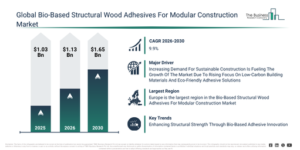
Bio-Based Structural Wood Adhesives For Modular Construction Market Growth From $1.13 Billion In 2026 To $1.65 Billion By 2030 At A CAGR Of 9.9%
The bio-based structural wood adhesives for modular construction market has observed strong growth in recent years. Its value is set to increase from $1.03 billion in 2025 to $1.13 billion in 2026, showing a compound annual growth rate (CAGR) of 9.7%. This expansion in the past period is a result of several factors, such as the increasing use of traditional timber construction practices, a rising need for cost-effective wood bonding solutions, the growth of plywood and engineered wood manufacturing, heightened environmental concerns regarding petrochemical adhesives, and initial progress in bio-based resin research.
The bio-based structural wood adhesives for modular construction market is anticipated to experience substantial growth over the coming years, with its size projected to reach $1.65 billion by 2030, exhibiting a compound annual growth rate (CAGR) of 9.9%. This expansion during the forecast period can be attributed to several factors, including the increasing adoption of sustainable and green building materials, a rising demand for modular and prefabricated construction systems, the proliferation of cross-laminated timber and mass timber projects, ongoing advancements in bio-polymer chemistry that enhance adhesive performance, and more rigorous regulations concerning formaldehyde and VOC emissions in construction materials. Significant trends during this period are expected to encompass the growing use of lignin-based adhesives for engineered wood bonding in modular construction, an increased application of soy-based bio adhesives in cross-laminated timber production, a heightened demand for low-VOC and formaldehyde-free structural wood adhesives, the broadened utilization of bio-based adhesives in prefabricated wall and floor panel systems, and an intensifying focus on high-performance bio-polymer adhesives for load-bearing engineered wood structures.
Get A Free Sample Report With In-Depth Market Insights:
Bio-Based Structural Wood Adhesives For Modular Construction Market Expansion Drivers: What’s Shaping Future Growth?
The increasing demand for sustainable construction is anticipated to propel the growth of the bio-based structural wood adhesives for modular construction market going forward. Sustainable construction refers to building practices that reduce environmental impact through the use of low-carbon materials, energy efficiency, and resource optimization. The rise in demand for sustainable construction, driven by a growing regulatory and environmental focus on reducing carbon emissions, is boosting the adoption of eco-friendly building materials. Bio-based structural wood adhesives for modular construction support this demand by providing renewable and low-emission bonding solutions that enhance structural performance while reducing environmental footprint. For instance, in February 2024, according to the Green Building Council, a US-based non-profit organization, 2023 witnessed a 9% rise in LEED certifications from the previous year, along with 21 additional certifications for single-family homes. Furthermore, new LEED project registrations jumped by 51%. Therefore, the increasing demand for sustainable construction is driving the growth of the bio-based structural wood adhesives for modular construction market.
Bio-Based Structural Wood Adhesives For Modular Construction Market Segmentation And Category Overview
The bio-based structural wood adhesives for modular construction market covered in this report is segmented –
1) By Resin Type: Lignin-Based Adhesives, Soy-Based Adhesives, Tannin-Based Adhesives, Starch-Based Adhesives, Other Bio-Polymers
2) By Performance Type: Structural Load-Bearing Adhesives, Semi-Structural Adhesives, Non-Structural Adhesives, Other Performance Types
3) By Curing Technology: Cold-Set Adhesives, Hot-Press Adhesives, Hybrid Curing Systems, Other Curing Technologies
4) By Application In Modular Construction: Cross-Laminated Timber Panels, Glue Laminated Beams, Laminated Veneer Lumber, Prefabricated Wall Systems, Roof And Floor Panels
5) By End-Use Sector: Residential Modular Construction, Commercial Modular Buildings, Institutional, Other End-Use Sectors
Subsegments:
1) By Lignin-Based Adhesives: Kraft Lignin-Based Adhesives, Organosolv Lignin-Based Adhesives, Lignosulfonate-Based Adhesives, Modified Lignin Adhesives, Blended Lignin Polymer Adhesives
2) By Soy-Based Adhesives: Soy Protein-Based Adhesives, Soy Flour-Based Adhesives, Enzyme Modified Soy Adhesives, Cross-Linked Soy Adhesives, Water Resistant Soy Adhesives
3) By Tannin-Based Adhesives: Condensed Tannin Adhesives, Hydrolyzable Tannin Adhesives, Mimosa Tannin Adhesives, Quebracho Tannin Adhesives, Modified Tannin Resin Adhesives
4) By Starch-Based Adhesives: Native Starch Adhesives, Oxidized Starch Adhesives, Cationic Starch Adhesives, Dextrin-Based Adhesives, Modified Starch Polymer Adhesives
5) By Other Bio-Polymers: Cellulose-Based Adhesives, Chitosan-Based Adhesives, Protein-Based Natural Adhesives, Natural Rubber-Based Adhesives, Polylactic Acid-Based Adhesives
Bio-Based Structural Wood Adhesives For Modular Construction Market Strategic Trends: What Defines The Next Growth Phase?
Leading companies in the bio-based structural wood adhesives market for modular construction are concentrating on advancing high-performance bio-adhesive formulations, such as bio-based polyurethane structural adhesives, to gain a competitive edge. Bio-based polyurethane structural adhesives are robust bonding materials partly derived from renewable feedstocks, providing load-bearing capacity, longevity, and reduced environmental impact for engineered wood applications in modular construction. For example, in November 2023, Henkel, a Germany-based chemical and materials company, launched Loctite HB S ECO and CR 821 ECO, bio-based polyurethane adhesives intended for load-bearing timber construction. These adhesives incorporate up to 71% bio-based raw materials, decrease CO2 emissions by over 60%, and offer solvent-free formulations with excellent durability and reliability. While these improvements enhance sustainability and performance, feedstock variability and cost pressures continue to be significant hurdles.
Bio-Based Structural Wood Adhesives For Modular Construction Market Competitive Landscape: Which Companies Lead The Industry?
Major companies operating in the bio-based structural wood adhesives for modular construction market are BASF SE, Dow Inc., Henkel AG & Co. KGaA, Sika AG, Akzo Nobel N.V., UPM Biochemicals, Arkema S.A., Stora Enso Oyj, Huntsman Corporation, H.B. Fuller Company, Ashland Inc., Aica Kogyo Co. Ltd., Pidilite Industries Limited, Borregaard ASA, Dynea AS, KLEIBERIT SE & Co. KG, Franklin International Inc., Follmann GmbH & Co. KG, Jowat SE, Chimar Hellas S.A.
View The Full Bio-Based Structural Wood Adhesives For Modular Construction Market Report:
Bio-Based Structural Wood Adhesives For Modular Construction Market Regional Outlook: Where Is Opportunity Concentrated?
Europe was the largest region in the bio-based structural wood adhesives for modular construction market in 2025. Asia-Pacific is expected to be the fastest-growing region in the forecast period. The regions covered in the bio-based structural wood adhesives for modular construction market report are Asia-Pacific, South East Asia, Western Europe, Eastern Europe, North America, South America, Middle East, Africa.
Reach Out To Our Team:
The Business Research Company: https://www.thebusinessresearchcompany.com/
Americas: +1 310-496-7795
Asia: +44 7882 955267 & +91 8897263534
Europe: +44 7882 955267
Email us at: marketing@tbrc.info
Follow us on:
LinkedIn: https://in.linkedin.com/company/the-business-research-company
YouTube: https://www.youtube.com/channel/UC24_fI0rV8cR5DxlCpgmyFQ
Global Market Model: https://www.thebusinessresearchcompany.com/global-market-model

Wasay has over a decade of experience in market research, data modelling, and analytics, with prior experience at GlobalData and Decision Tree Consulting Services. At The Business Research Company , he leads research operations across syndicated studies, customized consulting engagements, and the Global Market Model platform. His professional experience includes supporting organizations such as Boston Consulting Group, KPMG, and Ernst & Young. Wasay holds a degree in Electronics and Communications Engineering, postgraduate management qualifications from International Management Institute Belgium and Indian School of Business and Entrepreneurship, and completed the Integrated Program in Business Analytics from Indian Institute of Management Indore.