Featuring market attractiveness scoring, total addressable market sizing, company benchmarking matrices, interactive Excel dashboards, deeper supply chain intelligence, emerging startup tracking, and granular product-level insights, The Business Research Company’s 2026 market reports are built to deliver research that is both more actionable and more strategically valuable.
Emulsion Stabilizers Market Size And Revenue Outlook Through 2030
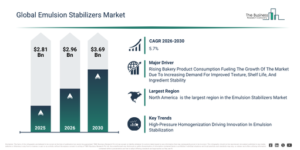
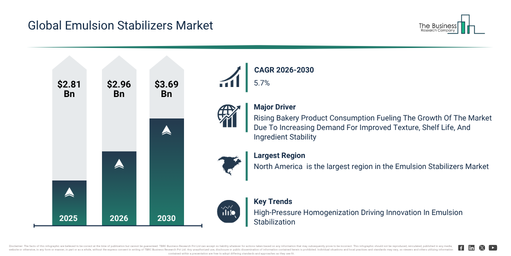
The market size for emulsion stabilizers has experienced robust expansion in recent years. It is forecast to rise from $2.81 billion in 2025 to $2.96 billion in 2026, demonstrating a compound annual growth rate (CAGR) of 5.4%. This historical growth can be attributed to several factors including the increased consumption of processed foods, an escalating demand for packaged cosmetics and personal care products, the progression of pharmaceutical formulation development, the expanded use of synthetic emulsifiers in industrial applications, and the influence of growing urbanization and lifestyle changes driving convenience foods.
The emulsion stabilizers market is projected to experience substantial expansion over the upcoming years. By 2030, its valuation is anticipated to reach $3.69 billion, exhibiting a compound annual growth rate (CAGR) of 5.7%. This anticipated growth during the forecast period stems from factors such as increasing consumer preference for clean label and natural ingredients, advancements in biotechnology-driven stabilizer innovations, a greater uptake of emulsifiers derived from plants, the expansion of functional foods and nutraceuticals sectors, and breakthroughs in nanostructured and multifunctional stabilizer technologies. Key developments foreseen for this period encompass a heightened call for clean label and natural emulsifier-based stabilizers, increased application of plant-based functional components in both food and cosmetic products, a surge in the utilization of high-performance stabilizers within pharmaceutical formulations, the continued growth of processed and packaged food industries, and an intensified emphasis on improving texture and extending shelf-life in various consumer goods.
Get A Free Sample Report With In-Depth Market Insights:
Emulsion Stabilizers Market Development Factors: What’s Supporting Demand?
The expanding consumption of bakery items is projected to boost the emulsion stabilizers market in the future. Bakery products encompass food preparations such as bread, cakes, pastries, biscuits, and other baked goods, made from flour, sugar, fats, and various components, available either freshly baked or packaged for longer use. The demand for these goods is increasing because of evolving dietary preferences and a rising need for convenient and indulgent food choices, especially among working adults and younger demographics. Emulsion stabilizers facilitate the development of bakery products by enhancing dough stability, improving texture, retaining moisture, and prolonging shelf life, while also ensuring even dispersion of constituents like fats and water. As an illustration, in March 2026, the Agriculture and Agri-Food Canada, a Canadian federal entity supporting the nation’s agriculture and agri-food sector, reported that retail sales of baked goods showed significant growth, reaching $8.7 billion (Can$11.8 billion) in 2024, with bread and pastries contributing substantially to this rise. Consequently, the uptick in bakery product consumption is propelling the expansion of the emulsion stabilizers market.
Emulsion Stabilizers Market Segment Analysis: What Are The Core Market Categories?
The emulsion stabilizers market covered in this report is segmented –
1) By Type: Natural Stabilizers, Synthetic Stabilizers, Semi Synthetic Stabilizers, Other Types
2) By Function: Emulsifying Agents, Thickening Agents, Gelling Agents, Stabilizing Agents
3) By Form: Liquid Stabilizers, Powder Stabilizers, Gel Based Stabilizers, Other Forms
4) By Application: Food and Beverages, Cosmetics and Personal Care, Pharmaceuticals, Industrial Applications
Subsegments:
1) By Natural Stabilizers: Plant Derived Stabilizers, Animal Derived Stabilizers, Microbial Derived Stabilizers, Seaweed Derived Stabilizers, Fermentation Based Stabilizers
2) By Synthetic Stabilizers: Chemically Synthesized Emulsifiers, Petrochemical Based Stabilizers, Synthetic Polymer Stabilizers, Artificial Surface Active Agents
3) By Semi Synthetic Stabilizers: Modified Cellulose Stabilizers, Esterified Natural Stabilizers, Chemically Modified Starches, Partially Synthetic Hydrocolloids, Derivatized Protein Stabilizers
4) By Other Types: Hybrid Stabilizer Systems, Enzyme Modified Stabilizers, Nano Structured Stabilizers, Multi Functional Stabilizer Blends, Specialty Application Stabilizers
Emulsion Stabilizers Market Transformation Trends: What Innovations Are Driving Change?
Major companies operating in the emulsion stabilizers market are concentrating on developing innovative solutions, such as high pressure homogenization, to boost emulsion stability, refine texture and shelf life, and facilitate the creation of clean-label, high-performance food and beverage formulations. High pressure homogenization is a mechanical process that involves propelling liquid through narrow gaps at elevated pressure to generate fine and uniform droplets, thereby enhancing emulsion stability, improving texture, and extending product longevity. For instance, in October 2024, Lubrizol Corporation, a US-based specialty chemicals company, introduced Novemer CS polymer. This innovative polymeric emulsifier and emulsion stabilizer is engineered for versatile application across personal care sectors like skin care, sun care, and makeup. The product enables the formation of stable oil-in-water emulsions across systems ranging from low to high viscosity, enhances texture and sensory properties with a light, watery feel, and ensures compatibility with UV filters and pigments, while also facilitating precise control over formulation performance and stability.
Emulsion Stabilizers Market Leading Players And Competitive Positioning
Major companies operating in the emulsion stabilizers market are Cargill Incorporated, Archer-Daniels-Midland Company, BASF SE, Evonik Industries AG, DuPont de Nemours Inc., Givaudan SA, Lonza Group AG, Kerry Group plc, Ingredion Incorporated, AAK AB, Tate & Lyle PLC, Ashland Inc., Corbion NV, CP Kelco US Inc., Riken Vitamin Co. Ltd., Palsgaard AS, Camlin Fine Sciences Limited, Lasenor Emul SL, Stearinerie Dubois SAS, Estelle Chemicals Private Limited.
View The Full Emulsion Stabilizers Market Report:
Emulsion Stabilizers Market Regional Split: Which Areas Are Fueling Growth?
North America was the largest region in the emulsion stabilizers market in 2025. Asia-Pacific is expected to be the fastest-growing region in the forecast period. The regions covered in the emulsion stabilizers market report are Asia-Pacific, South East Asia, Western Europe, Eastern Europe, North America, South America, Middle East, Africa.
Reach Out To Our Team:
The Business Research Company: https://www.thebusinessresearchcompany.com/
Americas: +1 310-496-7795
Asia: +44 7882 955267 & +91 8897263534
Europe: +44 7882 955267
Email us at: marketing@tbrc.info
Follow us on:
LinkedIn: https://in.linkedin.com/company/the-business-research-company
YouTube: https://www.youtube.com/channel/UC24_fI0rV8cR5DxlCpgmyFQ
Global Market Model: https://www.thebusinessresearchcompany.com/global-market-model

Wasay has over a decade of experience in market research, data modelling, and analytics, with prior experience at GlobalData and Decision Tree Consulting Services. At The Business Research Company , he leads research operations across syndicated studies, customized consulting engagements, and the Global Market Model platform. His professional experience includes supporting organizations such as Boston Consulting Group, KPMG, and Ernst & Young. Wasay holds a degree in Electronics and Communications Engineering, postgraduate management qualifications from International Management Institute Belgium and Indian School of Business and Entrepreneurship, and completed the Integrated Program in Business Analytics from Indian Institute of Management Indore.