Featuring market attractiveness scoring, total addressable market sizing, company benchmarking matrices, interactive Excel dashboards, deeper supply chain intelligence, emerging startup tracking, and granular product-level insights, The Business Research Company’s 2026 market reports are built to deliver research that is both more actionable and more strategically valuable.
Fluid Catalytic Cracking (FCC) Wet Gas Scrubbers Market Forecast: What Value Will The Market Reach By 2030?
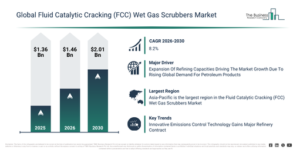
The market size for fluid catalytic cracking (FCC) wet gas scrubbers has expanded significantly in recent years. This market is projected to expand from $1.36 billion in 2025 to $1.46 billion in 2026, demonstrating a compound annual growth rate (CAGR) of 8.0%. Historically, this expansion can be ascribed to factors such as more stringent environmental emission rules for refineries, escalating demands for industrial pollution control, the worldwide expansion of oil refining capacity, increased recognition of the importance of air quality management, and the rising implementation of sulfur emission reduction technologies.
The fluid catalytic cracking (FCC) wet gas scrubbers market is projected to experience substantial growth in the upcoming years, expanding to $2.01 billion in 2030 at a compound annual growth rate (CAGR) of 8.2%. The anticipated growth within this forecast period can be attributed to more stringent carbon emission reduction policies, increasing investments in refinery modernization projects, the rising adoption of advanced pollution control systems, the development of sustainable refining operations, and the expansion of multi pollutant regulatory compliance frameworks. Key trends for the forecast period include the deployment of advanced wet gas scrubber systems designed for high-efficiency particulate removal, the increasing uptake of multi pollutant control scrubber systems in refinery operations, the rising integration of energy-efficient scrubbing technologies to meet emission reduction compliance, the expansion of retrofit scrubber installations within aging refinery infrastructure, and the growing application of hybrid scrubbing systems that combine chemical and mechanical filtration methods.
Get A Free Sample Report With In-Depth Market Insights:
Fluid Catalytic Cracking (FCC) Wet Gas Scrubbers Market Demand Drivers: What’s Powering Industry Growth?
The future expansion of refining capabilities is projected to propel the growth of the fluid catalytic cracking (FCC) wet gas scrubbers market. This surge in refining capacity stems from increasing worldwide demand for petroleum products, which encourages refiners to enlarge their current facilities and incorporate additional processing units. With an expanded capacity, refineries operate their FCC units more intensively, resulting in greater emissions of acid gases and particulate matter. Crucially, FCC wet gas scrubbers are essential for managing these emissions, ensuring adherence to regulations and facilitating uninterrupted refinery operations. For example, in June 2024, the U.S. Energy Information Administration, a US-based government agency, reported that operable atmospheric crude oil distillation capacity in the United States increased by 2% in 2023, amounting to an additional 324,000 barrels per day. Consequently, the expanding refining capacities are serving as a key driver for the growth of the fluid catalytic cracking (FCC) wet gas scrubbers market.
Fluid Catalytic Cracking (FCC) Wet Gas Scrubbers Market Segment Analysis Spotlighting Growth Areas
The fluid catalytic cracking (FCC) wet gas scrubbers market covered in this report is segmented –
1) By Type: Venturi Scrubbers, Packed Bed Scrubbers, Spray Tower Scrubbers, Other Types
2) By Pollutant Focus: Particulate Matter Removal, Sulfur Oxides Removal, Multi Pollutant Control Systems
3) By Installation Type: New Plant Installations, Retrofits And Upgrades
4) By Application: Petroleum Refineries, Petrochemical Plants, Chemical Processing, Other Applications
5) By End-User: Oil And Gas, Chemical, Power Generation, Other End Users
Subsegments:
1) By Venturi Scrubbers: High Energy Venturi Scrubbers, Low Energy Venturi Scrubbers, Adjustable Throat Venturi Scrubbers, Fixed Throat Venturi Scrubbers
2) By Packed Bed Scrubbers: Structured Packing Packed Bed Scrubbers, Random Packing Packed Bed Scrubbers, Counter Current Flow Packed Bed Scrubbers, Cross Flow Packed Bed Scrubbers
3) By Spray Tower Scrubbers: Single Stage Spray Tower Scrubbers, Multi Stage Spray Tower Scrubbers, Vertical Spray Tower Scrubbers, Horizontal Spray Tower Scrubbers
4) By Other Types: Cyclonic Scrubbers, Wet Electrostatic Precipitator Systems, Hybrid Scrubber Systems, Multi Stage Combination Scrubbers
Fluid Catalytic Cracking (FCC) Wet Gas Scrubbers Market Innovation Trends: What Developments Are Reshaping The Industry?
Key players in the fluid catalytic cracking (FCC) wet gas scrubbers market are prioritizing the creation of novel solutions, specifically advanced wet gas scrubbing technology, to lower emissions and improve refinery efficiency. This advanced technology employs high-efficiency spray towers and chemical absorption to extract sulfur oxides and fine particulates from FCC flue gas, thereby assisting refineries in emission reduction and adherence to environmental mandates. A notable example occurred in December 2025, when Babcock & Wilcox, an engineering and manufacturing firm based in the US, secured a $40 million contract to implement advanced wet gas scrubbing technology at a Canadian petroleum refinery. The system specified in the contract will incorporate high-capacity absorbers, optimized spray towers, materials resistant to corrosion, and integrated process controls, all designed to achieve effective pollutant removal with minimal energy usage. This particular technology proves highly effective for processing high-sulfur feedstocks, providing refineries with a means to meet strict environmental regulations and achieve savings in operational costs.
Fluid Catalytic Cracking (FCC) Wet Gas Scrubbers Market Competitive Landscape: Which Companies Lead The Industry?
Major companies operating in the fluid catalytic cracking (fcc) wet gas scrubbers market are Mitsubishi Heavy Industries Ltd., DuPont Clean Technologies, Andritz AG, GEA Group Aktiengesellschaft (AG), Hitachi Zosen Corporation, Thermax Limited, Babcock & Wilcox Enterprises Inc., CECO Environmental Corp., Sly Inc., Tri-Mer Corporation, Ducon Technologies Inc., AirPol Inc., Elessent Clean Technologies Inc., KCH Engineered Systems, ExxonMobil, Ducon Infratechnologies Limited, Kimre Inc.
View The Full Fluid Catalytic Cracking (FCC) Wet Gas Scrubbers Market Report:
Fluid Catalytic Cracking (FCC) Wet Gas Scrubbers Market Regional Outlook: Where Is Opportunity Concentrated?
Asia-Pacific was the largest region in the fluid catalytic cracking (FCC) wet gas scrubbers market in 2025. Middle East is expected to be the fastest-growing region in the forecast period. The regions covered in the fluid catalytic cracking (FCC) wet gas scrubbers market report are Asia-Pacific, South East Asia, Western Europe, Eastern Europe, North America, South America, Middle East, Africa.
Reach Out To Our Team:
The Business Research Company: https://www.thebusinessresearchcompany.com/
Americas: +1 310-496-7795
Asia: +44 7882 955267 & +91 8897263534
Europe: +44 7882 955267
Email us at: marketing@tbrc.info
Follow us on:
LinkedIn: https://in.linkedin.com/company/the-business-research-company
YouTube: https://www.youtube.com/channel/UC24_fI0rV8cR5DxlCpgmyFQ
Global Market Model: https://www.thebusinessresearchcompany.com/global-market-model

Wasay has over a decade of experience in market research, data modelling, and analytics, with prior experience at GlobalData and Decision Tree Consulting Services. At The Business Research Company , he leads research operations across syndicated studies, customized consulting engagements, and the Global Market Model platform. His professional experience includes supporting organizations such as Boston Consulting Group, KPMG, and Ernst & Young. Wasay holds a degree in Electronics and Communications Engineering, postgraduate management qualifications from International Management Institute Belgium and Indian School of Business and Entrepreneurship, and completed the Integrated Program in Business Analytics from Indian Institute of Management Indore.