Backed by market attractiveness analysis, total addressable market sizing, company benchmarking matrices, interactive Excel dashboards, wider supply chain intelligence, emerging startup coverage, and detailed product-level insights, The Business Research Company’s 2026 market reports are designed to offer research that is more actionable and strategically valuable than ever.
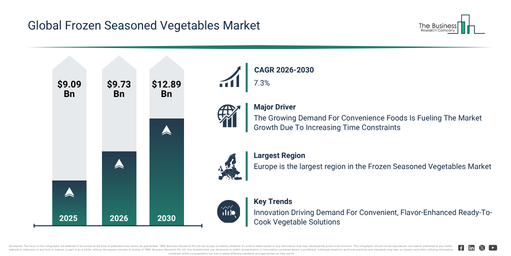
Frozen Seasoned Vegetables Market Growth From $9.73 Billion In 2026 To $12.89 Billion By 2030 At A CAGR Of 7.3%
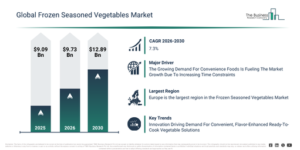
The frozen seasoned vegetables market has demonstrated robust growth in recent years. It will grow from $9.09 billion in 2025 to $9.73 billion in 2026 at a compound annual growth rate (CAGR) of 7.1%. The historical expansion can be attributed to increased urbanization and nuclear households driving greater adoption of frozen foods, the necessity for preservation due to limited year-round access to fresh vegetables, the spread of modern retail and supermarket networks, an increasing focus on convenience-based cooking, and the impact of seasonal variations on vegetable supply.
The frozen seasoned vegetables market is anticipated to experience substantial growth over the coming years. It is projected to expand to $12.89 billion by 2030, achieving a compound annual growth rate (CAGR) of 7.3%. This projected expansion can be attributed to several factors, including the increasing desire for convenient meal solutions, the proliferation of organized retail and online grocery channels, a growing adoption of plant-based dietary preferences, continuous innovation in flash freezing and seasoning technologies, and an escalating demand from the foodservice sector for ready-to-cook vegetable ingredients. Key trends expected within this period encompass a rising consumer demand for globally inspired, flavor-infused frozen vegetable blends, the emergence of ready-to-cook vegetable meal starter kits, a growing inclination towards clean label and minimally processed seasoned frozen vegetables, the increased availability of air fryer and microwave compatible frozen vegetable formats, and a heightened demand from the foodservice industry for pre-seasoned, portion-controlled vegetable solutions.
Get A Free Sample Report With In-Depth Market Insights:
Frozen Seasoned Vegetables Market Growth Catalysts And Demand Drivers
The increasing consumer desire for convenience foods is anticipated to boost the expansion of the frozen seasoned vegetables market. Convenience foods are defined as items that are pre-processed, pre-cooked, or ready for quick consumption, specifically designed to minimize the time and effort involved in preparing meals. This escalating demand stems from busier urban living, increased participation in the workforce, and a stronger inclination towards meal options that save time. Frozen seasoned vegetables align perfectly with this trend, providing ready-to-cook alternatives that merge ease of use with taste and nutritional benefits. They serve as a practical substitute for more time-consuming meal preparation and also compete effectively within the broader quick-meal segment. For example, as reported by the US-based trade association National Association of Convenience Stores in April 2025, prepared food contributes to the majority of foodservice sales, a share that has grown over time, reaching 72.6% of all foodservice sales in 2024. Consequently, the rising need for convenient, ready-to-cook meals is a primary factor driving the expansion of the frozen seasoned vegetables market.
Frozen Seasoned Vegetables Market Segment Outlook: Which Categories Are Growing Fastest?
The frozen seasoned vegetables market covered in this report is segmented –
1) By Product Type: Mixed Vegetables, Single Vegetables, Vegetable Blends, Ready-To-Cook Seasoned Vegetables, Organic Seasoned Vegetables
2) By Form: Whole, Sliced, Diced, Chopped, Pureed
3) By Packaging Type: Bags, Boxes, Trays, Bulk Packaging
4) By Application: Retail, Foodservice, Industrial
5) By End User: Household Or Residential, Foodservice Industry, Institutional Buyers
Subsegments:
1) By Mixed Vegetables: Assorted Frozen Mixed Vegetables, Seasoned Mixed Vegetable Packs, Stir Fry Mixed Vegetables, Soup Mix Frozen Vegetables
2) By Single Vegetables: Seasoned Frozen Peas, Seasoned Frozen Corn, Seasoned Frozen Carrots, Seasoned Frozen Beans
3) By Vegetable Blends: Cuisine-Specific Vegetable Blends, Herb And Spice Infused Vegetable Blends, Grill And Roast Vegetable Blends, Premium Gourmet Vegetable Blends
4) By Ready-To-Cook Seasoned Vegetables: Microwave Ready Seasoned Vegetables, Skillet Ready Seasoned Vegetables, Oven Ready Seasoned Vegetables, Quick Cook Seasoned Vegetable Kits
5) By Organic Seasoned Vegetables: Certified Organic Seasoned Vegetables, Non-Genetically Modified Organism Organic Seasoned Vegetables, Pesticide-Free Organic Seasoned Vegetables, Premium Organic Vegetable Mixes
Frozen Seasoned Vegetables Market Trends Shaping Long-Term Demand
Major companies operating in the frozen seasoned vegetables market are focusing on crafting innovative products, such as flavor-infused frozen vegetable blends, to address the rising consumer demand for convenient, ready-to-cook, and time-efficient meal solutions. These flavor-infused frozen vegetable blends, comprising pre-seasoned vegetables combined with sauces, herbs, and spices, benefit consumers by reducing preparation time and providing ready-to-cook, consistent, and elevated flavors compared to traditional plain frozen vegetables. For instance, in September 2024, Green Giant, a US-based food company, unveiled a new line of frozen vegetable products, including seasoned and sauced vegetable options aimed at enhancing convenience and taste. These products feature vegetable combinations paired with chef-inspired sauces and seasonings, offered in microwave-ready and skillet-ready formats for quick preparation. The range emphasizes clean-label ingredients, bold flavors, and minimal prep time, catering to modern dietary preferences and busy lifestyles. Additionally, these products are designed to retain nutritional value while delivering enhanced taste compared to plain frozen vegetables.
Frozen Seasoned Vegetables Market Competitive Analysis Of Leading Industry Participants
Major companies operating in the frozen seasoned vegetables market are ITOCHU Corporation, The Kraft Heinz Company, General Mills Inc., McCain Foods Limited, Conagra Brands Inc., J.R. Simplot Company, Dole Food Company Inc., Kerry Group plc, Lamb Weston Holdings Inc., Greenyard NV, Bonduelle SCA, B&G Foods Inc., Ardo NV, Birds Eye Foods Inc., Hanover Foods Corporation, The Pictsweet Company, Twin City Foods Inc., Oerlemans Foods Netherlands B.V., Pinnacle Foods Inc., Seapoint Farms Inc.
View The Full Frozen Seasoned Vegetables Market Report:
Frozen Seasoned Vegetables Market Geographic Distribution And Regional Opportunities
Europe was the largest region in the frozen seasoned vegetables market in 2025. Asia-Pacific is expected to be the fastest-growing region in the forecast period. The regions covered in the frozen seasoned vegetables market report are Asia-Pacific, South East Asia, Western Europe, Eastern Europe, North America, South America, Middle East, Africa.
Reach Out To Our Team:
The Business Research Company: https://www.thebusinessresearchcompany.com/
Americas: +1 310-496-7795
Asia: +44 7882 955267 & +91 8897263534
Europe: +44 7882 955267
Email us at: marketing@tbrc.info
Follow us on:
LinkedIn: https://in.linkedin.com/company/the-business-research-company
YouTube: https://www.youtube.com/channel/UC24_fI0rV8cR5DxlCpgmyFQ
Global Market Model: https://www.thebusinessresearchcompany.com/global-market-model

Wasay has over a decade of experience in market research, data modelling, and analytics, with prior experience at GlobalData and Decision Tree Consulting Services. At The Business Research Company , he leads research operations across syndicated studies, customized consulting engagements, and the Global Market Model platform. His professional experience includes supporting organizations such as Boston Consulting Group, KPMG, and Ernst & Young. Wasay holds a degree in Electronics and Communications Engineering, postgraduate management qualifications from International Management Institute Belgium and Indian School of Business and Entrepreneurship, and completed the Integrated Program in Business Analytics from Indian Institute of Management Indore.