The Business Research Company’s 2026 market reports are designed to deliver research that is more actionable and strategically valuable. Key offerings include market attractiveness scoring, total addressable market sizing, company benchmarking matrices, interactive Excel dashboards, deeper supply chain intelligence, emerging startup tracking, and granular product-level insights.
Atmospheric Satellite Market Revenue Projected To Rise To $17.01 Billion By 2030
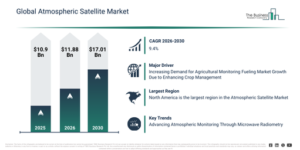
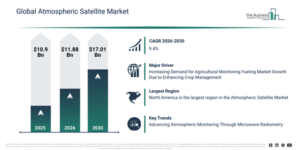
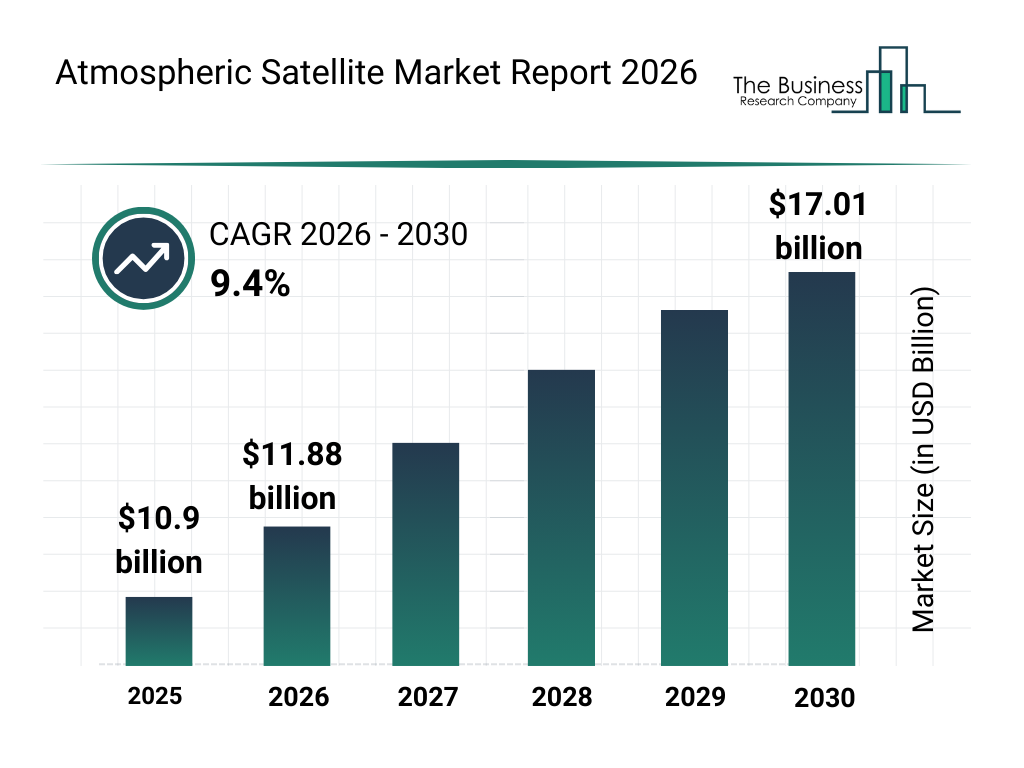
The atmospheric satellite market size has experienced robust growth in recent years. It is projected to increase from $10.9 billion in 2025 to $11.88 billion in 2026, achieving a compound annual growth rate (CAGR) of 9.0%. This historical expansion can be attributed to the deployment of early earth observation satellites, the adoption of high-precision sensors, a rise in climate monitoring programs, technological advancements in propulsion and stabilization, and increased international collaboration in satellite missions.
The atmospheric satellite market size is poised for substantial growth over the coming years. It is projected to reach $17.01 billion by 2030, exhibiting a compound annual growth rate (CAGR) of 9.4%. This anticipated growth during the forecast period is driven by factors such as the development of stratospheric platform-based satellites, the uptake of miniaturized high-resolution sensor payloads, the broadening of real-time atmospheric data services, the integration with AI for predictive climate analytics, and the expansion of commercial satellite weather monitoring. Key trends expected within the forecast timeframe encompass advancements in atmospheric data modeling, a surge in high-altitude persistent monitoring, increased multi-sensor payload integration, a rising demand for climate and air quality insights, and the extension of satellite-assisted disaster risk mapping.
Want Deeper Atmospheric Satellite Market Insights? Get A Free Sample Report:
Primary Growth Driver Shaping The Atmospheric Satellite Market Outlook
The escalating demand for agricultural monitoring is expected to drive the future growth of the atmospheric satellite market. Agricultural monitoring involves utilizing technology to observe crop well-being, soil states, and farm operations to enhance productivity and efficiency. The increasing need for agricultural oversight stems from the requirement for higher crop yields, as cultivators seek precise data to optimize farming practices and resource allocation. Atmospheric satellites facilitate this growing demand by providing accurate, real-time data on weather, soil, and crop conditions to improve farm management. For example, in September 2025, according to the U.S. Department of Agriculture’s Economic Research Service (ERS), a US-based government agency, direct government farm program payments are projected to reach $40.5 billion in 2025, marking a substantial increase of $30.4 billion from the $10.1 billion disbursed in 2024. Therefore, the rising demand for agricultural monitoring is a key factor propelling the expansion of the atmospheric satellite market.
Atmospheric Satellite Market Structure: A Detailed Look At Segments And Subsegments
The atmospheric satellite market covered in this report is segmented –
1) By Type Of Satellite: Low Earth Orbit Satellites, Medium Earth Orbit Satellites, Geostationary Satellites, Sun-Synchronous Orbit Satellites
2) By Payload Type: Imaging Sensors, Radiometers, Lidar Systems, Sounding Instruments
3) By Orbit Strategy: Standalone Satellites, Satellite Constellations, Multi-Sensor Satellite Systems
4) By Application: Weather Forecasting, Climate Monitoring, Disaster Management, Agricultural Monitoring, Environmental Monitoring, Air Quality Monitoring
5) By End-User Sector: Government Agencies, Research Institutions, Commercial Enterprises, Agriculture And Forestry
Subsegments:
1) By Low Earth Orbit Satellites: Mini Satellites, Micro Satellites, Nano Satellites, Pico Satellites
2) By Medium Earth Orbit Satellites: Navigation Satellites, Remote Sensing Satellites
3) By Geostationary Satellites: Weather Satellites, Broadcast Satellite
4) By Sun-Synchronous Orbit Satellites: Earth Observation Satellites, Environmental Monitoring Satellites, Reconnaissance Satellites
Atmospheric Satellite Market Innovation And Strategy Trends Among Leading Companies
Leading entities within the atmospheric satellite market are focusing on creating new observation technologies, including microwave radiometry, with the aim of refining atmospheric observation and boosting the precision of climate and weather analysis. This advanced remote sensing method, microwave radiometry, functions by measuring the natural microwave radiation emitted by the Earth’s surface and atmosphere, allowing for the deduction of crucial atmospheric parameters like water vapor, precipitation, and cloud liquid water, even when weather conditions are cloudy or unfavorable. As an illustration, in June 2025, the Japan Aerospace Exploration Agency (JAXA), a space agency based in Japan, deployed the Greenhouse Gases and Water Cycle Observation Satellite (GOSAT-GW). This sophisticated atmospheric observation satellite incorporates the Advanced Microwave Scanning Radiometer (AMSR3). AMSR3 represents a next-generation microwave radiometer specifically engineered to deliver accurate estimations of atmospheric water vapor, precipitation, and cloud characteristics. Through this capability, GOSAT-GW plays a role in monitoring the water cycle, provides assistance for weather and climate modeling, furthers climate change research, and facilitates a more extensive analysis of atmospheric dynamics and their interactions.
Top Companies Competing In The Atmospheric Satellite Market
Major companies operating in the atmospheric satellite market are Airbus SE, Maxar Technologies Holdings Inc., Lockheed Martin Corp., Northrop Grumman Corp., L3Harris Technologies Inc., Thales Group, Raytheon Technologies, General Dynamics Corp., Honeywell International, Israel Aerospace Industries, Elbit Systems, Planet Labs PBC, Saab AB, OHB System AG, SES S.A., Echostar Corporation, QinetiQ Group, Viasat, Virgin Orbit, Blue Canyon Technologies LLC, Loral Space & Communications, Thuraya Telecommunications Co., National Aeronautics and Space Administration (NASA), Telesat Corp., Oxford Space Systems, Astroscale, UAVOS, Ball Aerospace Corp., Mitsubishi Electric Corp., Boeing Company, BAE Systems plc.
View The Complete Atmospheric Satellite Market Study With Segment And Regional Data:
Atmospheric Satellite Market Regional Outlook Across Major Geographies
North America was the largest region in the atmospheric satellite market in 2025. Asia-Pacific is expected to be the fastest-growing region in the forecast period. The regions covered in the atmospheric satellite market report are Asia-Pacific, South East Asia, Western Europe, Eastern Europe, North America, South America, Middle East, Africa.
Reach Out To Our Team:
The Business Research Company: https://www.thebusinessresearchcompany.com/
Americas: +1 310-496-7795
Asia: +44 7882 955267 & +91 8897263534
Europe: +44 7882 955267
Email us at: marketing@tbrc.info
Follow us on:
LinkedIn: https://in.linkedin.com/company/the-business-research-company
YouTube: https://www.youtube.com/channel/UC24_fI0rV8cR5DxlCpgmyFQ
Global Market Model: https://www.thebusinessresearchcompany.com/global-market-model

Wasay has over a decade of experience in market research, data modelling, and analytics, with prior experience at GlobalData and Decision Tree Consulting Services. At The Business Research Company , he leads research operations across syndicated studies, customized consulting engagements, and the Global Market Model platform. His professional experience includes supporting organizations such as Boston Consulting Group, KPMG, and Ernst & Young. Wasay holds a degree in Electronics and Communications Engineering, postgraduate management qualifications from International Management Institute Belgium and Indian School of Business and Entrepreneurship, and completed the Integrated Program in Business Analytics from Indian Institute of Management Indore.