Designed to make market research more actionable and strategically valuable, The Business Research Company’s 2026 market reports feature market attractiveness scoring, total addressable market sizing, company benchmarking matrices, interactive Excel dashboards, deeper supply chain intelligence, emerging startup tracking, and granular product-level insights.
Autonomous Aircraft Market To Expand At A 5.4% CAGR: Size And Growth Projections Through 2030
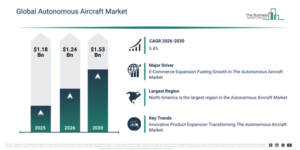
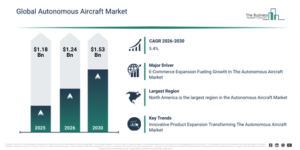
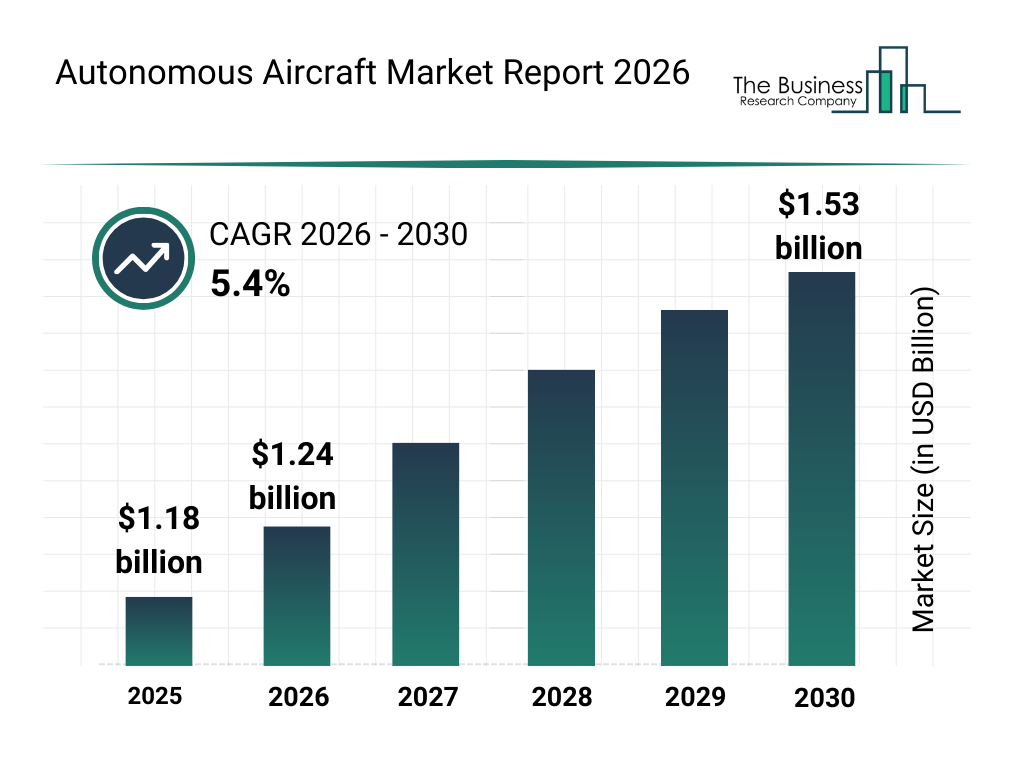
The autonomous aircraft market has seen robust growth in its size over recent years. It is anticipated to expand from $1.18 billion in 2025 to $1.24 billion in 2026, achieving a compound annual growth rate (CAGR) of 5.1%. The historical increase can be ascribed to factors such as the evolution of initial unmanned aerial vehicle (UAV) technologies, the utilization of autonomous drones for defense and surveillance, continuous improvements in avionics and flight control systems, regulatory sanctions for restricted autonomous flight operations, and enhanced investment in research and development for autonomous aircraft systems.
The autonomous aircraft market is projected to experience substantial growth over the coming years. It is anticipated to expand to $1.53 billion by 2030, exhibiting a compound annual growth rate (CAGR) of 5.4%. This expansion during the forecast period stems from several factors, including increased deployment of autonomous aircraft for passenger and cargo operations, the incorporation of AI and machine learning for enhanced flight management, the broader adoption of urban air mobility solutions, growing defense sector adoption of sophisticated autonomous aircraft, and breakthroughs in battery and propulsion technologies facilitating longer autonomous flights. Significant trends expected throughout the forecast period involve the establishment of robust certification and safety standards, the integration of air traffic management with unmanned traffic management (UTM) systems, the development of advanced materials and lightweight structural designs, the emergence of novel business models, such as air taxis, subscription services, and fractional ownership, and the provision of comprehensive maintenance, lifecycle management, and predictive support services.
Get Your Free Autonomous Aircraft Market Report Sample Today:
Which Factor Is Expected To Drive The Autonomous Aircraft Market Over The Forecast Period?
The expansion of the e-commerce sector is anticipated to propel the autonomous aircraft market’s growth in the future. E-commerce involves the transaction of goods and services via the Internet or digital platforms. Businesses operating in e-commerce frequently encounter difficulties stemming from traffic jams and urban logistical complexities. Autonomous aircraft offer a more effective and reliable delivery solution, particularly in crowded city environments, by circumventing ground traffic. For instance, in 2024, an article from the US-based International Trade Administration (ITA) stated that The B2B eCommerce market is projected to reach a value of USD $36 trillion by 2026, and B2C eCommerce revenue is anticipated to grow to USD $5.5 trillion by 2027, sustaining a consistent compound annual growth rate of 14.4%. Consequently, the expanding e-commerce industry is a primary driver for the autonomous aircraft market’s development.
Autonomous Aircraft Market Segmentation Insights: How Is The Industry Categorized?
The autonomous aircraft market covered in this report is segmented –
1) By Technology: Increasingly Autonomous, Fully Autonomous
2) By Aircraft Type: Fixed-Wing, Rotary-Wing
3) By Application: Cargo Aircraft, Passenger Aircraft
4) By End User: Commercial, Defense
Subsegments:
1) By Increasingly Autonomous: Semi-Autonomous Aircraft, Autonomous Aircraft
2) By Fully Autonomous: Fully Autonomous Drones, Fully Autonomous Passenger Aircraft, Autonomous Cargo Aircraft
Autonomous Aircraft Market Trends Explained: What Is Changing And Why It Matters
Leading companies operating in the autonomous aircraft market are developing new offerings such as autonomous electric cargo airplanes to serve larger customer bases, drive more sales, and increase revenue. An Autonomous Electric Cargo Airplane is an uncrewed aerial vehicle designed for transporting goods or freight, typically utilizing electric propulsion systems. For instance, in January 2023, Pyka, a US-based developer of autonomous electric aircraft, unveiled Pelican Cargo, the first autonomous vehicle of its kind and the largest zero-emission cargo aircraft. The Pelican Cargo platform is designed to bolster express logistics networks, provide connectivity for isolated rural communities, and ensure rapid and dependable access to crucial goods and supplies for areas in need. It features a range of up to 200 miles, a payload capacity of up to 400 pounds within 66 cubic feet of cargo volume, and a nose-loading configuration complete with a sliding cargo tray. Its aim is to completely eradicate CO2 emissions from the supply chain of goods while offering a significant speed advantage over ground transportation and operating costs that are considerably lower than those of traditional air transportation.
Autonomous Aircraft Market Competitor Landscape: Who Are The Major Companies?
Major companies operating in the autonomous aircraft market are The Boeing Company, Airbus SE, Lockheed Martin Corporation, Northrop Grumman Corporation, Elbit Systems Ltd., Raytheon Technologies Corporation, AeroVironment Inc., Saab Group, BAE Systems plc, Aeronautics Ltd., General Atomics Aeronautical Systems Inc., Airobotics Ltd., Aurora Flight Sciences a Boeing Company, Bell Textron Inc., Embraer S.A., Joby Aviation Inc., Karem Aircraft Inc., Lift Aircraft Inc., Piasecki Aircraft Corporation, Planck Aero Inc., PrecisionHawk Inc., Volocopter GmbH, Wing, Textron Inc., Israel Aerospace Industries Ltd. (IAI), Opener Inc., Xwing Inc.
See The Full Autonomous Aircraft Market Report For Complete Market Sizing And Trends:
Autonomous Aircraft Market Regional Demand Analysis And Leading Geography
North America was the largest region in autonomous aircraft market in 2025. Asia-Pacific is expected to be the fastest-growing region in the autonomous aircraft market during the forecast period. The regions covered in the autonomous aircraft market report are Asia-Pacific, South East Asia, Western Europe, Eastern Europe, North America, South America, Middle East, Africa.
Reach Out To Our Team:
The Business Research Company: https://www.thebusinessresearchcompany.com/
Americas: +1 310-496-7795
Asia: +44 7882 955267 & +91 8897263534
Europe: +44 7882 955267
Email us at: marketing@tbrc.info
Follow us on:
LinkedIn: https://in.linkedin.com/company/the-business-research-company
YouTube: https://www.youtube.com/channel/UC24_fI0rV8cR5DxlCpgmyFQ
Global Market Model: https://www.thebusinessresearchcompany.com/global-market-model

Wasay has over a decade of experience in market research, data modelling, and analytics, with prior experience at GlobalData and Decision Tree Consulting Services. At The Business Research Company , he leads research operations across syndicated studies, customized consulting engagements, and the Global Market Model platform. His professional experience includes supporting organizations such as Boston Consulting Group, KPMG, and Ernst & Young. Wasay holds a degree in Electronics and Communications Engineering, postgraduate management qualifications from International Management Institute Belgium and Indian School of Business and Entrepreneurship, and completed the Integrated Program in Business Analytics from Indian Institute of Management Indore.