Designed to make market research more actionable and strategically valuable, The Business Research Company’s 2026 market reports feature market attractiveness scoring, total addressable market sizing, company benchmarking matrices, interactive Excel dashboards, deeper supply chain intelligence, emerging startup tracking, and granular product-level insights.
How Big Is The Autopilot System Market In 2026, And How Fast Will It Grow?
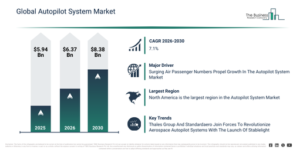
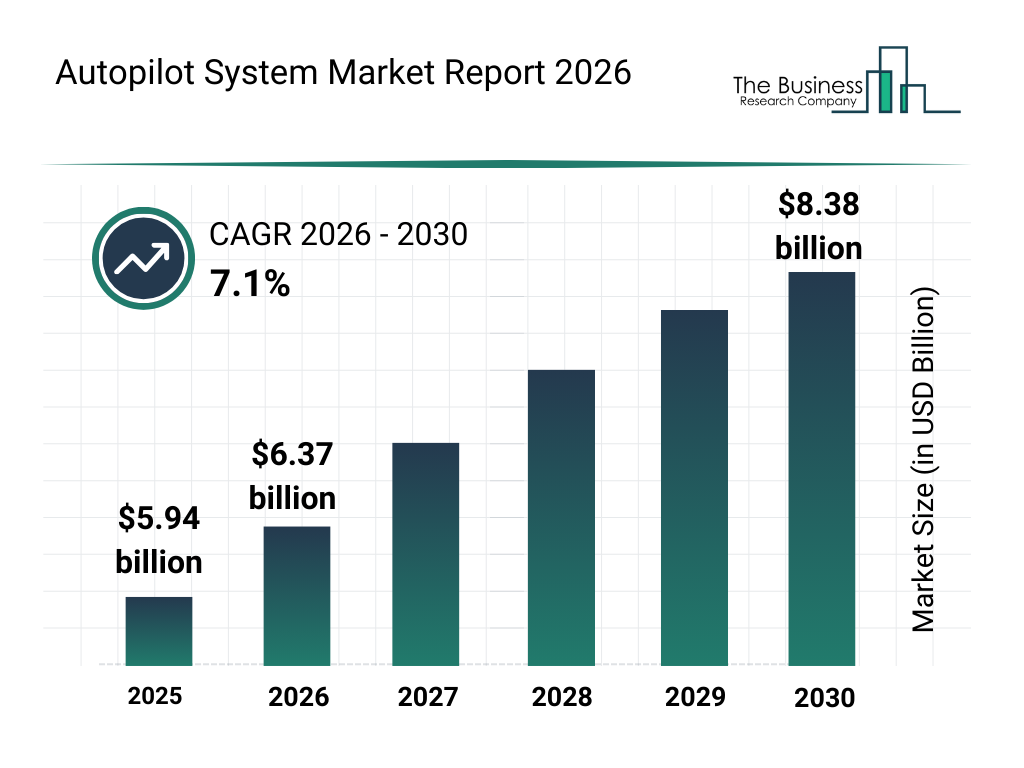
The market size for autopilot systems has experienced substantial growth in recent years. This market is projected to expand from $5.94 billion in 2025 to $6.37 billion in 2026, achieving a compound annual growth rate (CAGR) of 7.2%. The historical increase in market size can be attributed to several factors, including the surge in commercial aviation traffic, which has amplified the demand for reliable autopilot systems; the evolution of marine navigation technologies, creating a need for automated steering solutions; the early adoption of GPS-based guidance, which improved system accuracy and widespread acceptance; the growing integration of avionics modernization programs across various aircraft fleets; and the increased deployment of unmanned aerial vehicles (UAVs), driving the need for compact autonomous control systems.
The autopilot system market is projected to experience substantial expansion in the coming years. By 2030, it is anticipated to reach $8.38 billion, displaying a compound annual growth rate (CAGR) of 7.1%. This growth during the forecast period is primarily attributed to advancements in AI-powered autonomous navigation, which enhances next-generation autopilot capabilities; a rising demand for fully automated flight management in commercial and cargo aviation; the expansion of unmanned aerial vehicle applications requiring sophisticated autopilot modules; a growing focus on fuel efficiency and optimized routing supported by smart autopilot functions; and increased investment in marine and aviation safety systems, boosting the adoption of advanced autopilot technologies. Major trends anticipated during this period include the increasing integration of multi-axis stabilization for smoother autonomous control, a growing demand for redundant sensor architectures to enhance safety and reliability, a rising adoption of compact autopilot systems for small UAVs and unmanned vessels, the expansion of modular autopilot components for easier upgrades and servicing, and progress in real-time flight director algorithms enhancing situational awareness.
Download A Free Autopilot System Market Sample Report With Size And Forecast Data:
Autopilot System Market Growth Driver: The Key Factor Behind Rising Demand
The future expansion of the autopilot system market is anticipated to be driven by a growing volume of air travelers. An air passenger is defined as an individual who utilizes airplanes or other aerial transport methods for travel. Elevated air passenger volumes often result in a heightened need for automated support within air traffic management. Automation’s role in air traffic control gains increasing importance given the exponential yearly increase in managed flights. Furthermore, the prolonged COVID-19 lockdown period contributed to an uptick in both business and recreational travel. For example, data from December 2024, provided by Eurostat, a Luxembourg-based government agency, revealed that air travel within the EU amounted to 973 million passengers in 2023, showing a 19.3% rise from the 816 million passengers noted in 2022. Consequently, the growing population of air passengers is a key factor propelling the autopilot system market.
Autopilot System Market Segmentation: Key Segments And Subsegments Covered
The autopilot system market covered in this report is segmented –
1) By System: Attitude And Heading Reference System, Flight Control System, Flight Director System, Avionics System
2) By Product Type: Rotary Wing Aircraft, Fixed Wing Aircraft
3) By Platform: Airborne, Sea, Subsea, Land-Based
4) By Application: Military, Defense, Commercial
Subsegments:
1) By Attitude And Heading Reference System (AHRS): Inertial Reference Units, Gyroscopic Sensors, Magnetometers
2) By Flight Control System (FCS): Primary Flight Control Systems, Secondary Flight Control Systems, Automatic Flight Control Systems
3) By Flight Director System (FDS): Vertical Flight Director, Lateral Flight Director, Integrated Flight Director Systems
4) By Avionics System: Navigation Systems, Communication Systems, Surveillance Systems, Display Systems
Autopilot System Market Trends: Key Developments Shaping 2026 And Beyond
Leading firms within the autopilot system market are prioritizing alliances and joint ventures to boost their market profitability. These strategic alliances involve cooperative arrangements between multiple entities, aimed at fulfilling particular business targets or objectives. When advanced autopilot systems are strategically integrated with such collaborations, a product like Stablelight can emerge as an innovative offering for the logistics and transportation sector, providing enhanced efficiency, safety, and reliability. An example of this is the collaboration in November 2023 between Thales Group, an electric systems manufacturer from France, and StandardAero, a US-based provider of gas turbine engines and accessories, resulting in the introduction of StableLight, an innovative 4-axis autopilot system. This system, specifically engineered for AS350 and H125 helicopters, has received a Supplemental Type Certificate (STC) from the US authorities. Its primary purpose is to improve safety and mitigate dangers during crucial flight stages and challenging environmental circumstances. Furthermore, it is engineered to enhance the helicopter’s flight control experience and possesses the capability to support diverse operational needs.
Leading Companies Operating In The Autopilot System Market
Major companies operating in the autopilot system market are Rockwell Collins Inc., BAE Systems plc, Cloud Cap Technology Inc., Furuno Electric Co. Ltd., Garmin International Inc., Genesys Aerosystems Group Inc., Honeywell International Inc., Micropilot Inc., Raymarine Ltd., Moog Inc., Safran SA, Parker Meggitt plc, Lockheed Martin Corporation, Century Flight Systems Inc., Cobham Limited, TMQ International Pty. Ltd., Thales Group, Avidyne Corporation, Dynon Avionics, SEA MACHINES Robotics Inc., West Marine, Kobelt Manufacturing Co. Ltd., Comnav Marine Ltd., Brunswick Corporation, Octopus Autopilot Drives systems, Trimble Navigation Limited, Raytheon Anschütz GmbH, The Mercedes-Benz Group AG
Access The Full Autopilot System Market Research Report:
Autopilot System Market Regional Analysis: Largest Region And Key Geographies Covered
North America was the largest region in the autopilot system market in 2025. Asia-Pacific is expected to be the fastest-growing region in the global autopilot system market during the forecast period. The regions covered in the autopilot system market report are Asia-Pacific, South East Asia, Western Europe, Eastern Europe, North America, South America, Middle East, Africa.
Reach Out To Our Team:
The Business Research Company: https://www.thebusinessresearchcompany.com/
Americas: +1 310-496-7795
Asia: +44 7882 955267 & +91 8897263534
Europe: +44 7882 955267
Email us at: marketing@tbrc.info
Follow us on:
LinkedIn: https://in.linkedin.com/company/the-business-research-company
YouTube: https://www.youtube.com/channel/UC24_fI0rV8cR5DxlCpgmyFQ
Global Market Model: https://www.thebusinessresearchcompany.com/global-market-model

Wasay has over a decade of experience in market research, data modelling, and analytics, with prior experience at GlobalData and Decision Tree Consulting Services. At The Business Research Company , he leads research operations across syndicated studies, customized consulting engagements, and the Global Market Model platform. His professional experience includes supporting organizations such as Boston Consulting Group, KPMG, and Ernst & Young. Wasay holds a degree in Electronics and Communications Engineering, postgraduate management qualifications from International Management Institute Belgium and Indian School of Business and Entrepreneurship, and completed the Integrated Program in Business Analytics from Indian Institute of Management Indore.