With a focus on actionable insights and strategic value, The Business Research Company’s 2026 market reports include market attractiveness scoring, total addressable market sizing, company benchmarking matrices, interactive Excel dashboards, deeper supply chain intelligence, emerging startup tracking, and granular product-level insights.
Chemical, Biological, Radiological, Nuclear, And Explosive (CBRNE) Threat Detection Instruments Market Size Snapshot: 2026 Valuation, 2030 Projection And Key Growth Factors
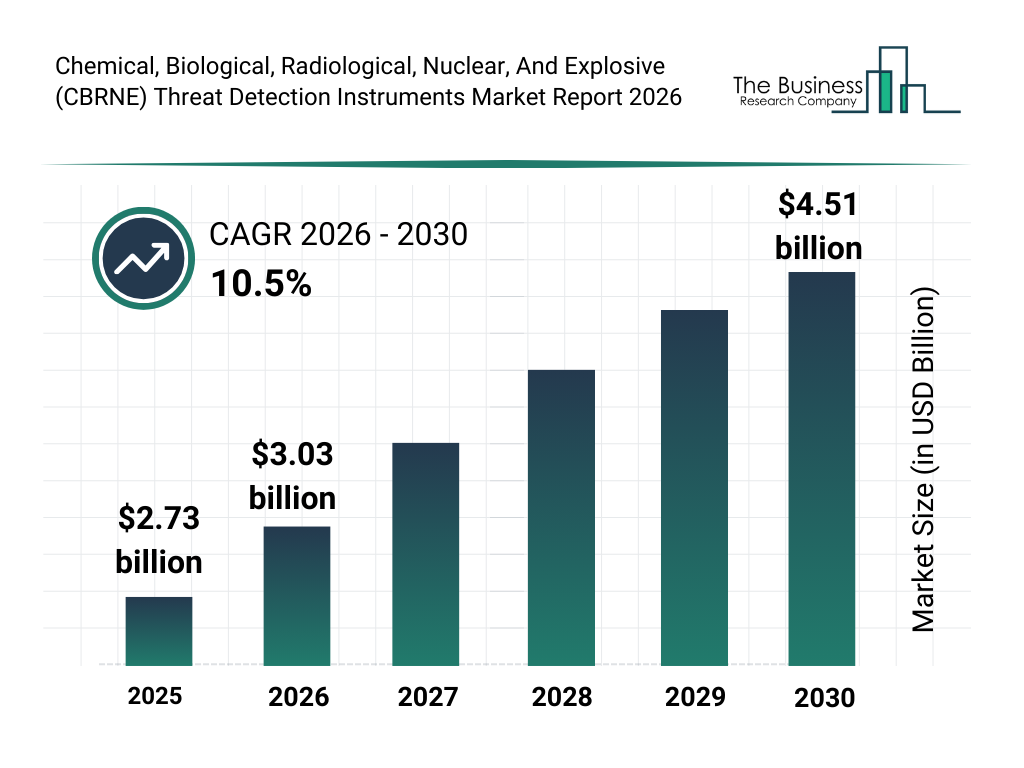
The chemical, biological, radiological, nuclear, and explosive (cbrne) threat detection instruments market size has experienced significant rapid growth recently. This market is projected to expand from $2.73 billion in 2025 to reach $3.03 billion by 2026, demonstrating a compound annual growth rate (CAGR) of 11.0%. Historically, this expansion has been driven by increasing worldwide worries regarding CBRNE threats, the greater uptake of both portable and fixed detection tools by military and homeland security bodies, breakthroughs in sensor and analytical technology, regulations mandating safety and emergency readiness, and partnerships between instrument producers and government entities.
The market for chemical, biological, radiological, nuclear, and explosive (CBRNE) threat detection instruments is anticipated to experience significant expansion over the coming years. This market is projected to reach a valuation of $4.51 billion by 2030, demonstrating a compound annual growth rate (CAGR) of 10.5%. This projected growth during the forecast period is driven by several factors, including the creation of multi-threat, real-time, and interconnected CBRNE detection systems; the incorporation of AI and data analytics for predictive threat analysis; increasing demand across industrial, transportation, and public safety domains; a focus on developing compact, lightweight, and user-friendly instruments; and the broadening of maintenance, calibration, training, and consulting services to ensure operational preparedness. Key trends anticipated during this period encompass the miniaturization of instruments capable of detecting multiple threats, a heightened need for comprehensive CBRNE detection suites, a move towards robust, field-ready analytical platforms, an increase in the outsourcing of calibration and maintenance, and the growing implementation of real-time monitoring solutions within industrial settings.
Get A No-Cost Sample Of The Chemical, Biological, Radiological, Nuclear, And Explosive (CBRNE) Threat Detection Instruments Market Study:
Major Factor Fueling The Chemical, Biological, Radiological, Nuclear, And Explosive (CBRNE) Threat Detection Instruments Market Through 2030
The chemical, biological, radiological, nuclear, and explosive (CBRNE) threat detection instruments market is anticipated to expand due to increasing terrorism and security concerns. These threats encompass actions or conditions that jeopardize individuals, locations, or societies, instilling fear or causing damage. The surge in terrorism and security threats is linked to religious extremism, as radical viewpoints continue to propagate digitally and physically, influencing susceptible individuals to perpetrate violent acts. CBRNE threat detection instruments are essential for countering these dangers by facilitating the early identification of hazardous substances, thus proving critical for military, law enforcement, and emergency personnel. They diminish risks through rapid detection and response capabilities, enhancing preparedness and safeguarding public well-being. For instance, in February 2024, the Institute for Economics and Peace reported that the fatality rate of terrorist attacks climbed to 2.5 fatalities per attack in 2023, compared to 1.6 in 2022. Hence, the rising terrorism and security threats are serving as a significant driver for the growth of the chemical, biological, radiological, nuclear, and explosive (CBRNE) threat detection instruments market.
Chemical, Biological, Radiological, Nuclear, And Explosive (CBRNE) Threat Detection Instruments Market Segment Landscape: Main Categories And Subcategories Covered
The chemical, biological, radiological, nuclear, and explosive (cbrne) threat detection instruments market covered in this report is segmented –
1) By Type: Fixed, Handheld Portable
2) By Technology Type: Gas Chromatography, Ion Mobility Spectrometry, Mass Spectrometry, Raman Spectroscopy
3) By Sales Channel: Direct Sales, Distributors, Online Sales
4) By Application: Environmental Monitoring, Healthcare, Homeland Security, Industrial, Military And Defense
5) By End User: Analytical Laboratories, Defense Forces, Fire Departments, Law Enforcement
Subsegments:
1) By Fixed: Mounted Detection Units, Stationary Monitoring Systems, Fixed-Site Surveillance Equipment
2) By Handheld Portable: Handheld Portable Chemical Detectors, Handheld Portable Biological Analyzers, Handheld Portable Radiological Sensors, Handheld Portable Explosive Trace Detectors
How Are Emerging Trends Influencing The Chemical, Biological, Radiological, Nuclear, And Explosive (CBRNE) Threat Detection Instruments Market’s Growth Path?
Key players in the chemical, biological, radiological, nuclear, and explosive (CBRNE) threat detection instruments market are increasingly engaging in strategic partnerships to boost both detection precision and operational effectiveness. These collaborations involve intentional alliances between entities, designed to merge resources and specialized knowledge for achieving shared long-term objectives and securing a competitive edge. For instance, in September 2024, Smiths Detection Group Ltd., a UK-based technology firm, teamed up with Riskaware Limited, a UK-based actionable intelligence consultancy, to introduce UrbanAware. This comprehensive platform is designed to improve, consolidate, and digitize real-time chemical, biological, radiological, and nuclear (CBRN) hazard intelligence delivery during an event. The partnership seeks to close the divide among data gathering, analysis, and situational understanding of chemical, biological, radiological, and nuclear threats, providing actionable insights to frontline operations instantly. This solution facilitates quicker, better-informed decisions for emergency personnel and military strategists through the integration of sensor data with sophisticated hazard modeling and simulation, thereby safeguarding individuals, infrastructure, and communities during chemical incidents and disaster response activities.
Chemical, Biological, Radiological, Nuclear, And Explosive (CBRNE) Threat Detection Instruments Market Leading Players And Key Industry Participants In 2026
Major companies operating in the chemical, biological, radiological, nuclear, and explosive (cbrne) threat detection instruments market are Thermo Fisher Scientific Inc., Honeywell International Inc., 3M Company, Thales Group, Leidos Holdings Inc., Rheinmetall AG, Agilent Technologies, Battelle Memorial Institute, Teledyne Technologies Inc., SAAB AB, Drägerwerk AG & Co. KGaA, Smiths Group PLC, Bruker Corporation, Hach Chemical Company, Chemring Group PLC, Kromek Group plc, Bertin Technologies, Kärcher Futuretech GmbH, Morphix Technologies, Argon Electronics Ltd., Proengin SAS, S. E. International Inc.
Check Out The Full Chemical, Biological, Radiological, Nuclear, And Explosive (CBRNE) Threat Detection Instruments Market Report 2026:
Chemical, Biological, Radiological, Nuclear, And Explosive (CBRNE) Threat Detection Instruments Market By Geography: Revenue Leaders Among Global Regions
North America was the largest region in the chemical, biological, radiological, nuclear, and explosive (CBRNE) threat detection instruments market in 2025. Asia-Pacific is expected to be the fastest-growing region in the forecast period. The regions covered in the chemical, biological, radiological, nuclear, and explosive (cbrne) threat detection instruments market report are Asia-Pacific, South East Asia, Western Europe, Eastern Europe, North America, South America, Middle East, Africa.
Reach Out To Our Team:
The Business Research Company: https://www.thebusinessresearchcompany.com/
Americas: +1 310-496-7795
Asia: +44 7882 955267 & +91 8897263534
Europe: +44 7882 955267
Email us at: marketing@tbrc.info
Follow us on:
LinkedIn: https://in.linkedin.com/company/the-business-research-company
YouTube: https://www.youtube.com/channel/UC24_fI0rV8cR5DxlCpgmyFQ
Global Market Model: https://www.thebusinessresearchcompany.com/global-market-model

Wasay has over a decade of experience in market research, data modelling, and analytics, with prior experience at GlobalData and Decision Tree Consulting Services. At The Business Research Company , he leads research operations across syndicated studies, customized consulting engagements, and the Global Market Model platform. His professional experience includes supporting organizations such as Boston Consulting Group, KPMG, and Ernst & Young. Wasay holds a degree in Electronics and Communications Engineering, postgraduate management qualifications from International Management Institute Belgium and Indian School of Business and Entrepreneurship, and completed the Integrated Program in Business Analytics from Indian Institute of Management Indore.