The Business Research Company’s 2026 market reports are designed to deliver research that is more actionable and strategically valuable. Key offerings include market attractiveness scoring, total addressable market sizing, company benchmarking matrices, interactive Excel dashboards, deeper supply chain intelligence, emerging startup tracking, and granular product-level insights.
Commercial Aircraft Gas Turbine Engine Market Revenue Projected To Rise To $133.13 Billion By 2030
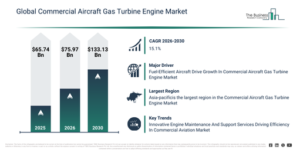
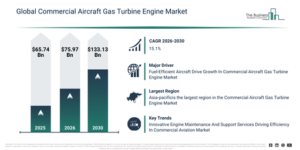
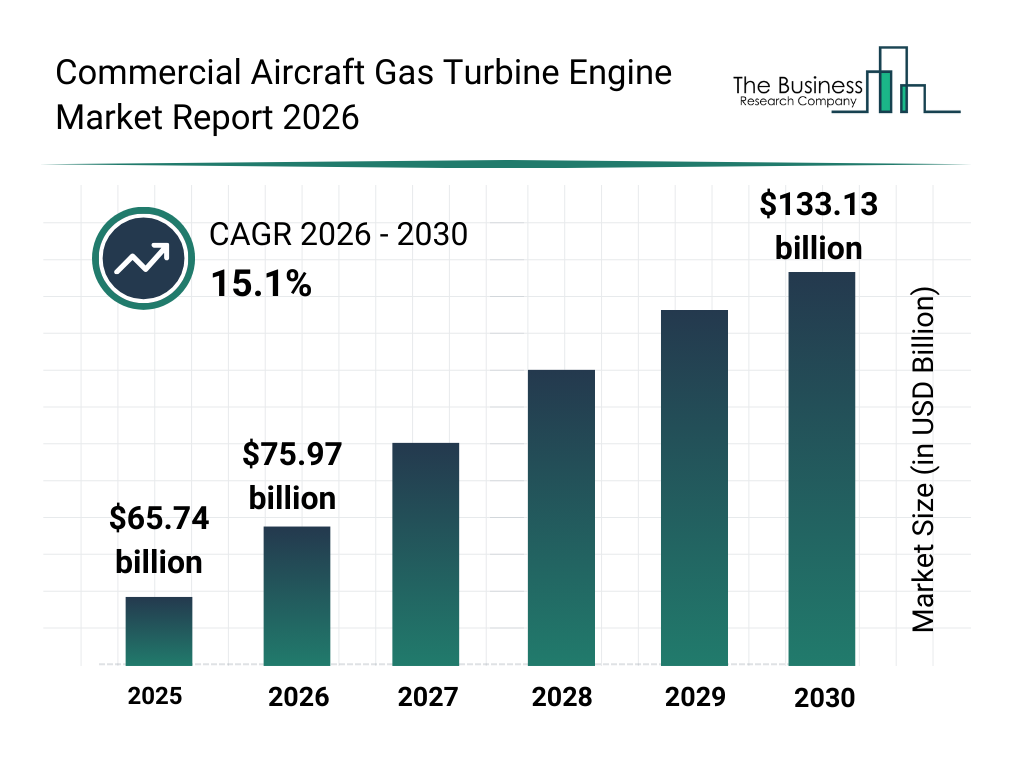
The commercial aircraft gas turbine engine market has experienced substantial expansion recently. It will grow from $65.74 billion in 2025 to $75.97 billion in 2026 at a compound annual growth rate (CAGR) of 15.6%. This past growth is primarily due to increased global air passenger traffic leading to higher demand for commercial aircraft engines, ongoing advancements in turbine effectiveness and materials improving engine capabilities, the enlargement of airline fleets necessitating new heavy-frame and aero-derivative engines, an increasing emphasis on fuel-efficient propulsion systems accelerating the creation of next-generation engines, and more frequent maintenance and replacement needs for older aircraft engines contributing to market revenues.
The commercial aircraft gas turbine engine market size is projected to experience swift expansion in the coming years. It will grow to $133.13 billion in 2030 at a compound annual growth rate (CAGR) of 15.1%. This expansion during the forecast period is attributable to increasing investment in ultra-high-bypass and geared turbofan technologies to enhance fuel efficiency, rising production of next-generation commercial aircraft necessitating advanced gas turbine engines, growing regulatory pressure to reduce aviation emissions accelerating innovation in cleaner combustion systems, the expansion of long-haul and low-cost carriers driving sustained engine procurement, and the development of hybrid-electric propulsion architectures influencing future gas turbine design and integration. Major trends expected in this period include the increasing adoption of turbofan engines for fuel efficiency, growth in aero-derivative and open-cycle engine deployments, a demand for lightweight and high-performance engine materials, the enlargement of the regional jet engine market, and the advancement of hybrid-electric propulsion for commercial aircraft.
Want Deeper Commercial Aircraft Gas Turbine Engine Market Insights? Get A Free Sample Report:
Primary Growth Driver Shaping The Commercial Aircraft Gas Turbine Engine Market Outlook
The rising need for modern, fuel-efficient aircraft is projected to stimulate expansion within the commercial aircraft gas turbine engine market in the foreseeable future. Fuel-efficient airplanes are defined as aircraft engines or entire airplanes that utilize less fuel compared to similar models. This growing desire for new fuel-efficient aircraft propels the commercial aircraft gas turbine engine market because improved fuel efficiency leads to reduced operational costs and decreased harmful emissions that impact the environment. For example, data from August 2024, provided by the US Energy Information Administration, a governmental body in the US, indicated that the overall availability of kerosene-based jet fuel rose from 1,596 thousand barrels per day in March 2023 to 1,717 thousand barrels per day by May 2024. Consequently, the escalating requirement for new fuel-efficient aircraft is a key driver for the market.
Commercial Aircraft Gas Turbine Engine Market Structure: A Detailed Look At Segments And Subsegments
The commercial aircraft gas turbine engine market covered in this report is segmented –
1) By Type: Narrow-Body, Wide-Body, Regional Jet
3) By Technology: Turbofan, Turbojet, Turboprop, Other Technology
4) By Aircraft Type: Light Commercial Aircraft, Heavy Commercial Aircraft, Passenger Based Aircraft, Cargo Based Multi-Model Aircraft
5) By Application: Commercial, Military
Subsegments:
1) By Narrow-Body: Single-Aisle Aircraft Engines, Short Or Medium-Haul Narrow-Body Aircraft Engines
2) By Wide-Body: Long-Haul Aircraft Engines, Twin-Engine Wide-Body Aircraft Engines
3) By Regional Jet: Turbofan Engines For Regional Jets, Turboprop Engines For Regional Jets
Commercial Aircraft Gas Turbine Engine Market Innovation And Strategy Trends Among Leading Companies
Leading firms within the commercial aircraft gas turbine engine market are prioritizing the creation of novel solutions, including extensive engine maintenance and support services, in response to the growing need for enhanced operational efficiency, reliability, and cost-effectiveness within commercial aviation. These thorough engine maintenance and support offerings represent complete solutions encompassing regular inspections, necessary repairs, direct on-wing assistance, management of spare parts, and proactive health monitoring. These services contribute to minimizing unexpected downtime, prolonging engine longevity, boosting fuel economy, and decreasing total operational expenditures when contrasted with conventional reactive maintenance approaches. As an example, in March 2024, Pratt & Whitney Canada Corp., an aerospace manufacturer based in Canada, formalized an engine services agreement with India’s FLY91. This accord is designed to deliver a complete array of maintenance, repair, and overhaul services for FLY91’s engines. This particular agreement encompasses on-wing support, provisions for spare engines, and digital health monitoring capabilities, enabling operators to foresee potential engine problems preemptively, thereby decreasing unplanned service interruptions and extending the operational life of the engines. These services are further strengthened by sophisticated analytics and extensive global repair networks, facilitating faster response times and boosting the operational efficiency of commercial airlines.
Top Companies Competing In The Commercial Aircraft Gas Turbine Engine Market
Major companies operating in the commercial aircraft gas turbine engine market are GE Aviation LLC, GKN Aerospace Services Ltd., Honeywell International Inc., MTU Aero Engines AG, Raytheon Technologies Corporation, Rolls-Royce Holdings plc, International Aero Engines AG, Engine Alliance LLC, CFM International Inc., Powerjet Plastic Machinery CO. LTD., Pratt and Whitney Co., Safran S.A., Williams International Co. LLC, EuroJet Turbo GmbH, Textron Inc., Ishikawajima-Harima Heavy Industries Co.Ltd., Mitsubishi Heavy Industries Ltd., Ansaldo Energia SpA, MAPNA Group, Caterpillar Inc., UEC NPO Saturn, Rotax Aircraft Engines, PBS Group, Teledyne Continental Motors, Spirit AeroSystems, Magellan Aerospace
View The Complete Commercial Aircraft Gas Turbine Engine Market Study With Segment And Regional Data:
Commercial Aircraft Gas Turbine Engine Market Regional Outlook Across Major Geographies
Asia-pacific was the fastest growing region in the commercial aircraft gas turbine engine market in 2025. The regions covered in the commercial aircraft gas turbine engine market report are Asia-Pacific, South East Asia, Western Europe, Eastern Europe, North America, South America, Middle East, Africa.
Reach Out To Our Team:
The Business Research Company: https://www.thebusinessresearchcompany.com/
Americas: +1 310-496-7795
Asia: +44 7882 955267 & +91 8897263534
Europe: +44 7882 955267
Email us at: marketing@tbrc.info
Follow us on:
LinkedIn: https://in.linkedin.com/company/the-business-research-company
YouTube: https://www.youtube.com/channel/UC24_fI0rV8cR5DxlCpgmyFQ
Global Market Model: https://www.thebusinessresearchcompany.com/global-market-model

Wasay has over a decade of experience in market research, data modelling, and analytics, with prior experience at GlobalData and Decision Tree Consulting Services. At The Business Research Company , he leads research operations across syndicated studies, customized consulting engagements, and the Global Market Model platform. His professional experience includes supporting organizations such as Boston Consulting Group, KPMG, and Ernst & Young. Wasay holds a degree in Electronics and Communications Engineering, postgraduate management qualifications from International Management Institute Belgium and Indian School of Business and Entrepreneurship, and completed the Integrated Program in Business Analytics from Indian Institute of Management Indore.