With a focus on actionable insights and strategic value, The Business Research Company’s 2026 market reports include market attractiveness scoring, total addressable market sizing, company benchmarking matrices, interactive Excel dashboards, deeper supply chain intelligence, emerging startup tracking, and granular product-level insights.
How Much Will The Fiber-Laser Naval Close-In Weapon System Market Be Worth By 2030?
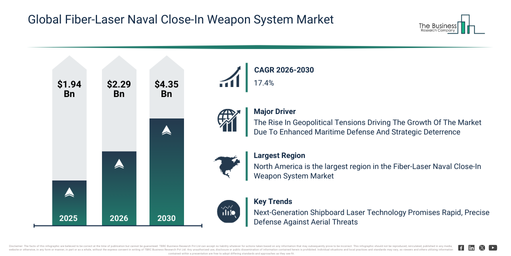
The market for fiber-laser naval close-in weapon systems has experienced rapid expansion recently. It is forecast to grow from $1.94 billion in 2025 to $2.29 billion in 2026, achieving a compound annual growth rate (CAGR) of 17.7%. Historically, this growth has been attributed to increasing naval threats from small boats and drones, the adoption of fiber-laser technology in naval defense, advancements in high-power fiber lasers, the need for cost-effective non-kinetic solutions, and the integration of laser systems with advanced fire control.
The market for fiber-laser naval close-in weapon systems is expected to experience rapid expansion in the coming years. It is projected to reach $4.35 billion by 2030, demonstrating a compound annual growth rate (CAGR) of 17.4%. This growth over the forecast period can be attributed to several factors, including an increase in the power and range of fiber lasers, their deployment on new generation naval vessels, integration with autonomous threat detection systems, an expansion in global naval modernization programs, and improvements in cooling and energy efficiency systems. Significant trends during this period involve advancements in high-energy fiber-laser power scaling, the integration of multi-threat engagement capabilities, enhanced maritime thermal management solutions, the miniaturization and modularity of laser CIWS components, and an increased adoption of all-electric ship combat systems.
Get Access To A Free Fiber-Laser Naval Close-In Weapon System Market Report Sample:
The Key Driver Behind The Fiber-Laser Naval Close-In Weapon System Market’s 17.4% CAGR
The increasing geopolitical instability is anticipated to fuel the expansion of the fiber-laser naval close-in weapon system market in the future. Geopolitical tensions signify stress or disputes among nations or regions stemming from political, economic, territorial, or strategic considerations that impact international relations and worldwide stability. The rise in such tensions often arises from territorial disputes, where conflicting claims over land or sea borders generate disagreements between countries, intensifying political and military friction. The fiber-laser naval close-in weapon system improves a country’s naval defense capabilities, functioning as a strategic deterrent that aids in controlling and mitigating geopolitical tensions. For example, reports from Euronews SA, a French television network, indicated in January 2025 that global conflicts escalated in 2024, showing a 25% increase in political violence compared to 2023, impacting one in eight individuals and leading to approximately 223,000 deaths, with total fatalities rising by 37%. Consequently, the escalating geopolitical tensions are propelling the expansion of the fiber-laser naval close-in weapon system market.
Fiber-Laser Naval Close-In Weapon System Market Classification: Main Segments And Detailed Subsegments
The fiber-laser naval close-in weapon system market covered in this report is segmented –
1) By Component: Laser Source, Beam Control System, Fire Control System, Power Supply, Cooling System, Other Components
2) By Platform: Destroyers, Frigates, Corvettes, Aircraft Carriers, Other Platforms
3) By Range: Short Range, Medium Range, Long Range
4) By Application: Defense, Homeland Security, Other Applications
5) By End-User: Naval Forces, Coast Guard, Other End-Users
Subsegments:
1) By Laser Source: Solid State Laser, Gas Laser, Semiconductor Laser, Free Electron Laser
2) By Beam Control System: Adaptive Optics System, Beam Steering System, Target Tracking System, Beam Stabilization System
3) By Fire Control System: Target Acquisition System, Weapon Aiming System, Engagement Management System, Sensor Integration System
4) By Power Supply: Battery Power Supply, Generator Power Supply, Capacitor Based Power Supply, Hybrid Power Supply
5) By Cooling System: Liquid Cooling System, Air Cooling System, Cryogenic Cooling System, Thermoelectric Cooling System
6) By Other Components: Safety Mechanisms, Diagnostic Systems, Communication Interfaces, Structural Components
Fiber-Laser Naval Close-In Weapon System Market Strategic Shifts: What Leading Players Are Prioritizing
Leading companies in the fiber-laser naval close-in weapon system market are concentrating on developing innovative solutions, such as high-powered pulsed fiber lasers, to enhance ship defense against drones, missiles, and other aerial threats. High-powered pulsed fiber lasers are sophisticated lasers that emit intense bursts of light through optical fibers, enabling precise, long-range targeting of fast-moving threats like drones and missiles. For instance, in July 2025, the United States Navy, a US-based military, partnered with Coherent Aerospace and Defense Inc., a US-based aerospace and defense company, to launch the SONGBOW project, a shipboard laser system designed to counter drone swarms, cruise missiles, and advanced aerial threats. This system integrates multiple pulsed fiber laser modules into a single precision-guided beam, offering scalable power output, advanced beam control, and continuous operation as long as shipboard power is available. It also supports additional functions like remote sensing and situational awareness, providing versatile defense capabilities for modern naval vessels.
Fiber-Laser Naval Close-In Weapon System Market Company Analysis: Major Industry Participants
Major companies operating in the fiber-laser naval close-in weapon system market are Boeing Defense Space And Security, Raytheon Technologies Corporation, Lockheed Martin Corporation, China North Industries Group Corporation, Northrop Grumman Corporation, Thales Group, Leonardo Società per Azioni, Rheinmetall AG, Hanwha Aerospace, Elbit Systems Ltd., Saab AB, Naval Group, Coherent Aerospace and Defense Inc., Rafael Advanced Defense Systems Ltd., ASELSAN A.S., MBDA Missile Systems, General Atomics, Hanwha Defense, IPG Photonics Corporation, Jenoptik AG
Get Full Access To The Fiber-Laser Naval Close-In Weapon System Market Report 2026:
Fiber-Laser Naval Close-In Weapon System Market Global Regional Breakdown: Key Regions Analyzed
North America was the largest region in the fiber-laser naval close-in weapon system market in 2025. Asia-Pacific is expected to be the fastest-growing region in the forecast period. The regions covered in the fiber-laser naval close-in weapon system market report are Asia-Pacific, South East Asia, Western Europe, Eastern Europe, North America, South America, Middle East, Africa.
Reach Out To Our Team:
The Business Research Company: https://www.thebusinessresearchcompany.com/
Americas: +1 310-496-7795
Asia: +44 7882 955267 & +91 8897263534
Europe: +44 7882 955267
Email us at: marketing@tbrc.info
Follow us on:
LinkedIn: https://in.linkedin.com/company/the-business-research-company
YouTube: https://www.youtube.com/channel/UC24_fI0rV8cR5DxlCpgmyFQ
Global Market Model: https://www.thebusinessresearchcompany.com/global-market-model

Wasay has over a decade of experience in market research, data modelling, and analytics, with prior experience at GlobalData and Decision Tree Consulting Services. At The Business Research Company , he leads research operations across syndicated studies, customized consulting engagements, and the Global Market Model platform. His professional experience includes supporting organizations such as Boston Consulting Group, KPMG, and Ernst & Young. Wasay holds a degree in Electronics and Communications Engineering, postgraduate management qualifications from International Management Institute Belgium and Indian School of Business and Entrepreneurship, and completed the Integrated Program in Business Analytics from Indian Institute of Management Indore.