Designed to make market research more actionable and strategically valuable, The Business Research Company’s 2026 market reports feature market attractiveness scoring, total addressable market sizing, company benchmarking matrices, interactive Excel dashboards, deeper supply chain intelligence, emerging startup tracking, and granular product-level insights.
Fire Control System Market To Expand At A 3.9% CAGR: Size And Growth Projections Through 2030
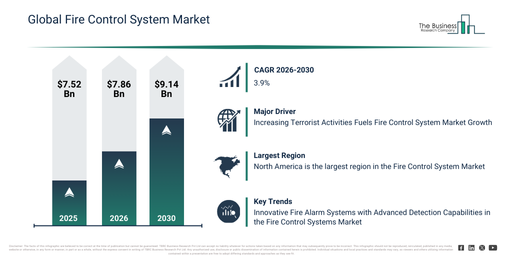
The fire control system market has seen steady expansion in recent years. This market is expected to increase from $7.52 billion in 2025 to $7.86 billion in 2026, showing a compound annual growth rate (CAGR) of 4.5%. Historically, this growth can be attributed to several factors: the increasing use of fire alarm, smoke, and heat detectors in commercial and industrial settings; a rise in the installation of automatic fire suppression systems to comply with safety regulations; growing demand for early detection solutions to reduce property damage and operational downtime; the expansion of firefighting support services as urban infrastructure developed; and the integration of remote monitoring capabilities, which improve the responsiveness of fire control systems.
The fire control system market is anticipated to experience consistent expansion over the coming years, projected to reach $9.14 billion in 2030, demonstrating a compound annual growth rate (CAGR) of 3.9%. This growth during the forecast period is driven by several factors, including a greater focus on smart and networked fire control systems for real-time surveillance, increased implementation of sophisticated flame detection technologies in hazardous settings, the proliferation of automated evacuation guidance solutions to improve occupant safety, wider deployment of intelligent sprinkler and suppression systems due to modernizing buildings, and increased investment in integrated fire management platforms that merge detection, suppression, and control functionalities. Key developments expected during this period involve the integration of advanced sensor technologies, the creation of multi-platform fire control systems, designs that are smaller and lighter, improved capabilities for fire suppression and early detection, and the provision of remote monitoring and real-time decision support.
Get Your Free Fire Control System Market Report Sample Today:
Which Factor Is Expected To Drive The Fire Control System Market Over The Forecast Period?
The expanding occurrence of terrorist acts is anticipated to boost the development of the fire control system market in the future. Such activities encompass the application of violence, fear-mongering, or force to accomplish political, religious, or ideological objectives, frequently targeting non-combatants without distinction. This rise in terrorist activities stems from factors like political instability, societal and economic dissatisfaction, extreme religious views, radical ideological shifts, international tensions, inadequate governance, and the dissemination of extremist beliefs via contemporary communication platforms and social media. Fire control systems contribute to mitigating terrorist threats by offering early identification, alert mechanisms, monitoring capabilities, automated containment, regulated entry, crisis preparedness, and integration with existing security frameworks. These technologies offer valuable data on patterns of unusual conduct or potential dangers, allowing authorities to address security issues proactively. For example, in February 2024, data from the global terrorism index 2024, published by the Australia-based non-profit Institute for Economics and Peace, indicated that the total terrorism-related fatalities climbed to 8,352 in 2023, marking a 22% rise compared to the preceding year. Consequently, the escalation in terrorist actions is propelling the expansion of the fire control system market.
Fire Control System Market Segmentation Insights: How Is The Industry Categorized?
The fire control system market covered in this report is segmented –
1) By System: Target Acquisition And Guidance System, Interface System, Navigation System, Other Systems
2) By Platform: Terrestrial, Aerial, Naval
3) By Weapon Class: Automatic Guns, Launchers
4) By Range: Short Range (0-9 Km), Medium Range (9-80 Km), Long Range (Above 80 Km)
5) By Applications: Machine Guns, Rockets, Mortars, Cannons, Other Applications
Subsegments:
1) By Target Acquisition And Guidance System: Radar-Based Target Acquisition, Infrared Targeting Systems, Electro-Optical Targeting Systems, Laser Targeting Systems
2) By Interface System: Display And Control Interface, Communication Interface, User Interface, Command And Control Interface
3) By Navigation System: GPS-Based Navigation Systems, Inertial Navigation Systems (INS), Doppler Radar Navigation Systems, Celestial Navigation Systems
4) By Other Systems: Weapon Control Systems, Fire Control Computers, Ballistic Calculators, Launch Control Systems
Fire Control System Market Trends Explained: What Is Changing And Why It Matters
Leading firms within the fire control systems market prioritize the development of cutting-edge solutions, such as fire alarm systems equipped with sophisticated detection functions, to promptly pinpoint and address fire risks. These systems are composite devices specifically engineered to sense fire, smoke, or heat, subsequently notifying building occupants via alarms, thereby facilitating rapid evacuation and immediate emergency action. As an illustration, during March 2023, Honeywell, a prominent US-headquartered fire safety company, unveiled the NOTIFIER INSPIRE fire alarm system, which incorporates the inaugural UL-certified self-testing smoke detectors. This particular system automates its own testing and upkeep, thereby boosting both safety and adherence to regulations, thanks to continuous monitoring delivered via Honeywell’s Connected Life Safety Services (CLSS) platform. The objective of the NOTIFIER INSPIRE is to simplify installation procedures and reduce response periods for both facility administrators and service personnel.
Fire Control System Market Competitor Landscape: Who Are The Major Companies?
Major companies operating in the fire control system market are Raytheon Technologies Corporation, Lockheed Martin Corporation, General Dynamics Corporation, Northrop Grumman Corporation, BAE Systems, Inc., Johnson Controls International plc, Safran SA, Thales S.A., L3Harris Technologies, Inc., Leonardo S.p.A., Rheinmetall AG, Elbit Systems Ltd., Israel Aerospace Industries Ltd. (IAI), Saab AB, Indra Sistemas, S.A., Halma plc, Bharat Electronics Limited, ASELSAN Elektronik Sanayi ve Ticaret A.S., Ultra Electronics Holdings plc, Hochiki Corporation, United Technologies Corporation, Yamato Protec Corporation, Seiler Instrument & Manufacturing Company Inc., Wilcox Industries Corp.
See The Full Fire Control System Market Report For Complete Market Sizing And Trends:
Fire Control System Market Regional Demand Analysis And Leading Geography
North America was the largest region in the fire control system market in 2025. Asia Pacific is expected to be the fastest-growing region in the forecast period. The regions covered in the fire control system market report are Asia-Pacific, South East Asia, Western Europe, Eastern Europe, North America, South America, Middle East, Africa.
Reach Out To Our Team:
The Business Research Company: https://www.thebusinessresearchcompany.com/
Americas: +1 310-496-7795
Asia: +44 7882 955267 & +91 8897263534
Europe: +44 7882 955267
Email us at: marketing@tbrc.info
Follow us on:
LinkedIn: https://in.linkedin.com/company/the-business-research-company
YouTube: https://www.youtube.com/channel/UC24_fI0rV8cR5DxlCpgmyFQ
Global Market Model: https://www.thebusinessresearchcompany.com/global-market-model

Wasay has over a decade of experience in market research, data modelling, and analytics, with prior experience at GlobalData and Decision Tree Consulting Services. At The Business Research Company , he leads research operations across syndicated studies, customized consulting engagements, and the Global Market Model platform. His professional experience includes supporting organizations such as Boston Consulting Group, KPMG, and Ernst & Young. Wasay holds a degree in Electronics and Communications Engineering, postgraduate management qualifications from International Management Institute Belgium and Indian School of Business and Entrepreneurship, and completed the Integrated Program in Business Analytics from Indian Institute of Management Indore.