The Business Research Company’s 2026 market reports are designed to deliver research that is more actionable and strategically valuable. Key offerings include market attractiveness scoring, total addressable market sizing, company benchmarking matrices, interactive Excel dashboards, deeper supply chain intelligence, emerging startup tracking, and granular product-level insights.
Fuel-Driven Fixed Wing Unmanned Aerial Vehicles Market Size Insights: Annual Growth Rate, Revenue Outlook And Forecast Drivers
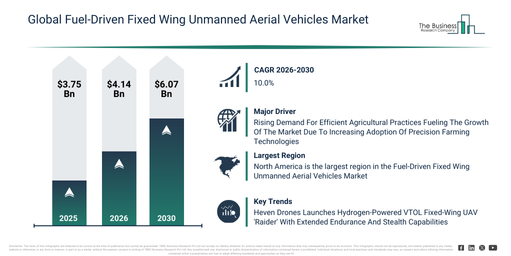
The fuel-driven fixed wing unmanned aerial vehicles market size has experienced rapid expansion in recent years. It is projected to grow from $3.75 billion in 2025 to $4.14 billion in 2026, demonstrating a compound annual growth rate (CAGR) of 10.4%. This historical growth can be attributed to several factors, including the increasing deployment of fuel-driven fixed-wing UAVs for extensive surveillance and reconnaissance missions, a rise in the adoption of tactical fixed-wing UAVs for extended-range operations in defense applications, the expansion of fixed-wing mapping and agricultural spraying missions that necessitate higher payload capacity, the development of maritime patrol UAVs to support coastal and oceanic monitoring, and advancements in internal combustion engine performance that enhance reliability and flight duration.
The fuel-driven fixed wing unmanned aerial vehicles market size is projected to experience swift expansion in the coming years, reaching $6.07 billion in 2030 at a compound annual growth rate (CAGR) of 10.0%. This anticipated growth is driven by several factors, including an increasing need for drones for high-altitude and long-range scientific observation, the growing deployment of hybrid-fuel fixed-wing UAVs in logistics and long-distance delivery, the expansion of border security and monitoring initiatives that require fuel-powered endurance platforms, advancements in lightweight airframe technology for improved efficiency and fuel economy, and the evolution of autonomous mission planning systems that boost the operational effectiveness of these UAVs. Key trends foreseen during this period involve the broadening scope of long-endurance intelligence, surveillance, and reconnaissance (ISR) missions in defense and security, the rising integration of fixed-wing UAVs into precision agriculture and forestry, increased application of fuel-driven UAVs for beyond visual line of sight (BVLOS) mapping and surveying, the growing utilization of fixed-wing UAVs for maritime patrol and border surveillance, and a move towards larger MALE and HALE platforms for strategic purposes.
Request A Free Excerpt Of The Fuel-Driven Fixed Wing Unmanned Aerial Vehicles Global Market Report 2026:
What Will Drive Fuel-Driven Fixed Wing Unmanned Aerial Vehicles Market Growth Through 2030?
The growing demand for effective agricultural methods is projected to boost the expansion of the fuel-driven fixed wing unmanned aerial vehicle market in the future. These practices encompass farming techniques designed to maximize crop output and optimize resource utilization, concurrently reducing waste, ecological footprints, and operational expenses. The increased adoption of precision farming technologies, which optimize input application and enhance crop productivity, is driving the growth of efficient agricultural practices. Fuel-driven fixed-wing unmanned aerial vehicles contribute to better agricultural practices through their capacity for extended aerial monitoring and accurate mapping across vast agricultural areas, thereby supporting improved resource allocation and prompt decision-making. For example, in January 2024, the Government Accountability Office, a US-based government agency, reported that in 2023, 27% of farms and ranches in the U.S. had incorporated precision agriculture methods for managing crops or livestock. Consequently, the expanding requirement for efficient agricultural methods is fueling market growth for fuel-driven fixed wing unmanned aerial vehicles.
Fuel-Driven Fixed Wing Unmanned Aerial Vehicles Market Segment Analysis Covering All Major Categories
The fuel-driven fixed wing unmanned aerial vehicles market covered in this report is segmented –
1) By Type: Small Unmanned Aerial Vehicles, Medium Unmanned Aerial Vehicles, Large Unmanned Aerial Vehicles
2) By Type Of Fuel: Gasoline, Diesel, Hybrid, Alternative Fuels
3) By Application: Surveillance And Reconnaissance, Search And Rescue Operations, Mapping And Surveying, Transport And Delivery, Firefighting And Emergency Response
4) By End-User Industry: Agriculture, Defense And Military, Construction And Infrastructure, Oil And Gas, Telecommunications, Environmental Monitoring
Subsegments:
1) By Small Unmanned Aerial Vehicles: Micro Unmanned Aerial Vehicles (UAVs), Mini Unmanned Aerial Vehicles (UAVs), Hand-Launched Unmanned Aerial Vehicles (UAVs)
2) By Medium Unmanned Aerial Vehicles: Short-Range Unmanned Aerial Vehicles (UAVs), Close-Range Unmanned Aerial Vehicles (UAVs)
3) By Large Unmanned Aerial Vehicles: Medium Altitude Long Endurance (MALE), High Altitude Long Endurance (HALE), Strategic Unmanned Aerial Vehicles (UAVs)
Major Trends Shaping The Future Of The Fuel-Driven Fixed Wing Unmanned Aerial Vehicles Market
Leading companies within the fuel-driven fixed wing unmanned aerial vehicle market are concentrating on developing advanced technologies, such as vertical take-off and landing (VTOL) systems, to enhance operational versatility and deployment efficiency. VTOL systems refer to aircraft capabilities that enable vertical takeoff, hovering, and landing, eliminating the necessity for traditional runways and allowing effective performance in remote or confined locations. For instance, in February 2025, Heven Drones, a US-based company that provides drone technology, launched the Raider, a hydrogen-powered fixed-wing unmanned aerial vehicle. The Raider features hydrogen fuel cell propulsion that allows over 10 hours of endurance with ultra-low thermal and acoustic signatures, significantly boosting stealth and mission range. Its modular payload integration and VTOL capability make it suitable for a wide range of missions, such as cargo delivery, surveillance, and emergency response, offering high adaptability and extended operational performance.
Fuel-Driven Fixed Wing Unmanned Aerial Vehicles Market Competitive Environment And Key Companies
Major companies operating in the fuel-driven fixed wing unmanned aerial vehicles market are The Boeing Company, Lockheed Martin Corporation, Aviation Industry Corporation of China, Northrop Grumman Corporation, Israel Aerospace Industries Ltd., Elbit Systems Ltd., General Atomics Aeronautical Systems Inc., Turkish Aerospace Industries Inc., Kratos Defense & Security Solutions Inc., Denel SOC Ltd., AeroVironment Inc., Aeronautics Ltd., Quantum-Systems GmbH, PBS India Private Limited, Baykar Teknoloji A.S, Chengdu JOUAV Automation Tech Co. Ltd., Skyeton LLC, Maverick Drones & Technologies Pvt. Ltd., Xi’an Supersonic Aviation Technology Co. Ltd., Adcom Systems United
Access Expert Fuel-Driven Fixed Wing Unmanned Aerial Vehicles Market Analysis In The Full Report:
Which Regions Are Covered In The Fuel-Driven Fixed Wing Unmanned Aerial Vehicles Market Report?
North America was the largest region in the fuel-driven fixed wing unmanned aerial vehicles market in 2025. Asia-Pacific is expected to be the fastest-growing region in the forecast period. The regions covered in the fuel-driven fixed wing unmanned aerial vehicles market report are Asia-Pacific, South East Asia, Western Europe, Eastern Europe, North America, South America, Middle East, Africa.
Reach Out To Our Team:
The Business Research Company: https://www.thebusinessresearchcompany.com/
Americas: +1 310-496-7795
Asia: +44 7882 955267 & +91 8897263534
Europe: +44 7882 955267
Email us at: marketing@tbrc.info
Follow us on:
LinkedIn: https://in.linkedin.com/company/the-business-research-company
YouTube: https://www.youtube.com/channel/UC24_fI0rV8cR5DxlCpgmyFQ
Global Market Model: https://www.thebusinessresearchcompany.com/global-market-model

Wasay has over a decade of experience in market research, data modelling, and analytics, with prior experience at GlobalData and Decision Tree Consulting Services. At The Business Research Company , he leads research operations across syndicated studies, customized consulting engagements, and the Global Market Model platform. His professional experience includes supporting organizations such as Boston Consulting Group, KPMG, and Ernst & Young. Wasay holds a degree in Electronics and Communications Engineering, postgraduate management qualifications from International Management Institute Belgium and Indian School of Business and Entrepreneurship, and completed the Integrated Program in Business Analytics from Indian Institute of Management Indore.