
With a focus on actionable insights and strategic value, The Business Research Company’s 2026 market reports include market attractiveness scoring, total addressable market sizing, company benchmarking matrices, interactive Excel dashboards, deeper supply chain intelligence, emerging startup tracking, and granular product-level insights.
How Much Will The Laser Rangefinder Transceiver Market Be Worth By 2030?
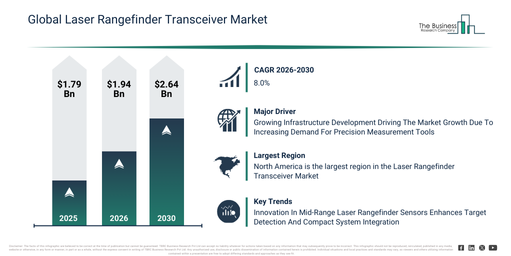
The laser rangefinder transceiver market has experienced robust expansion in recent years. This market is projected to expand from $1.79 billion in 2025 to $1.94 billion in 2026, demonstrating a compound annual growth rate (CAGR) of 8.4%. Historically, this growth has been driven by factors such as the increasing military adoption of laser-based targeting and ranging systems, the early development of time-of-flight measurement technologies, the rising demand for precise distance measurement tools in industrial automation, the expansion of surveying and mapping applications utilizing optical rangefinders, and the initial integration of rangefinder modules into unmanned aerial vehicles.
The laser rangefinder transceiver market is projected to experience substantial growth over the coming years, reaching $2.64 billion in 2030 with a compound annual growth rate (CAGR) of 8.0%. This expansion is primarily driven by factors such as the increasing demand for drone-integrated rangefinder transceivers for advanced navigation and 3D mapping, the growing adoption of vehicle-mounted systems for autonomous and assisted driving, continued defense modernization initiatives driving next-generation targeting solutions, technological advancements enhancing accuracy and long-range measurement capabilities, and the expanding use of laser rangefinders in robotics and smart industrial systems. Key trends anticipated during this forecast period include a rising demand for compact, rugged handheld laser rangefinder transceivers for field operations and outdoor sports, the increasing integration of long-range, high-precision targeting and surveillance rangefinders in defense and border security programs, the broadening use of OEM-integrated rangefinder modules within drones, vehicles, and industrial machinery for embedded distance sensing, a notable shift towards eye-safe wavelength lasers and enhanced compliance with global laser safety standards in commercial and consumer devices, and a growing preference for multi-function rangefinder systems that combine distance measurement, speed detection, and basic 3D profiling in a single unit.
Get Access To A Free Laser Rangefinder Transceiver Market Report Sample:
The Key Driver Behind The Laser Rangefinder Transceiver Market’s 8% CAGR
The future expansion of the laser rangefinder transceiver market is anticipated, driven by increasing infrastructure development. This development encompasses the construction and enlargement of essential physical systems like transportation, energy, and telecommunication facilities. The primary impetus for this growth is rising urbanization, where expanding cities and denser populations necessitate greater demand for transport systems, housing, utilities, and public services crucial for urban living. In infrastructure projects, laser rangefinder transceivers are employed to deliver accurate distance measurements for activities such as surveying, mapping, and ensuring structural precision. As an illustration, data from the Australian Bureau of Statistics, an Australia-based government agency, indicated in July 2023 that the March quarter of 2023 saw 240,813 dwellings under construction, surpassing the 240,065 recorded in the equivalent period of 2022. Specifically, 103,778 of these were new houses in 2023, an increase from 101,240 in 2022. Consequently, the expansion of infrastructure development is propelling the growth of the laser rangefinder transceiver market.
Laser Rangefinder Transceiver Market Classification: Main Segments And Detailed Subsegments
The laser rangefinder transceiver market covered in this report is segmented –
1) By Type: Handheld, Mounted
2) By Range: Short Range, Medium Range, Long Range
3) By Type Of Laser Technology: Time Of Flight (ToF) Lasers, Phase Shift Lasers, Frequency Modulated Continuous Wave (FMCW) Lasers, Other Laser Technologies
4) By End User Industry: Commercial, Industrial, Military, Government, Agricultural, Consumer Electronics, Other End User Industries
Subsegments:
1) By Handheld: Monocular Rangefinders, Binocular Rangefinders, Compact Tactical Rangefinders, Smartphone-Compatible Rangefinders
2) By Mounted: Vehicle-Mounted Rangefinders, Tripod-Mounted Rangefinders, Weapon-Mounted Rangefinders, Drone-Mounted Rangefinders
Laser Rangefinder Transceiver Market Strategic Shifts: What Leading Players Are Prioritizing
Leading companies operating in the laser rangefinder transceiver market are concentrating on developing innovative products, such as mid-range laser rangefinder sensors, to improve target detection accuracy and enhance performance in compact systems. Mid-range laser rangefinder sensors are optical instruments crafted to measure distances, typically between 100 meters and 5 kilometers, utilizing laser beams. For example, in September 2024, LightWare LiDAR Inc., a US-based manufacturing entity, launched the GRF-250 gimbal rangefinder. This mid-range laser rangefinder sensor is designed to offer depth perception capabilities for small EO/IR gimbals, thereby boosting detection accuracy and integration within compact defense and industrial systems. The GRF-250 provides precise distance measurements ideal for mid-range operations, making it suitable for applications like drone-based surveillance, target tracking, and autonomous navigation. With its ultralight form factor and easy integration, the GRF-250 facilitates advanced situational awareness in restricted environments, supporting real-time decision-making and operational efficiency in crucial missions.
Laser Rangefinder Transceiver Market Company Analysis: Major Industry Participants
Major companies operating in the laser rangefinder transceiver market are Lockheed Martin Corporation, Northrop Grumman Corporation, BAE Systems, Thales S.A., L3Harris Technologies Inc., Elbit Systems Ltd., Saab AB, Trimble Inc., Kongsberg Gruppen ASA, Hamamatsu Photonics K.K., Topcon Corporation, Leica Geosystems AG, Pepperl+Fuchs Inc., Safran Electronics & Defense SAS, Shenzhen Leishen Intelligent System Co. Ltd., Bushnell Holdings Inc., Laser Technology Inc., Newcon Optik Ltd., Chengdu JRT Meter Technology Co. Ltd., OPTEX FA CO. LTD., LightWare LiDAR LLC, Motionics LLC, Phoenix LiDAR Systems LLC, Wuhan Jiuan Laser Technology Co. Ltd.
Get Full Access To The Laser Rangefinder Transceiver Market Report 2026:
Laser Rangefinder Transceiver Market Global Regional Breakdown: Key Regions Analyzed
North America was the largest region in the laser rangefinder transceiver market in 2025. Asia-Pacific is expected to be the fastest-growing region in the forecast period. The regions covered in the laser rangefinder transceiver market report are Asia-Pacific, South East Asia, Western Europe, Eastern Europe, North America, South America, Middle East, Africa.
Reach Out To Our Team:
The Business Research Company: https://www.thebusinessresearchcompany.com/
Americas: +1 310-496-7795
Asia: +44 7882 955267 & +91 8897263534
Europe: +44 7882 955267
Email us at: marketing@tbrc.info
Follow us on:
LinkedIn: https://in.linkedin.com/company/the-business-research-company
YouTube: https://www.youtube.com/channel/UC24_fI0rV8cR5DxlCpgmyFQ
Global Market Model: https://www.thebusinessresearchcompany.com/global-market-model

Wasay has over a decade of experience in market research, data modelling, and analytics, with prior experience at GlobalData and Decision Tree Consulting Services. At The Business Research Company , he leads research operations across syndicated studies, customized consulting engagements, and the Global Market Model platform. His professional experience includes supporting organizations such as Boston Consulting Group, KPMG, and Ernst & Young. Wasay holds a degree in Electronics and Communications Engineering, postgraduate management qualifications from International Management Institute Belgium and Indian School of Business and Entrepreneurship, and completed the Integrated Program in Business Analytics from Indian Institute of Management Indore.


