
Featuring market attractiveness scoring, total addressable market sizing, company benchmarking matrices, interactive Excel dashboards, deeper supply chain intelligence, emerging startup tracking, and granular product-level insights, The Business Research Company’s 2026 market reports are built to deliver research that is both more actionable and more strategically valuable.
#Hall Effect Sensors Market Expansion Outlook: What Revenue Opportunities Are Ahead?#_x000D_
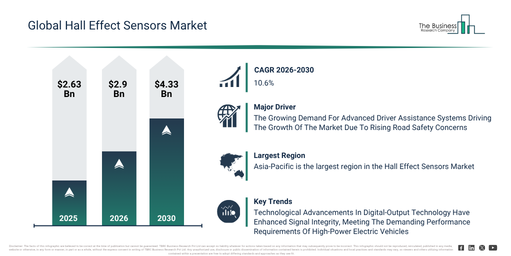
The Hall effect sensors market has experienced substantial growth in recent years. Its valuation is predicted to increase from $2.63 billion in 2025 to $2.9 billion in 2026, demonstrating a compound annual growth rate (CAGR) of 10.3%. In the past, this expansion was driven by factors such as the increasing demand for contactless sensing, the growing integration of automotive electronics, advancements in industrial automation, wider application of magnetic position detection, and a heightened demand for reliable speed sensing._x000D_
_x000D_
The hall effect sensors market is expected to demonstrate significant expansion over the next few years. It is predicted to reach a valuation of $4.33 billion in 2030, driven by a compound annual growth rate (CAGR) of 10.6%. This growth during the forecast period is fueled by the increasing adoption of electric vehicles, the rising deployment of advanced driver assistance systems, the growing demand for smart robotics, the increasing integration of magnetic current sensing, and the rising need for high-precision industrial sensors. Noteworthy trends for this period include the increasing embrace of contactless magnetic sensing, a rising demand for precise position and speed detection, the development of miniaturized hall effect sensor packages, the increasing integration of multi-axis magnetic sensing, and a growing demand for programmable and application-specific hall effect sensors._x000D_
_x000D_
#Get A Free Sample Report With In-Depth Market Insights:#_x000D_
_x000D_
#Hall Effect Sensors Market Expansion Drivers: What’s Shaping Future Growth?#_x000D_
The increasing need for advanced driver assistance systems is projected to fuel the expansion of the hall effect sensors market moving forward. These advanced driver assistance systems are vehicle-integrated electronic technologies that utilize sensors, cameras, and software to aid drivers in secure operation and parking, by boosting vehicle awareness, automating certain driving tasks, and mitigating collision risks. The surge in demand for these systems stems from growing concerns about road safety and the imperative to decrease traffic incidents through instantaneous driver assistance and automated safety functions. As advanced driver assistance systems (ADAS) continuously improve vehicle safety, automation, and real-time decision-making through precise tracking of elements like steering, braking, throttle position, and wheel speed, hall effect sensors have become crucial for enabling accurate, dependable, and non-contact position and speed detection. For instance, in October 2024, data from the MITRE Corporation, a US-based non-profit, indicated significant market growth for Advanced Driver Assistance Systems (ADAS), with 10 of the 14 ADAS features surpassing 50% penetration by the 2023 model year, and five features reaching over 90% adoption. Consequently, the rising demand for advanced driver assistance systems is a key factor driving the growth of the hall effect sensors market. The expansion of industrial automation is anticipated to drive the hall effect sensors market forward. Industrial automation involves deploying control systems, robotics, and information technologies to manage industrial operations and machinery with minimal human involvement. The increasing embrace of industrial automation is a response to manufacturers’ requirements to boost production efficiency and overcome labor shortages in vital industries. As industrial automation continues its evolution through the widespread adoption of smart manufacturing, robotics, and automated process controls, the rising need for precise, dependable, and non-contact sensing has made hall effect sensors indispensable for accurate measurement of position, speed, current, and proximity. For example, in September 2024, the World Robotics 2024 report, issued by the Germany-based International Federation of Robotics, reported that the global operational stock of industrial robots reached 4,281,585 units in factories worldwide, marking a 10% year-on-year increase, while yearly installations surpassed 500,000 units for the third consecutive year. Thus, the growing trend of industrial automation is a significant factor in the growth of the hall effect sensors market._x000D_
_x000D_
#Hall Effect Sensors Market Breakdown By Product Type And Application#_x000D_
The hall effect sensors market covered in this report is segmented – _x000D_
_x000D_
1) By Type: Linear Hall Effect Sensors, Rotary Hall Effect Sensors, Digital Hall Effect Sensors, Analog Hall Effect Sensors_x000D_
2) By Material Type: Indium Antimonide, Gallium Arsenide, Indium Arsenide, Other Material Types_x000D_
3) By Technology Type: Bipolar, Unipolar, Omnipolar, Latching_x000D_
4) By Application Type: Position Sensing, Current Sensing, Speed Sensing, Proximity Detection, Level Sensing, Motion Detection, Angle Sensing, Magnetic Field Detection_x000D_
5) By End User: Automotive, Consumer Electronics, Industrial Automation, Aerospace And Defense, Healthcare And Medical Devices, Energy And Utilities, Telecommunications, Robotics_x000D_
_x000D_
Subsegments:_x000D_
1) By Linear Hall Effect Sensors: Open-Loop Linear Hall Effect Sensors, Closed-Loop Linear Hall Effect Sensors, Current Sensing Linear Hall Effect Sensors, Position Sensing Linear Hall Effect Sensors, Magnetic Field Measurement Linear Hall Effect Sensors_x000D_
2) By Rotary Hall Effect Sensors: Absolute Rotary Hall Effect Sensors, Incremental Rotary Hall Effect Sensors, Angular Position Hall Effect Sensors, Rotational Speed Hall Effect Sensors, Steering Angle Hall Effect Sensors_x000D_
3) By Digital Hall Effect Sensors: Switch-Type Digital Hall Effect Sensors, Speed Detection Hall Effect Sensors, Gear Tooth Detection Hall Effect Sensors, Proximity Detection Hall Effect Sensors, Limit Detection Hall Effect Sensors_x000D_
4) By Analog Hall Effect Sensors: Voltage Output Analog Hall Effect Sensors, Current Output Analog Hall Effect Sensors, Ratiometric Analog Hall Effect Sensors, Programmable Analog Hall Effect Sensors, Precision Analog Hall Effect Sensors_x000D_
_x000D_
#Hall Effect Sensors Market Strategic Trends: What Defines The Next Growth Phase?#_x000D_
Major companies operating in the hall effect sensors market are increasingly concentrating on leveraging innovative technologies, such as digital-output technology, to enhance signal integrity, improve electromagnetic interference (EMI) immunity, and enable accurate current sensing in high-power electric vehicle applications. Digital-output technology is a sensing method that converts measured physical signals into digital data, leading to higher noise immunity, improved signal integrity, and more reliable communication compared to traditional analog-output sensors. For instance, in June 2026, Melexis N.V., a Belgium-based semiconductor company, introduced the MLX91229, an innovative digital-output Hall-effect current sensor designed for automotive current sensing applications. The MLX91229 incorporates a second-order sigma-delta digital output that transfers current measurements as a high-speed digital bitstream rather than an analog voltage, significantly boosting signal integrity in electrically noisy environments. The sensor supports current sensing from 200 A to 2000 A and is optimized for traction inverters, battery management systems, and other high-power automotive electronics. It features a drop-in footprint compatible with existing analog Hall-effect solutions, enabling seamless upgrades without major PCB redesigns. The device also allows configurable demodulation at the microcontroller to optimize either response speed or measurement accuracy while providing high immunity to EMI, making it well-suited for next-generation EV powertrains and advanced mobility systems._x000D_
_x000D_
#Hall Effect Sensors Market Leading Players And Competitive Positioning#_x000D_
Major companies operating in the hall effect sensors market are Texas Instruments Incorporated, Honeywell International Inc., STMicroelectronics N.V., Infineon Technologies AG, NXP Semiconductors N.V., Microchip Technology Inc., TE Connectivity plc, TDK Corporation, Renesas Electronics Corporation, Sensata Technologies Inc., ams-OSRAM AG, ROHM Co. Ltd., Asahi Kasei Microdevices Corporation, Littelfuse Inc., Allegro MicroSystems Inc., LEM Holding SA, Diodes Incorporated, Melexis NV, Shanghai Belling Co. Ltd., Tamura Corporation, Silan Microelectronics Co. Ltd., Nanjing AH Electronic Science & Technology Co. Ltd., Celduc Relais_x000D_
_x000D_
#View The Full Hall Effect Sensors Market Report:#_x000D_
_x000D_
#Hall Effect Sensors Market Regional Distribution: Which Areas Power Market Growth?#_x000D_
Asia-Pacific was the largest region in the hall effect sensors market in 2025. Asia-Pacific is expected to be the fastest-growing region in the forecast period. The regions covered in the hall effect sensors market report are Asia-Pacific, South East Asia, Western Europe, Eastern Europe, North America, South America, Middle East, Africa._x000D_
_x000D_
#Reach Out To Our Team:#_x000D_
_x000D_
The Business Research Company: https://www.thebusinessresearchcompany.com/_x000D_
Americas: +1 310-496-7795_x000D_
Asia: +44 7882 955267 & +91 8897263534_x000D_
Europe: +44 7882 955267_x000D_
Email us at: marketing@tbrc.info_x000D_
_x000D_
#Follow us on:#_x000D_
_x000D_
LinkedIn: https://in.linkedin.com/company/the-business-research-company_x000D_
YouTube: https://www.youtube.com/channel/UC24_fI0rV8cR5DxlCpgmyFQ_x000D_
Global Market Model: https://www.thebusinessresearchcompany.com/global-market-model

Wasay has over a decade of experience in market research, data modelling, and analytics, with prior experience at GlobalData and Decision Tree Consulting Services. At The Business Research Company , he leads research operations across syndicated studies, customized consulting engagements, and the Global Market Model platform. His professional experience includes supporting organizations such as Boston Consulting Group, KPMG, and Ernst & Young. Wasay holds a degree in Electronics and Communications Engineering, postgraduate management qualifications from International Management Institute Belgium and Indian School of Business and Entrepreneurship, and completed the Integrated Program in Business Analytics from Indian Institute of Management Indore.