
Market attractiveness scoring, total addressable market sizing, company benchmarking matrices, interactive Excel dashboards, deeper supply chain intelligence, emerging startup tracking, and granular product-level insights are among the key offerings featured in The Business Research Company’s 2026 market reports, designed to deliver more actionable and strategically valuable research.
Lunar Exploration Technology Market Valued At $12.98 Billion In 2026, Projected To Reach $21.42 Billion By 2030
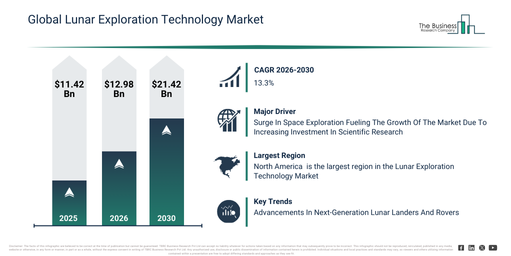
The lunar exploration technology market size has seen significant expansion in recent years. It is anticipated to grow from $11.42 billion in 2025 to $12.98 billion in 2026, exhibiting a compound annual growth rate (CAGR) of 13.7%. This historic growth can be linked to accomplishments like successful robotic lunar missions, advancements in lunar rover capabilities, the establishment of lunar communication relays, the execution of in-situ resource utilization experiments, and investments from government space agencies.
The lunar exploration technology market is projected to experience significant expansion over the next few years. It is anticipated to reach $21.42 billion in 2030, growing at a compound annual growth rate (CAGR) of 13.3%. This growth during the forecast period is primarily driven by factors such as the rise in commercial lunar exploration missions, increasing demand for autonomous surface operations, the development of advanced lunar drilling and excavation systems, the adoption of radiation-resistant materials, and the integration of AI-driven lunar data analytics. Prominent trends expected in this period include the widespread adoption of in-situ resource utilization (isru), the implementation of modular lunar lander and rover designs, advanced solutions for lunar surface mobility, sophisticated lunar environment monitoring and hazard detection, and the deployment of high-precision lunar landing and navigation systems.
Request A Complimentary Lunar Exploration Technology Market Research Sample:
Key Factor Propelling The Lunar Exploration Technology Market Forward
Growing enthusiasm for space exploration is anticipated to fuel the expansion of the lunar exploration technology market in the future. This endeavor involves investigating and uncovering aspects of outer space through the deployment of rockets, satellites, and various spacecraft. The surge in space exploration activities stems from increased funding in scientific investigations, which empowers nations and corporations to uncover novel insights and create cutting-edge technologies. Through its capacity to facilitate in-depth analysis of the Moon’s terrain, aid upcoming missions, and deepen our comprehension of the solar system, lunar exploration technology contributes significantly to space exploration. As an illustration, data from Pixalytics Ltd., a UK-based earth observation firm, revealed that by the close of June 2023, 11330 distinct satellites were in Earth’s orbit, marking a substantial 37.94% rise since January 2022. Consequently, the heightened focus on space exploration imagery is a key factor propelling the development of the lunar exploration technology market.
Lunar Exploration Technology Market Segments And Subsegments Explained
The lunar exploration technology market covered in this report is segmented –
1) By Technology Type: Propulsion Systems, Landing Systems, Navigation And Guidance, Communication Systems, Power Systems, Robotics And Automation, Scientific Instruments, Other Technology Types
2) By Application: Manned Missions, Unmanned Missions, Lunar Rovers, Lunar Landers, Lunar Orbiters, Other Applications
3) By End-User: Government Space Agencies, Commercial Space Companies, Research Institutes, Other End-Users
Subsegments:
1) By Propulsion Systems Type: Chemical Propulsion, Electric Propulsion, Hybrid Propulsion, Nuclear Propulsion
2) By Landing Systems Type: Powered Descent Systems, Precision Landing Systems, Hazard Detection And Avoidance Systems, Soft Landing Systems
3) By Navigation And Guidance Type: Inertial Navigation Systems, Celestial Navigation Systems, Terrain Relative Navigation, Autonomous Guidance Systems
4) By Communication Systems Type: Deep Space Communication Systems, Optical Communication Systems, Radio Frequency Communication Systems, Relay Satellite Systems
5) By Power Systems Type: Solar Power Systems, Nuclear Power Systems, Fuel Cell Systems, Battery Storage Systems
6) By Robotics And Automation Type: Lunar Rovers, Robotic Arms, Autonomous Navigation Robots, In Situ Resource Utilization Robots
7) By Scientific Instruments Type: Spectrometers, Seismometers, Imaging Systems, Drilling And Sampling Instruments
8) By Other Technology Types: Thermal Control Systems, Radiation Protection Systems, Habitat Support Systems, Additive Manufacturing Systems
Emerging Trends Transforming The Lunar Exploration Technology Market
Major companies operating within the lunar exploration technology market are concentrating on developing technological advancements, such as next-generation lunar lander and rover systems, to achieve secure landings, mobility, and on-site experiments on the Moon. These advanced exploration technologies are specifically designed for precise landings, navigating difficult lunar terrain, and carrying scientific payloads for extended missions. For instance, in July 2023, the Indian Space Research Organisation (ISRO), an India-based government space agency, launched Chandrayaan-3. This mission demonstrated a successful soft landing near the lunar south pole, deployed a rover for surface exploration, significantly enhanced India’s capabilities in planetary missions, and contributed vital scientific data for future lunar research. Additionally, the data gathered from the mission helps deepen the understanding of the Moon’s geology and resources, creating opportunities for further scientific discovery and potential utilization.
Lunar Exploration Technology Market Key Players: Major Companies In The 2026 Report
Major companies operating in the lunar exploration technology market are Boeing Company, Lockheed Martin Corporation, Northrop Grumman Corporation, National Aeronautics and Space Administration (NASA), Space Exploration Technologies Corp. (SpaceX), Blue Origin LLC, Sierra Nevada Corporation, MDA Space Ltd., Teledyne Brown Engineering Inc., ispace Inc., Astrolab SAS, Intuitive Machines Inc., Firefly Aerospace Inc., The Exploration Company GmbH, GITAI Japan Inc., Special Aerospace Services Ltd., Astrobotic Technology Inc., Indian Space Research Organisation (ISRO), Lunar Outpost Inc., CisLunar Industries Inc.
Explore The Full Lunar Exploration Technology Market Report With Forecasts To 2030:
Lunar Exploration Technology Market By Region: Where Is Demand Strongest?
North America was the largest region in the lunar exploration technology market in 2025. Asia-Pacific is expected to be the fastest-growing region in the forecast period. The regions covered in the lunar exploration technology market report are Asia-Pacific, South East Asia, Western Europe, Eastern Europe, North America, South America, Middle East, Africa.
Reach Out To Our Team:
The Business Research Company: https://www.thebusinessresearchcompany.com/
Americas: +1 310-496-7795
Asia: +44 7882 955267 & +91 8897263534
Europe: +44 7882 955267
Email us at: marketing@tbrc.info
Follow us on:
LinkedIn: https://in.linkedin.com/company/the-business-research-company
YouTube: https://www.youtube.com/channel/UC24_fI0rV8cR5DxlCpgmyFQ
Global Market Model: https://www.thebusinessresearchcompany.com/global-market-model

Wasay has over a decade of experience in market research, data modelling, and analytics, with prior experience at GlobalData and Decision Tree Consulting Services. At The Business Research Company , he leads research operations across syndicated studies, customized consulting engagements, and the Global Market Model platform. His professional experience includes supporting organizations such as Boston Consulting Group, KPMG, and Ernst & Young. Wasay holds a degree in Electronics and Communications Engineering, postgraduate management qualifications from International Management Institute Belgium and Indian School of Business and Entrepreneurship, and completed the Integrated Program in Business Analytics from Indian Institute of Management Indore.


