With a focus on actionable insights and strategic value, The Business Research Company’s 2026 market reports include market attractiveness scoring, total addressable market sizing, company benchmarking matrices, interactive Excel dashboards, deeper supply chain intelligence, emerging startup tracking, and granular product-level insights.
How Much Will The Marine Base Steering Gear Market Be Worth By 2030?
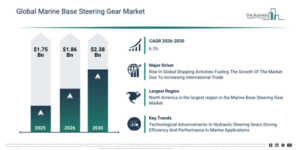
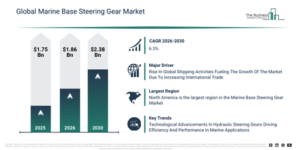
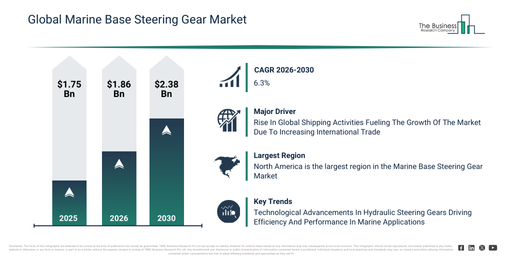
The marine base steering gear market has experienced robust expansion in recent years. It is projected to grow from $1.75 billion in 2025 to $1.86 billion in 2026, exhibiting a compound annual growth rate (CAGR) of 6.6%. This historical growth can be attributed to several factors, including the increasing adoption of hydraulic and electric steering systems in commercial and naval vessels, advancements in servo motor and actuator technologies, a rising demand for precise rudder control and course stability, the expansion of vessel fleets requiring maintenance and modernization of steering systems, and the growing integration of steering gear with navigation and autopilot systems.
The marine base steering gear market is projected for robust expansion over the coming years, with its size expected to reach $2.38 billion by 2030, reflecting a compound annual growth rate (CAGR) of 6.3%. This anticipated growth is primarily driven by advancements in energy-efficient and low-maintenance marine base steering systems, alongside the increasing adoption of automated and fly-by-wire steering technologies. Further contributing factors include the integration of AI-driven navigation and predictive maintenance solutions, a rising demand for retrofit and upgrade services for aging vessels, and the expansion of commercial and naval fleets in emerging maritime markets. Key trends during this period encompass a heightened demand for dependable steering systems in large commercial vessels, significant modernization efforts within naval fleets leading to the replacement of legacy steering gear, and a growing inclination towards electro-hydraulic steering gear due to its precision and efficiency. Additionally, expanding global shipbuilding activities are expected to further boost steering gear installations, coupled with an increased focus on safety compliance and redundancy in marine steering operations.
Get Access To A Free Marine Base Steering Gear Market Report Sample:
The Key Driver Behind The Marine Base Steering Gear Market’s 6.3% CAGR
The anticipated expansion of global shipping activities is set to drive the growth of the marine base steering gear market in the coming years. Shipping activities involve the efficient planning, execution, and control of goods movement and storage from their starting point to their final destination. The demand for shipping is increasing due to the worldwide integration of supply chains and a rise in international trade, which necessitates efficient and dependable transportation and storage solutions. Marine steering gears provide accurate and responsive control over rudder movement, enabling vessels to navigate securely in challenging environments like rough seas, crowded ports, or narrow channels. This functionality facilitates quick response times, improving the ability to prevent collisions or adjust course rapidly. For instance, in June 2024, the United States Department of Transportation, a US-based government department, reported that in 2023, total U.S. transportation through Water mode was 797 million tons, a volume expected to reach 1,238 million tons by 2050. Consequently, the increase in global shipping activities will stimulate the growth of the marine base steering gear market.
Marine Base Steering Gear Market Classification: Main Segments And Detailed Subsegments
The marine base steering gear market covered in this report is segmented –
1) By Type: Mechanical Steering Gear, Electrical Steering Gear, Hydraulic Steering Gear, Pneumatic Steering Gear
2) By Technology: Automatic, Manual, Semi-Automatic
3) By Vessel Type: Commercial Vessels, Military Vessels, Recreational Vessels
4) By End User: Shipbuilders, Shipping Companies, Naval Forces, Yacht Owners
Subsegments:
1) By Mechanical Steering Gear: Rack And Pinion Systems, Cable And Pulley Systems, Worm And Sector Mechanisms, Chain And Sprocket Systems
2) By Electrical Steering Gear: Electro-Mechanical Actuators, Servo Motor-Based Systems, Stepper Motor-Based Systems, Integrated Control Modules
3) By Hydraulic Steering Gear: Ram Type Steering Gear, Rotary Vane Steering Gear, Electro-Hydraulic Steering Systems, Power-Assisted Hydraulic Units
4) By Pneumatic Steering Gear: Pneumatic Actuator Systems, Air-Over-Hydraulic Systems, Compressed Air Cylinder Systems, Pneumatic Servo Systems
Marine Base Steering Gear Market Strategic Shifts: What Leading Players Are Prioritizing
Leading firms within the marine base steering gear market are concentrating on creating sophisticated technological solutions, like hydraulic steering gears, to ensure seamless operation even with heavy loads. These hydraulic steering gear systems utilize pressurized fluid to transfer force and govern the rudder’s motion, thus facilitating fluid and effective steering. An example of this is Becker Marine Systems, a Germany-based company specializing in maritime maneuverability and energy efficiency, which introduced Becker Steering Gear, a hydraulic steering gear, in September 2024. Its compact, low-pressure hydraulic system conserves space and boosts efficiency, rendering it ideal for confined steering areas. Featuring integrated bearings and a rudder carrier made from robust synthetic materials, it delivers durable performance requiring minimal maintenance. The system is available in eight distinct versions, offering torque capacities between 160 kilonewton-meters (KNm) and 500 KNm. It is specifically designed for smaller vessels, including fishing boats, supply ships, tugboats, and yachts. These solutions offer a complete package prioritizing vessel safety and adhering to classification society standards. Furthermore, their design emphasizes ease of installation and handling.
Marine Base Steering Gear Market Company Analysis: Major Industry Participants
Major companies operating in the marine base steering gear market are ZF Friedrichshafen AG, Rolls-Royce Plc, Jastram Engineering Ltd., Hyundai Heavy Industries Co. Ltd., Bosch Rexroth AG, Wärtsilä, Schottel Inc., Damen Marine Components, Kongsberg Maritime, Japan Radio Co. Ltd. (JRC), Kawasaki Heavy Industries, Twin Disc Inc., Nakashima Propeller Co. Ltd., Veth Propulsion, Lilaas AS, Fluiten S.p.A., Palmarine (Singapore) Pte Ltd, D-I Industrial Co. Ltd., Data Hidrolik, Beijing Haihua Co. Ltd
Get Full Access To The Marine Base Steering Gear Market Report 2026:
Marine Base Steering Gear Market Global Regional Breakdown: Key Regions Analyzed
North America was the largest region in the marine base steering gear market in 2025. Europe is expected to be the fastest-growing region in the forecast period. The regions covered in the marine base steering gear market report are Asia-Pacific, South East Asia, Western Europe, Eastern Europe, North America, South America, Middle East, Africa.
Reach Out To Our Team:
The Business Research Company: https://www.thebusinessresearchcompany.com/
Americas: +1 310-496-7795
Asia: +44 7882 955267 & +91 8897263534
Europe: +44 7882 955267
Email us at: marketing@tbrc.info
Follow us on:
LinkedIn: https://in.linkedin.com/company/the-business-research-company
YouTube: https://www.youtube.com/channel/UC24_fI0rV8cR5DxlCpgmyFQ
Global Market Model: https://www.thebusinessresearchcompany.com/global-market-model

Wasay has over a decade of experience in market research, data modelling, and analytics, with prior experience at GlobalData and Decision Tree Consulting Services. At The Business Research Company , he leads research operations across syndicated studies, customized consulting engagements, and the Global Market Model platform. His professional experience includes supporting organizations such as Boston Consulting Group, KPMG, and Ernst & Young. Wasay holds a degree in Electronics and Communications Engineering, postgraduate management qualifications from International Management Institute Belgium and Indian School of Business and Entrepreneurship, and completed the Integrated Program in Business Analytics from Indian Institute of Management Indore.