The Business Research Company’s 2026 market reports are designed to deliver research that is more actionable and strategically valuable. Key offerings include market attractiveness scoring, total addressable market sizing, company benchmarking matrices, interactive Excel dashboards, deeper supply chain intelligence, emerging startup tracking, and granular product-level insights.
Micro-Unmanned Aerial Vehicle (UAV) Organic Recon Kit Market Historical Growth Vs. Forecast Growth: How Do The Numbers Compare?
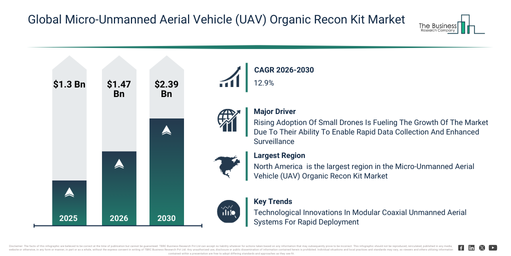
The micro-unmanned aerial vehicle (UAV) organic recon kit market has demonstrated rapid expansion in recent years. It is projected to increase from $1.3 billion in 2025 to $1.47 billion in 2026, reflecting a compound annual growth rate (CAGR) of 13.1%. Historically, this market’s growth can be attributed to the adoption of small UAVs for battlefield reconnaissance, advancements in lightweight airframes and portable control units, the integration of high-resolution imaging sensors, an escalating demand for real-time intelligence, and increased defense spending on tactical UAV systems.
The micro-unmanned aerial vehicle (UAV) organic recon kit market is anticipated to experience substantial growth in the upcoming years. It is projected to reach $2.39 billion in 2030, showing a compound annual growth rate (CAGR) of 12.9%. This expansion during the forecast period is attributed to several factors, including the implementation of autonomous reconnaissance drones, the integration of AI-based image and signal processing, an increase in multi-sensor payload capabilities, the development of compact UAV kits for rapid deployment, and the adoption of secure military communication links for small units. Major trends expected in this timeframe include the miniaturization of UAV platforms for quick deployment, the incorporation of high-resolution imaging sensors into UAVs, advancements in real-time communication and telemetry systems, an increased preference for hybrid UAVs that combine fixed-wing and rotary-wing features, and the creation of lightweight airframe components for extended operational endurance.
Start With A Free Sample Of The Micro-Unmanned Aerial Vehicle (UAV) Organic Recon Kit Market Research Report:
The Leading Growth Driver In The Micro-Unmanned Aerial Vehicle (UAV) Organic Recon Kit Market Explained
The expanding deployment of small drones across various sectors is projected to stimulate the growth of the micro-unmanned aerial vehicle (UAV) organic recon kit market. Small drones are compact, lightweight unmanned aerial vehicles (UAVs) designed for short-range operations, commonly employed for surveillance, photography, or recreational activities. The heightened adoption of these drones is driven by the necessity for rapid data collection, facilitating quicker and more precise insights with minimal human intervention. Micro-unmanned aerial vehicle (UAV) organic recon kits augment the capabilities of small drones by enabling real-time data acquisition and accurate surveillance in challenging environments. For instance, in January 2025, the European Council on Foreign Relations, a Germany-based non-governmental think tank, reported that Ukraine aimed to produce one million drones in 2024, significantly exceeding the approximately 100,000 quadcopters purchased by European countries in 2023. Consequently, the increasing embrace of small drones across diverse sectors is propelling the expansion of the micro-unmanned aerial vehicle (UAV) organic recon kit market.
Key Segments Shaping The Micro-Unmanned Aerial Vehicle (UAV) Organic Recon Kit Market Landscape
The micro-unmanned aerial vehicle (uav) organic recon kit market covered in this report is segmented –
1) By Product Type: Fixed-Wing, Rotary-Wing, Hybrid
2) By Payload: Camera, Sensors, Communication Systems, Other Payload
3) By Application: Military And Defense, Law Enforcement, Border Surveillance, Disaster Management, Other Applications
4) By End-User: Armed Forces, Homeland Security, Emergency Services, Other End-User
Subsegments:
1) By Fixed-Wing: Tactical, Long-Endurance, Mini, Micro
2) By Rotary-Wing: Single-Rotor, Multi-Rotor, Coaxial-Rotor, Tilt-Rotor
3) By Hybrid: Fixed-Rotor, Electric, Vertical Takeoff, Long-Endurance
Micro-Unmanned Aerial Vehicle (UAV) Organic Recon Kit Market Trend Spotlight: Key Shifts Shaping Future Demand
Leading companies within the micro-unmanned aerial vehicle (UAV) organic recon kit market are concentrating on technological breakthroughs, such as modular coaxial rotor systems. Their objective is to supply operators with versatile, ready-to-fly platforms that enhance reconnaissance capabilities, improve operational efficiency, and enable the seamless integration of advanced intelligence payloads. A modular coaxial rotor system is a propulsion design for an unmanned aerial vehicle, featuring two counter-rotating rotors stacked on the same axis, complemented by a flexible and easily upgradable structure that facilitates quick integration or replacement of components and mission equipment. For instance, in February 2025, Ascent AeroSystems Inc., a US-based company producing rugged, aircraft-grade coaxial Unmanned Aerial Systems (UAS), launched its Ready-to-Fly All-in-One Spirit and NX30 Kits, designed for rapid field deployment. These kits boast a robust cylindrical design for all-weather operation, integrated ground control systems for swift setup, and modular payload bays for effortless mission adaptability. These innovations support tactical users seeking organic intelligence, surveillance, and reconnaissance (ISR) capabilities with minimal logistical burden.
Micro-Unmanned Aerial Vehicle (UAV) Organic Recon Kit Market Competitive Analysis: Who Are The Main Competitors?
Major companies operating in the micro-unmanned aerial vehicle (UAV) organic recon kit market are Lockheed Martin Corporation, Northrop Grumman Corporation, BAE Systems plc, Thales Group, Leonardo S.p.A., Elbit Systems Ltd., Israel Aerospace Industries (IAI), Saab AB, DJI Innovations, Teledyne FLIR LLC, AeroVironment Inc., Aeronautics Ltd., Quantum-Systems GmbH, Parrot Drones SAS, Microdrones GmbH, UAV Factory Ltd. (Edge Autonomy), Delair SAS, Blue Bear Systems Research Ltd., Skydio Inc., Shield AI, Anduril Industries, Novadem, Garuda Aerospace, Baykar Technology, Rheinmetall AG
Find The Complete Micro-Unmanned Aerial Vehicle (UAV) Organic Recon Kit Market Outlook In The Full Report:
Mapping The Micro-Unmanned Aerial Vehicle (UAV) Organic Recon Kit Market: Regional Leadership And Global Reach
North America was the largest region in the micro-unmanned aerial vehicle (UAV) organic recon kit market in 2025. Asia-Pacific is expected to be the fastest-growing region in the forecast period. The regions covered in the micro-unmanned aerial vehicle (UAV) organic recon kit market report are Asia-Pacific, South East Asia, Western Europe, Eastern Europe, North America, South America, Middle East, Africa.
Reach Out To Our Team:
The Business Research Company: https://www.thebusinessresearchcompany.com/
Americas: +1 310-496-7795
Asia: +44 7882 955267 & +91 8897263534
Europe: +44 7882 955267
Email us at: marketing@tbrc.info
Follow us on:
LinkedIn: https://in.linkedin.com/company/the-business-research-company
YouTube: https://www.youtube.com/channel/UC24_fI0rV8cR5DxlCpgmyFQ
Global Market Model: https://www.thebusinessresearchcompany.com/global-market-model

Wasay has over a decade of experience in market research, data modelling, and analytics, with prior experience at GlobalData and Decision Tree Consulting Services. At The Business Research Company , he leads research operations across syndicated studies, customized consulting engagements, and the Global Market Model platform. His professional experience includes supporting organizations such as Boston Consulting Group, KPMG, and Ernst & Young. Wasay holds a degree in Electronics and Communications Engineering, postgraduate management qualifications from International Management Institute Belgium and Indian School of Business and Entrepreneurship, and completed the Integrated Program in Business Analytics from Indian Institute of Management Indore.