Market attractiveness scoring, total addressable market sizing, company benchmarking matrices, interactive Excel dashboards, deeper supply chain intelligence, emerging startup tracking, and granular product-level insights are among the key offerings featured in The Business Research Company’s 2026 market reports, designed to deliver more actionable and strategically valuable research.
What Is The Inertial Navigation Systems Market Size In 2026, And Where Is It Heading By 2030?
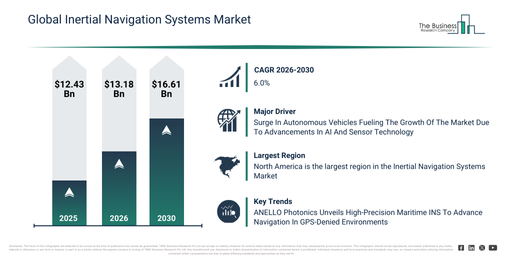
The inertial navigation systems market has shown robust expansion in recent years. Forecasts indicate its expansion from $12.43 billion in 2025 to $13.18 billion in 2026, with a compound annual growth rate (CAGR) of 6.0%. This historical growth can be attributed to key developments such as the evolution of early gyroscope and accelerometer technologies for navigation, the uptake of inertial navigation systems in aerospace and defense applications, the rise of industrial and railway navigation solutions, advancements in surveying and mapping using INS technology, and government-funded programs for precise navigation in GPS-denied environments.
The inertial navigation systems market size is anticipated to experience substantial expansion over the coming years. It is projected to reach $16.61 billion by 2030, exhibiting a compound annual growth rate (CAGR) of 6.0%. This growth during the forecast period can be primarily attributed to factors such as the increasing demand for INS in autonomous vehicles and drones, the expansion of industrial and marine navigation applications, ongoing advancements in micro-electromechanical systems (MEMS) INS technologies, the integration of artificial intelligence (AI) and sensor fusion for improved navigation accuracy, and rising investment in personal and foot-mounted INS for both military and commercial use. Concurrently, major trends expected in this period include a heightened demand for GPS-denied navigation solutions, broader adoption within unmanned and autonomous platforms, the expansion of MEMS-based INS into commercial applications, continuous miniaturization and performance enhancement of sensors, and increasing deployment in surveying, mapping, and industrial automation.
Request Your Free Inertial Navigation Systems Market Sample With Segment And Regional Data:
Inertial Navigation Systems Market Growth Drivers And Their Impact On Future Demand
The increasing need for autonomous vehicles is anticipated to drive the expansion of the inertial navigation systems market in the future. Autonomous vehicles are self-driving cars that operate and navigate without human input, relying on sensors, software, and artificial intelligence. Progress in AI and sensor technology fuels the escalating demand for autonomous vehicles due to their ability to improve transportation safety, efficiency, and convenience. Inertial navigation systems (INS) find application in autonomous vehicles, offering accurate real-time positioning and motion tracking, even where GPS is unavailable, thereby guaranteeing precise navigation and operational stability. For instance, data from Salvi, Schostok & Pritchard P.C., a US-based law firm, indicates that approximately 58 million self-driving cars are projected to be sold by 2030, based on projections from 2025. Furthermore, the Department for Science, Innovation, and Technology (DSIT), a UK-based geospatial commission, reported in October 2023 that in the United Kingdom, up to 40% of automobiles could feature autonomous driving capabilities by 2035. Consequently, the growing demand for autonomous vehicles is a key factor propelling the expansion of the inertial navigation systems market.
What Categories Define The Inertial Navigation Systems Market?
The inertial navigation systems market covered in this report is segmented –
1) By Component: Accelerometers, Gyroscopes, Other Components
2) By Technology: Mechanical Gyro, Ring Laser Gyro, Fiber Optics Gyro, Micro-Electro-Mechanical Systems, Other Technologies
3) By Grade: Aircraft Grade, Marine Grade, Space Grade, Tactical Grade, Other Grades
4) By Application: Space Launch Vehicles, Unmanned Ground Vehicles, Missiles, Unmanned Aerial Vehicles, Aircraft, Military Armored Vehicles, Marine, Unmanned Marine Vehicles
5) By End User Industry: Automotive, Commercial Aviation, Marine, Military and Defense
Subsegments:
1) By Accelerometers: Mechanical Accelerometers, Micro-Electro-Mechanical Systems Accelerometers, Fiber Optic Accelerometers, Ring Laser Accelerometers, Quartz Accelerometers
2) By Gyroscopes: Mechanical Gyroscopes, Micro-Electro-Mechanical Systems Gyroscopes, Ring Laser Gyroscopes (RLG), Fiber Optic Gyroscopes (FOG), Hemispherical Resonator Gyroscopes (HRG), Dynamically Tuned Gyroscopes (DTG)
3) By Other Components: Magnetometers, Navigation Processors, Inertial Measurement Units (IMUs), GPS Receivers, Control Systems
What New Developments Are Emerging In The Inertial Navigation Systems Market?
Major companies operating in the inertial navigation systems market are focusing on developing innovative systems, such as maritime inertial navigation systems, to meet the growing demand for maritime applications. A maritime inertial navigation system (INS) functions as a self-contained navigation solution deployed on ships and submarines to determine their position, velocity, and orientation (attitude) without relying on external references like GPS. For instance, in January 2025, ANELLO Photonics, a US-based company specializing in silicon photonics optical gyroscopes, introduced the ANELLO Maritime INS, a state-of-the-art Inertial Navigation System (INS) specifically engineered for maritime use. This breakthrough technology enhances navigation capabilities for marine operations in environments where GPS signals are unavailable or vulnerable to spoofing. The launch underscores a significant step forward in providing reliable navigation solutions for challenging maritime conditions. The ANELLO Maritime INS integrates advanced SiPhOG technology for precise and robust performance.
Major Players Driving Competition In The Inertial Navigation Systems Market
Major companies operating in the inertial navigation systems market are Robert Bosch GmbH, RTX Corporation, Northrop Grumman Corporation, Honeywell International Inc., Safran SA, Thales Group, Parker Hannifin Corporation, TDK Corporation, STMicroelectronics N.V., Teledyne Technologies Inc., Trimble Inc., Moog Inc., MEMSIC Inc., iMAR Navigation GmbH, VectorNav Technologies LLC, Oxford Technical Solutions Ltd., SBG Systems S.A.S., Inertial Labs Inc., Point One Navigation, Tersus GNSS Inc.
View The Comprehensive Inertial Navigation Systems Market Analysis:
Inertial Navigation Systems Market Regional Leaders: Insights From The 2026 Report
North America was the largest region in the inertial navigation systems market in 2025. Asia-Pacific is expected to be the fastest-growing region in the forecast period. The regions covered in the inertial navigation systems market report are Asia-Pacific, South East Asia, Western Europe, Eastern Europe, North America, South America, Middle East, Africa.
Reach Out To Our Team:
The Business Research Company: https://www.thebusinessresearchcompany.com/
Americas: +1 310-496-7795
Asia: +44 7882 955267 & +91 8897263534
Europe: +44 7882 955267
Email us at: marketing@tbrc.info
Follow us on:
LinkedIn: https://in.linkedin.com/company/the-business-research-company
YouTube: https://www.youtube.com/channel/UC24_fI0rV8cR5DxlCpgmyFQ
Global Market Model: https://www.thebusinessresearchcompany.com/global-market-model

Wasay has over a decade of experience in market research, data modelling, and analytics, with prior experience at GlobalData and Decision Tree Consulting Services. At The Business Research Company , he leads research operations across syndicated studies, customized consulting engagements, and the Global Market Model platform. His professional experience includes supporting organizations such as Boston Consulting Group, KPMG, and Ernst & Young. Wasay holds a degree in Electronics and Communications Engineering, postgraduate management qualifications from International Management Institute Belgium and Indian School of Business and Entrepreneurship, and completed the Integrated Program in Business Analytics from Indian Institute of Management Indore.