The Business Research Company’s 2026 market reports are designed to deliver research that is more actionable and strategically valuable. Key offerings include market attractiveness scoring, total addressable market sizing, company benchmarking matrices, interactive Excel dashboards, deeper supply chain intelligence, emerging startup tracking, and granular product-level insights.
Which Factors Will Shape The Military aircraft communication avionics Market Size Through 2030?
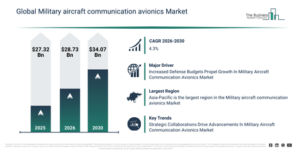
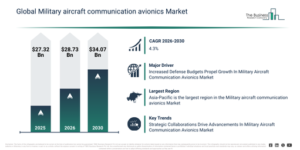
Significant growth has been observed in the military aircraft communication avionics market size recently. Looking ahead, its size is projected to increase from $27.32 billion in 2025 to $28.73 billion in 2026, demonstrating a compound annual growth rate (CAGR) of 5.2%. Factors contributing to its historical growth include the increasing deployment of sophisticated communication avionics to facilitate secure exchange of mission-critical data, a greater uptake of signal intercept systems for improved situational awareness in challenging environments, the rising application of noise jammers and electronic countermeasures designed to safeguard military aircraft against adversarial radar, the broadening integration of passive decoy (chaff) and active decoy mechanisms to boost survivability, and ongoing advancements in avionics architecture, which enhance compatibility across various aircraft platforms.
The military aircraft communication avionics market is set for sustained expansion over the next few years, with projections indicating it will climb to $34.07 billion in 2030, demonstrating a compound annual growth rate (CAGR) of 4.3%. This anticipated growth during the forecast period is driven by increased investments in advanced electronic warfare suites that integrate communication and jamming capabilities, a growing embrace of AI-enabled communication avionics for autonomous threat detection and response, the expansion of interoperable communication systems to support joint and coalition missions, the accelerating development of lightweight and modular avionics systems for both upgraded and new aircraft platforms, and the creation of sophisticated decoy technologies designed to counteract emerging radar and missile threats. Significant trends expected during this period encompass advanced signal intercept systems, next-generation noise jammers, integrated passive and active decoy systems, secure military data links, and multi-band communication systems.
Request A Free Military aircraft communication avionics Market Sample To Support Your Strategic Planning:
What Is Propelling The Military aircraft communication avionics Market Toward $34.07 Billion By 2030?
An expanding defense budget is anticipated to boost the military aircraft communication avionics market’s expansion. A defense budget represents government financial allocations earmarked for national defense and military expenses. The impetus behind the defense budget stems from the necessity to counter emerging global security risks and to improve military preparedness and technological prowess. A rising defense budget directly fuels the demand for sophisticated communication systems in military aircraft, which are vital for dependable and secure command and control during operations. For example, in April 2024, the Stockholm International Peace Research Institute (SIPRI), a Sweden-based international research institute, reported that global military spending reached $2.443 trillion in 2023, reflecting a 6.8% increase in real terms over 2022. Consequently, the expansion of the defense budget is propelling the growth of the military aircraft communication avionics market.
What Are The Key Segments And Subsegments In The Military aircraft communication avionics Market?
The military aircraft communication avionics market covered in this report is segmented –
1) By Component: Antenna, Receiver, Transmitter, Display And Processors
2) By Aircraft Type: Training Aircraft And Helicopters, Combat Aircraft, Special Mission Aircraft, Tanker And Transport Aircraft, Combat Helicopters
3) By Solution: Satellite Communications(SATCOM), Very High Frequency(VHF) And Ultra High Frequency(UHF), High Frequency(HF) And MF(Medium Frequency)
4) By Sales Channel: Original Equipment Manufacturer(OEM), Aftermarket
Subsegments:
1) By Antenna: Communication Antennas, Navigation Antennas, Surveillance Antennas
2) By Receiver: VHF Or UHF Receivers, Satellite Communication Receivers, ELINT Or INT Receivers
3) By Transmitter: VHF Or UHF Transmitters, Satellite Communication Transmitters, Digital Transmitters
4) By Display And Processors: Control Displays, Data Processing Units, Integrated Display Systems
Military aircraft communication avionics Market Trends Behind The 4.3% CAGR Forecast
Leading companies in the military aircraft communication avionics market are concentrating on employing strategic partnerships to introduce advanced solutions and gain a competitive edge. These collaborations are pivotal in the military aircraft communication avionics market, as they facilitate the creation and incorporation of sophisticated technologies and systems for military aircraft. For instance, in August 2024, the United States Air Force, a US-based air service, unveiled the Special Mission Display Processor (SMDP) during various military exercises and operations. Developed by the U.S. Air Force and Lockheed Martin with Green Hills Software, the SMDP serves as an onboard operating system designed to manage both secure and unsecured data within aircraft. Introduced after years of development, it significantly enhances the C-130J Super Hercules’s software and hardware integration. This upgrade consequently boosts its versatility for missions such as troop transport and cargo logistics. With over 1.2 million flight hours, the C-130J continues to be essential for global military operations.
Major Companies Profiled In The Military aircraft communication avionics Market Report
Major companies operating in the military aircraft communication avionics market are L3 Harris Technologies Inc., Raytheon Technologies Corporation, Lockheed Martin Corporation, Northrop Grumman Corporation, Thales Group, BAE Systems Plc., Honeywell Internatonal Inc., Elbit Systems Ltd., Genesys Aero systems, Moog Inc., Sagetech Avionics Inc., Iridium communications, Collins Aerospace, General Dynamics Corporation, Cobham plc, Viasat Inc., Saab AB, Aselsan A.S., Leonardo S.p.A., Airbus SE, Boeing Company, Kratos Defense & Security Solutions Inc., Comtech Telecommunications Corp., General Electric Company, Rohde & Schwarz GmbH & Co. KG, Orbit Communications Systems Ltd.
Explore The Business Research Company’s Complete Military aircraft communication avionics Market Report:
Where Does The Military aircraft communication avionics Market Generate The Most Revenue?
Asia-Pacific was the largest region in the military aircraft communication avionics market in 2025. The regions covered in the military aircraft communication avionics market report are Asia-Pacific, South East Asia, Western Europe, Eastern Europe, North America, South America, Middle East, Africa.
Reach Out To Our Team:
The Business Research Company: https://www.thebusinessresearchcompany.com/
Americas: +1 310-496-7795
Asia: +44 7882 955267 & +91 8897263534
Europe: +44 7882 955267
Email us at: marketing@tbrc.info
Follow us on:
LinkedIn: https://in.linkedin.com/company/the-business-research-company
YouTube: https://www.youtube.com/channel/UC24_fI0rV8cR5DxlCpgmyFQ
Global Market Model: https://www.thebusinessresearchcompany.com/global-market-model

Wasay has over a decade of experience in market research, data modelling, and analytics, with prior experience at GlobalData and Decision Tree Consulting Services. At The Business Research Company , he leads research operations across syndicated studies, customized consulting engagements, and the Global Market Model platform. His professional experience includes supporting organizations such as Boston Consulting Group, KPMG, and Ernst & Young. Wasay holds a degree in Electronics and Communications Engineering, postgraduate management qualifications from International Management Institute Belgium and Indian School of Business and Entrepreneurship, and completed the Integrated Program in Business Analytics from Indian Institute of Management Indore.