The Business Research Company’s 2026 market reports combine market attractiveness scoring, total addressable market sizing, company benchmarking matrices, interactive Excel dashboards, deeper supply chain intelligence, emerging startup tracking, and granular product-level insights to deliver research that is more actionable and strategically valuable.
In-Orbit Servicing Robotics Market Value Projected To Grow At A 13.1% Compound Annual Growth Rate Through 2030
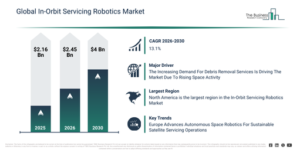
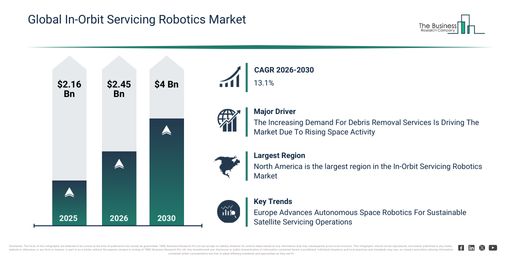
The in-orbit servicing robotics market has experienced substantial growth in recent times. This market is predicted to expand from $2.16 billion in 2025 to $2.45 billion by 2026, achieving a compound annual growth rate (CAGR) of 13.3%. Historically, this expansion has been driven by the early integration of robotic arms for satellite upkeep, the development of autonomous docking and capture mechanisms, the initial deployment of dexterous manipulators for replacing components, an increase in orbit optimization and payload transfer services, and the establishment of satellite relocation and end-of-life decommissioning solutions.
The in-orbit servicing robotics market is anticipated to experience substantial growth over the coming years. Its valuation is projected to reach $4 billion in 2030, exhibiting a compound annual growth rate (CAGR) of 13.1%. This expansion during the forecast period is primarily driven by the increasing deployment of modular robotic platforms for multi-satellite servicing, a heightened demand for autonomous reconfiguration and repair tasks, the integration of sophisticated guidance and navigation systems, the rise in orbital tug and satellite relocation services, and the growing adoption of in-orbit testing and calibration solutions. Key trends foreseen in this period encompass the incorporation of modular robotic platforms, innovations in on-orbit satellite life extension, active space debris removal technologies, autonomous docking and capture mechanisms, and multi-mission robotics designed for satellite reconfiguration.
Evaluate The In-Orbit Servicing Robotics Market Report Before You Buy With A Free Sample:
In-Orbit Servicing Robotics Market Growth Driver Analysis For The 2026–2030 Forecast Period
The expanding need for debris removal services is projected to drive the growth of the in-orbit servicing robotics market in the future. These services encompass space-based operations and technologies developed to locate, retrieve, and either safely eliminate or reposition inactive satellites, used rocket stages, and various other orbital debris. The rising requirement for debris removal stems from the rapid growth in space activities, leading to increased orbital crowding and potential collision hazards. In-orbit servicing robotics address this requirement by facilitating efficient and economical debris removal or repositioning, thereby promoting safer and more sustainable space operations. As an illustration, in July 2024, data from the Office of Space Commerce, a key US unit for space commerce policy within the Department of Commerce, revealed that the United States Department of Defense is presently tracking over 45,200 space objects. This figure includes approximately 10,200 active satellites and 18,800 pieces of debris, with specialists estimating that more than one million additional fragments are too small for current tracking methods. Consequently, the heightened demand for debris removal services is propelling the in-orbit servicing robotics market.
In-Orbit Servicing Robotics Market Segmentation Breakdown: Primary And Secondary Categories
The in-orbit servicing robotics market covered in this report is segmented –
1) By Service Type: Life Extension, Refueling, Repair And Maintenance, Assembly, Debris Removal, Other Services
2) By Robot Type: Remotely Operated, Autonomous
3) By Application: Commercial, Defense, Scientific Research, Other Applications
4) By End-User: Satellite Operators, Space Agencies, Defense Organizations, Other End-Users
Subsegments:
1) By Life Extension: Station Keeping, Orbit Raising, Attitude Control Adjustment, Component Replacement, Satellite Upgrading
2) By Refueling: Fuel Transfer, Pressurant Transfer, Fuel Tank Augmentation, Cryogenic Propellant Transfer, On-Orbit Fuel Storage
3) By Repair And Maintenance: Component Repair, System Diagnostics, Hardware Replacement, Software Updates, Structure Reinforcement
4) By Assembly: Modular Component Integration, Large Structure Construction, Antenna Deployment, Solar Array Installation, Spacecraft Reconfiguration
5) By Debris Removal: Active Debris Capture, Deorbiting Services, Collision Avoidance Support, Disposal Of Defunct Satellites, Tethered Removal Systems
6) By Other Services: Inspection Services, Testing And Calibration, Payload Transfer, Orbit Optimization, End OF Life Decommissioning
In-Orbit Servicing Robotics Market Industry Trends: New Developments From Leading Companies
Leading companies within the in-orbit servicing robotics market are concentrating on creating sophisticated solutions, such as autonomous in-orbit servicing vehicles, to showcase and validate advanced robotic servicing functionalities that boost the lifespan, operational capability, and sustainability of satellites in orbit. An autonomous in-orbit servicing vehicle is defined as a spacecraft equipped with robotic systems capable of independently performing maintenance, refueling, upgrades, relocation, or de-orbiting services for other satellites already operational in space. For example, in May 2023, Thales Alenia Space, a France-based space systems company and joint venture between Thales and Leonardo specializing in satellite systems and space infrastructure, secured a $273 million (€235 million) contract from the Italian Space Agency. This agreement is for the design, development, and qualification of an autonomous robotic vehicle for an in-orbit servicing demonstration mission. This vehicle integrates an advanced spacecraft platform with a dexterous robotic arm to execute complex tasks like refueling, component repair or replacement, orbital transfers, and controlled re-entry of satellites. The project signifies a key progression in advancing Europe’s autonomous space robotics capabilities, contributing to more sustainable, flexible, and cost-effective satellite operations.
Who Are The Top Competitors In The In-Orbit Servicing Robotics Market?
Major companies operating in the in-orbit servicing robotics market are Airbus SE, Northrop Grumman Corporation, Blue Origin, Thales Alenia Space, MDA Space Ltd., Sierra Space, Redwire Corporation, Voyager Space Holdings, Inc., D-Orbit S.p.A., ClearSpace SA, GITAI, Starfish Space, Astroscale Holdings Inc., Space Applications Services, Skycorp Inc., Orbit Fab, Turion Space Corp., Motiv Space Systems, PIAP Space, Infinite Orbits, Kurs Orbital, OrbitAID Aerospace, Momentus Inc., Kinetik Space, WorkerInSpace.
Access The In-Orbit Servicing Robotics Market Report For Complete Segment-Level Analysis:
Which Region Leads The In-Orbit Servicing Robotics Market, And Which Regions Are Covered?
North America was the largest region in the in-orbit servicing robotics market in 2025. Asia-Pacific is expected to be the fastest-growing region in the forecast period. The regions covered in the in-orbit servicing robotics market report are Asia-Pacific, South East Asia, Western Europe, Eastern Europe, North America, South America, Middle East, Africa.
Reach Out To Our Team:
The Business Research Company: https://www.thebusinessresearchcompany.com/
Americas: +1 310-496-7795
Asia: +44 7882 955267 & +91 8897263534
Europe: +44 7882 955267
Email us at: marketing@tbrc.info
Follow us on:
LinkedIn: https://in.linkedin.com/company/the-business-research-company
YouTube: https://www.youtube.com/channel/UC24_fI0rV8cR5DxlCpgmyFQ
Global Market Model: https://www.thebusinessresearchcompany.com/global-market-model

Wasay has over a decade of experience in market research, data modelling, and analytics, with prior experience at GlobalData and Decision Tree Consulting Services. At The Business Research Company , he leads research operations across syndicated studies, customized consulting engagements, and the Global Market Model platform. His professional experience includes supporting organizations such as Boston Consulting Group, KPMG, and Ernst & Young. Wasay holds a degree in Electronics and Communications Engineering, postgraduate management qualifications from International Management Institute Belgium and Indian School of Business and Entrepreneurship, and completed the Integrated Program in Business Analytics from Indian Institute of Management Indore.