The Business Research Company’s 2026 market reports are designed to deliver research that is more actionable and strategically valuable. Key offerings include market attractiveness scoring, total addressable market sizing, company benchmarking matrices, interactive Excel dashboards, deeper supply chain intelligence, emerging startup tracking, and granular product-level insights.
Military Embedded Systems Market Size 2026: Valuation, Growth Rate And Forecast To 2030
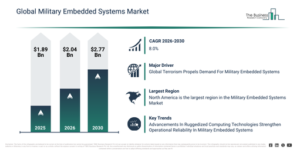
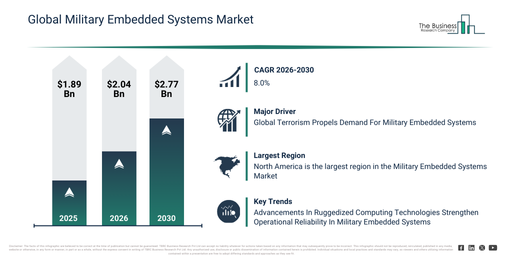
The military embedded systems market size has demonstrated robust growth in recent years. It is forecast to expand from $1.89 billion in 2025 to $2.04 billion in 2026, with a compound annual growth rate (CAGR) of 8.1%. The expansion observed in the past can be attributed to the increased deployment of embedded systems to support intelligence and reconnaissance missions, enhanced integration of embedded computing platforms into radar and navigation systems, a growing demand for rugged and mission-critical hardware capable of functioning in extreme environments, advancements in real-time processing technologies that improve battlefield decision-making, and the broadening of command-and-control modernization programs requiring reliable embedded architectures.
The military embedded systems market size is projected to experience substantial growth in the coming years. It is anticipated to reach $2.77 billion in 2030, demonstrating a compound annual growth rate (CAGR) of 8.0%. This expansion during the forecast period is attributed to the growing adoption of AI-enabled embedded systems for autonomous threat detection and mission execution, an increasing demand for modular open systems architecture facilitating rapid system upgrades, the expansion of embedded solutions supporting multi-domain operations and data fusion, rising investment in cyber-secure embedded platforms to protect mission-critical information, and the development of high-performance, low-power embedded processors optimized for next-generation defense applications. Key trends expected in this period include real-time data processing and analysis, the integration of multi-sensor systems, miniaturization and low-power hardware, enhanced cybersecurity for embedded systems, and modular and upgradable embedded platforms.
Get A Free Sample Of The Military Embedded Systems Market Report 2026:
What Is Driving The Growth Of The Military Embedded Systems Market?
The escalating global terrorism is anticipated to drive the expansion of the military embedded systems market going forward. Terrorism describes a non-state actor employing or threatening unlawful force and violence to achieve political, economic, religious, or social aims through fear, coercion, or intimidation. The increasing danger from terrorist activities is largely propelled by the growth of extremist groups across conflict zones and unstable regions, which leads to more frequent and complex coordinated attacks targeting civilian populations and vital infrastructure. Military embedded systems assist in countering terrorism by offering real-time Intelligence, Surveillance, and Reconnaissance (ISR) capabilities that enable forces to swiftly detect, track, and neutralize threats, while also improving communication, data analysis, and precision targeting for quicker and more effective mission responses. For instance, in February 2024, according to the Institute for Economics & Peace (IEP), an Australia-based non-profit think tank, terrorism continues to present a significant global threat, with total deaths climbing to 8,352 in 2023, an increase from 6,823 in 2022. Consequently, the worldwide rise in terrorism fuels the military embedded systems market.
How Is The Military Embedded Systems Market Segmented?
The military embedded systems market covered in this report is segmented –
1) By Component: Hardware, Software
2) By Installation Type: New installation, Upgradation
3) By Platform: Land, Airborne, Naval, Space
4) By Technology: Edge Computing, Fog Computing, Mist Computing
5) By Application: Intelligence, Surveillance, And Reconnaissance (ISR), Command And Control, Communication And Navigation, Electronic Warfare (EW), Weapon And Fire Control, Wearable, Other Applications
Subsegments:
1) By Hardware: Processors, Memory, Input Or Output Devices, Communication Interfaces, Sensors
2) By Software: Operating Systems, Middleware, Application Software, Development Tools
What Are The Latest Trends In The Military Embedded Systems Market?
Leading companies in the military embedded systems market are prioritizing the development of advanced solutions, such as extreme-rugged, waterproof embedded computing platforms, to bolster mission resilience and operational reliability. These robust, waterproof platforms are engineered to endure harsh environments by incorporating strong sealing ratings, hardened chassis materials, and military-grade shock and vibration compliance, ensuring reliable operation under severe conditions. For instance, in February 2024, Neousys Technology, a Taiwan-based supplier of rugged embedded systems, introduced its SEMIL-2000 series, featuring IP69K-rated waterproof and shock-hardened embedded computers. The new SEMIL-2000 series supports Intel 14th/13th/12th Gen LGA1700 processors and offers a variant with an NVIDIA L4 GPU. Its chassis combines corrosion-proof stainless steel and aluminum, and the system adheres to MIL-STD-810H standards for shock and vibration in dusty, humid, and corrosive environments. These systems can operate from 40°C to 70°C, and the IP69K rating allows them to withstand high-pressure 80°C water jets from various angles. They support a DC input of 8 V to 48 V with ignition power control and reverse polarity protection, utilize M12 connectors, and include seven Ethernet ports (two 10 GbE, one GbE, and four 2.5 GbE PoE+) plus two USB 3.2 Gen1 Type-C ports with DisplayPort alternate mode.
Who Are The Key Players In The Military Embedded Systems Market?
Major companies operating in the military embedded systems market are Xilinx Inc., Mercury Systems Inc., Curtiss-Wright Corporation, Kontron (S&T), SMART Embedded Computing, Advantech Co Ltd., Thales Group, Abaco Systems, Microsemi Corporation, General Micro Systems Inc., BAE Systems, Intel Corporation, Radisys Corporation, Telephonics Corporation, General Dynamics Corporation, Raytheon Company, Rockwell Collins, AMETEK, Saab AB, Boeing, Concurrent Technologies, Crystal Group Inc., Elma Electronic Inc., Excalibur Systems, Northrop Grumman Corporation, ECRIN Systems, Harris Corporation, Honeywell International Inc., IBM Corporation
Read The Complete Military Embedded Systems Market Report 2026:
Which Region Is The Largest In The Military Embedded Systems Market?
North America was the largest region in the military embedded systems market in 2025. Asia-Pacific is expected to be the fastest-growing region in the military embedded systems market report during the forecast period. The regions covered in the military embedded systems market report are Asia-Pacific, South East Asia, Western Europe, Eastern Europe, North America, South America, Middle East, Africa.
Reach Out To Our Team:
The Business Research Company: https://www.thebusinessresearchcompany.com/
Americas: +1 310-496-7795
Asia: +44 7882 955267 & +91 8897263534
Europe: +44 7882 955267
Email us at: marketing@tbrc.info
Follow us on:
LinkedIn: https://in.linkedin.com/company/the-business-research-company
YouTube: https://www.youtube.com/channel/UC24_fI0rV8cR5DxlCpgmyFQ
Global Market Model: https://www.thebusinessresearchcompany.com/global-market-model

Wasay has over a decade of experience in market research, data modelling, and analytics, with prior experience at GlobalData and Decision Tree Consulting Services. At The Business Research Company , he leads research operations across syndicated studies, customized consulting engagements, and the Global Market Model platform. His professional experience includes supporting organizations such as Boston Consulting Group, KPMG, and Ernst & Young. Wasay holds a degree in Electronics and Communications Engineering, postgraduate management qualifications from International Management Institute Belgium and Indian School of Business and Entrepreneurship, and completed the Integrated Program in Business Analytics from Indian Institute of Management Indore.