Market attractiveness scoring, total addressable market sizing, company benchmarking matrices, interactive Excel dashboards, deeper supply chain intelligence, emerging startup tracking, and granular product-level insights are among the key offerings featured in The Business Research Company’s 2026 market reports, designed to deliver more actionable and strategically valuable research.
Military Exoskeleton Market Valued At $1.4 Billion In 2026, Projected To Reach $2.25 Billion By 2030
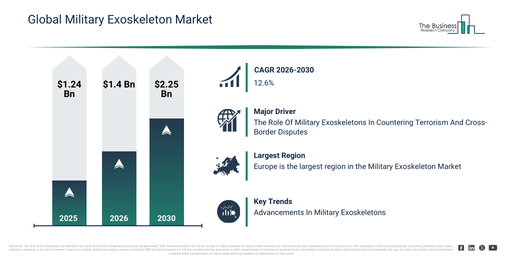
The military exoskeleton market has expanded quickly in recent years. This market is projected to expand from $1.24 billion in 2025 to $1.4 billion in 2026, exhibiting a compound annual growth rate (CAGR) of 12.8%. Historically, this growth can be ascribed to a heightened emphasis on reducing soldier fatigue, which propelled the adoption of early exoskeleton prototypes. Other contributing factors include a rising demand for improved load-carrying capabilities, supporting the deployment of unpowered exoskeletons; advancements in powered exoskeleton technology that boosted mobility and endurance; an increase in military research programs evaluating human-performance augmentation systems; and the expansion of field trials confirming the operational benefits of wearable support devices.
The military exoskeleton market size is anticipated to undergo significant expansion in the upcoming years, projected to reach $2.25 billion in 2030 at a compound annual growth rate (CAGR) of 12.6%. This growth in the forecast period can be attributed to the development of lightweight and energy-efficient exoskeleton materials that enhance usability and mission duration, the increasing integration of sensors and AI control systems enabling adaptive movement assistance, rising investment in next-generation soldier modernization programs boosting exoskeleton procurement, a growing emphasis on injury prevention and ergonomics driving wider adoption across military units, and advancements in battery and power management technologies improving the performance of powered exoskeleton systems. Major trends observed during this period include the rising adoption of load-carrying and physical augmentation exoskeletons, the creation of lightweight and ergonomic designs, seamless integration with human-machine and human-computer interfaces, an expansion in rehabilitation and soldier performance enhancement applications, and the proliferation of battery-efficient and hybrid-powered exoskeleton systems.
Request A Complimentary Military Exoskeleton Market Research Sample:
Key Factor Propelling The Military Exoskeleton Market Forward
The increasing frequency of terrorist actions and international border conflicts is anticipated to drive the expansion of the military exoskeleton market in the future. Terrorism involves the deliberate application of violence or threats to achieve political, religious, or ideological goals through fear or compulsion among the populace. Cross-border disputes are defined as legal disagreements or conflicts that occur between entities or individuals spanning various nations. Employing military exoskeletons boosts soldiers’ physical capabilities, such as strength, agility, and endurance, thus increasing their preparedness for responding to terrorist assaults. For example, in February 2024, The Institute for Economics and Peace, an Australia-based international think tank, reported that terrorist attacks in 2023 were deadlier, accounting for 2.5 deaths per attack versus 1.6 in 2022. Consequently, the escalating incidence of terrorist activities and cross-border disputes is fueling the growth of the military exoskeleton market in the upcoming period.
Military Exoskeleton Market Segments And Subsegments Explained
The military exoskeleton market covered in this report is segmented –
1) By Type: Full-body Exoskeleton, Partial-body Exoskeleton
2) By Power: Active Exoskeleton, Passive Exoskeleton
3) By Operation: Battery-powered, Cable-powered
4) By Application: Physical Augmentation, Human-machine Interface, Human-computer Interface
Subsegments:
1) By Full-body Exoskeleton: Powered Full-body Exoskeletons, Passive Full-Body Exoskeletons, Rehabilitation Full-body Exoskeletons, Load-Carrying Full-body Exoskeletons
2) By Partial-Body Exoskeleton: Lower-Limb Exoskeletons, Upper-Limb Exoskeletons, Exoskeletons For Specific Tasks, Hybrid Exoskeletons
Emerging Trends Transforming The Military Exoskeleton Market
Leading companies within the military exoskeleton market are focusing on developing advanced solutions, including personal protection technology, to enhance soldier safety and increase combat efficiency. Personal protection technology refers to devices, equipment, or systems designed to safeguard individuals from physical harm or injury. It serves to improve physical defense against ballistic threats while also offering increased strength, endurance, and mobility. Such technologies aid in redistributing the weight of heavy loads, reducing fatigue, and boosting combat effectiveness, all without compromising high levels of protection. For instance, in January 2024, Mehler Protection, a Germany-based division of Mehler Systems specializing in advanced ballistic protection, introduced the ExoM Up-Armoured Exoskeleton, created for military and law enforcement applications. This innovative exoskeleton integrates superior ballistic protection with exceptional load-bearing capabilities, providing unparalleled comfort and safety. Its key attributes encompass load redistribution, enhanced ballistic protection, and improved mobility, signifying a major advancement in personal protective technology.
Military Exoskeleton Market Key Players: Major Companies In The 2026 Report
Major companies operating in the military exoskeleton market are Lockheed Martin Corporation, Sarcos Technology and Robotics Corporation, Aselsan Elektronik Sanayi ve Ticaret AS, Dephy Inc., Rostec State Corporation, BAE Systems plc, General Atomics, Raytheon Technologies Corporation, Ekso Bionics Holdings Inc., SpringActive Inc., Safran SA, General Dynamics Corporation, CYBERDYNE INC., Bionic Power Inc., B-Temia, Boeing, Honeywell Aerospace, QinetiQ Group plc, Hunter Defense Technologies Inc, Fifth Dimension Technologies, Endeavor Robotics, EXHAUSS Exoskeletons
Explore The Full Military Exoskeleton Market Report With Forecasts To 2030:
Military Exoskeleton Market By Region: Where Is Demand Strongest?
Europe was the largest region in the military exoskeleton market in 2025.North America is expected to be the fastest-growing region in the global military exoskeleton market report during the forecast period. The regions covered in the military exoskeleton market report are Asia-Pacific, South East Asia, Western Europe, Eastern Europe, North America, South America, Middle East, Africa.
Reach Out To Our Team:
The Business Research Company: https://www.thebusinessresearchcompany.com/
Americas: +1 310-496-7795
Asia: +44 7882 955267 & +91 8897263534
Europe: +44 7882 955267
Email us at: marketing@tbrc.info
Follow us on:
LinkedIn: https://in.linkedin.com/company/the-business-research-company
YouTube: https://www.youtube.com/channel/UC24_fI0rV8cR5DxlCpgmyFQ
Global Market Model: https://www.thebusinessresearchcompany.com/global-market-model

Wasay has over a decade of experience in market research, data modelling, and analytics, with prior experience at GlobalData and Decision Tree Consulting Services. At The Business Research Company , he leads research operations across syndicated studies, customized consulting engagements, and the Global Market Model platform. His professional experience includes supporting organizations such as Boston Consulting Group, KPMG, and Ernst & Young. Wasay holds a degree in Electronics and Communications Engineering, postgraduate management qualifications from International Management Institute Belgium and Indian School of Business and Entrepreneurship, and completed the Integrated Program in Business Analytics from Indian Institute of Management Indore.