Enhanced with market attractiveness analysis, total addressable market evaluation, company benchmarking matrices, interactive Excel dashboards, expanded supply chain intelligence, emerging startup coverage, and detailed product insights, The Business Research Company’s 2026 market reports deliver more actionable and strategically valuable research.
Nonresidential Green Buildings Market Growth Potential: How Will Market Size Change Through 2030?
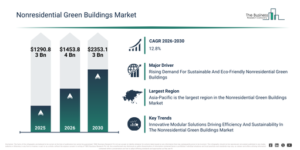
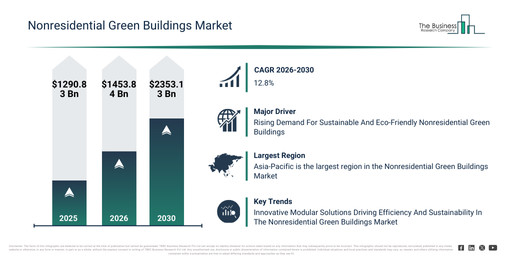
The nonresidential green buildings market size has expanded considerably in recent years. It is anticipated to grow from $1290.83 billion in 2025 to $1453.84 billion in 2026, demonstrating a compound annual growth rate (CAGR) of 12.6%. This historical expansion can be attributed to the early adoption of eco-friendly materials, an increase in commercial green building certifications, rising awareness of environmental sustainability, heightened investment in green retrofitting, and the expansion of regulatory incentives for sustainable construction.
The market size for nonresidential green buildings is projected to experience swift expansion over the coming years. This market is anticipated to reach $2353.13 billion by 2030, demonstrating a compound annual growth rate (CAGR) of 12.8%. Several factors will fuel this expansion during the forecast period, including a growing appetite for intelligent green structures, broader implementation of renewable energy systems, an increased emphasis on carbon-neutral building techniques, the rise of construction methods rooted in the circular economy, and increased spending on advanced green materials. Key developments expected during the forecast timeframe involve the increasing embrace of green-certified architectural plans, a greater utilization of construction materials with low emissions, heightened interest in energy-efficient nonresidential constructions, an increase in environmentally friendly refurbishment and upgrade initiatives, and boosted funding for systems designed for water preservation and waste minimization.
Download A Free Sample Report For Comprehensive Market Insights:
Nonresidential Green Buildings Market Industry Drivers: What Is Driving Revenue Growth?
The rising demand for sustainable and environmentally friendly approaches has fueled the expansion of the nonresidential green buildings market. A report from the USGBC (U.S. Green Building Council) indicates that green structures are capable of reducing carbon emissions by 34% and utilize 25% less energy compared to traditional buildings. As an illustration, data from April 2024, provided by the National Association of Convenience Stores (NACS), a US-based trade association for the convenience and fuel retailing industry, shows that 2024 80% of consumers reported concerns regarding the environmental impact of their acquisitions, a rise from 68% in 2023 and 66% in 2022. Consequently, the escalating requirement for sustainable and eco-friendly solutions is propelling the development of the nonresidential green buildings market.
Nonresidential Green Buildings Market Segmentation Trends And Revenue Drivers
The nonresidential green buildings market covered in this report is segmented –
1) By Product: Interior Products, Exterior Products
2) By Component: Roofing, Insulation, Framing, Exterior Siding, Interior Finishing, Other Components
3) By Application: Office, Education, Hotels and Restaurants, Retail, Institutional/ Assembly, Healthcare, Warehouse
Subsegments:
1) By Interior Products: Sustainable Flooring, Eco-Friendly Paints And Finishes, Energy-Efficient Lighting Fixtures, Green Insulation Materials, Low-VOC (Volatile Organic Compounds) Products
2) By Exterior Products: Green Roofing Systems, Sustainable Siding Materials, Energy-Efficient Windows And Doors, Rainwater Harvesting Systems, Solar Panels And Renewable Energy Solutions
#Nonresidential Green Buildings Market Growth Trends: What Is Influencing The Future Outlook?
Major companies operating within the nonresidential green buildings market are concentrating on creating innovative solutions, such as off-site manufactured room modules, to boost construction efficiency, shorten project durations, and enhance overall cost-effectiveness. Off-site manufactured room modules are defined as pre-engineered, three-dimensional building components that are fully or partially completed in a controlled factory setting, subsequently transported to the construction site for final placement or assembly. For instance, in November 2024, Module-T Prefabrik, a French manufacturer of prefabricated containers, announced its entry into the U.S. market, introducing a diverse range of modular solutions including office, sanitary, locker, and dormitory containers, as well as modular office structures designed for swift deployment in non-residential settings. Their product line encompasses factory-produced modules adaptable for various applications, such as worker accommodations, educational facilities, dining areas, and temporary or permanent workspaces. Each module incorporates the structural framework, insulation, internal finishes, and rough-ins for mechanical, electrical, and plumbing systems, and is engineered for easy crane placement and assembly on-site. Key attributes include standardized container-format modules for design versatility, a strong emphasis on environmental sustainability through minimized material waste and reduced transportation emissions, and rapid installation that lessens disturbance to surrounding areas.
#Nonresidential Green Buildings Market Industry Leaders: Which Organizations Are Driving Competition?
Major companies operating in the nonresidential green buildings market are Turner Construction Company, AECOM Technical Services Inc., Balfour Beatty Construction Inc., Whiting-Turner Contracting Company, The Whiting-Turner Contracting Company, Lendlease Americas Inc., Gilbane Building Company, PCL Construction Enterprises Inc., Hensel Phelps Construction Co., DPR Construction Inc., HITT Contracting Inc., The Walsh Group LLC, Clark Construction Group, Holder Construction Company, JE Dunn Construction Group Inc., Swinerton Builders, McCarthy Holdings Inc., Suffolk Construction Company Inc., Consigli Construction Company Inc., The Haskell Company, Ryan Companies US Inc., Austin Industries Inc., Skanska USA Civil Inc., The Beck Group Inc., The Weitz Company Inc., Mortenson Inc., The Boldt Company, Webcor Builders Inc., The Opus Group, The Korte Company, The Christman Company, The Barton Malow Company
Access The Complete Nonresidential Green Buildings Market Report:
Nonresidential Green Buildings Market Regional Analysis: Which Region Leads By Revenue?
Asia-Pacific was the largest region in the nonresidential green buildings market in 2025. Eastern Europe is expected to be the fastest-growing region in the global nonresidential green buildings market share during the forecast period. The regions covered in the nonresidential green buildings market report are Asia-Pacific, South East Asia, Western Europe, Eastern Europe, North America, South America, Middle East, Africa.
Get in touch with us:
The Business Research Company: https://www.thebusinessresearchcompany.com/
Americas: +1 310-496-7795
Asia: +44 7882 955267 & +91 8897263534
Europe: +44 7882 955267
Email us at: marketing@tbrc.info
Follow us on:
LinkedIn: https://in.linkedin.com/company/the-business-research-company
YouTube: https://www.youtube.com/channel/UC24_fI0rV8cR5DxlCpgmyFQ
Global Market Model: https://www.thebusinessresearchcompany.com/global-market-model

Wasay has over a decade of experience in market research, data modelling, and analytics, with prior experience at GlobalData and Decision Tree Consulting Services. At The Business Research Company , he leads research operations across syndicated studies, customized consulting engagements, and the Global Market Model platform. His professional experience includes supporting organizations such as Boston Consulting Group, KPMG, and Ernst & Young. Wasay holds a degree in Electronics and Communications Engineering, postgraduate management qualifications from International Management Institute Belgium and Indian School of Business and Entrepreneurship, and completed the Integrated Program in Business Analytics from Indian Institute of Management Indore.