The Business Research Company’s 2026 market reports combine market attractiveness scoring, total addressable market sizing, company benchmarking matrices, interactive Excel dashboards, deeper supply chain intelligence, emerging startup tracking, and granular product-level insights to deliver research that is more actionable and strategically valuable.
What Is The Aircraft Flight Control System Market Growth Rate? A 6% CAGR Outlook Through 2030
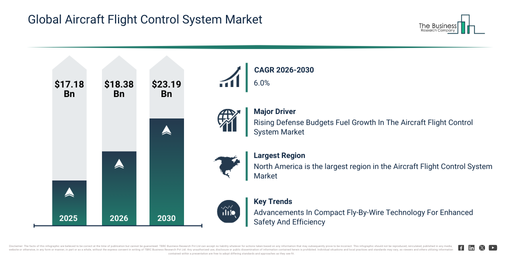
The aircraft flight control system market has experienced robust growth in recent years. This market is projected to expand from $17.18 billion in 2025 to $18.38 billion in 2026, demonstrating a compound annual growth rate (CAGR) of 7.0%. Historically, this expansion has been driven by several key factors: an increasing uptake of advanced flight control systems aimed at enhancing aircraft stability and safety; a greater integration of navigation and communication modules within the overarching flight control architecture; a rise in the need for collision-avoidance technologies across both commercial and military aircraft fleets; an increase in aircraft deliveries necessitating the installation of contemporary flight control components; and improvements in weather forecasting systems that boost flight planning efficiency and operational reliability.
The market for aircraft flight control systems is projected to experience substantial expansion over the upcoming years. It will grow to $23.19 billion in 2030 at a compound annual growth rate (CAGR) of 6.0%. This expansion during the forecast period is driven by several factors, including the increasing demand for autonomous and semi-autonomous flight control functionalities, the greater adoption of fly-by-wire and advanced digital control systems, heightened investment in integrated flight management solutions that facilitate real-time decision-making, the broader deployment of lightweight and energy-efficient control system components for new aircraft designs, and the creation of improved situational awareness tools connecting navigation and communication. Key trends anticipated during this period involve improvements in flight safety and redundancy systems, continuous real-time monitoring of aircraft performance, advancements in adaptive control system technologies, the incorporation of predictive maintenance instruments, and the optimization of human-machine interfaces.
Access A Free Sample Of The Latest Aircraft Flight Control System Market Analysis:
Why Is The Aircraft Flight Control System Market Growing? The Key Demand Driver Explained
Increasing allocations for defense are anticipated to propel the expansion of the aircraft flight control system market in the future. A defense budget represents a financial strategy or fund distribution by a government or nation, specifically designated for its defense and military operations. Aircraft flight control systems, when utilized in defense operations, offer several advantages, contributing to more cost-effective and efficient military activities, enhancing the capabilities of military aircraft, increasing the likelihood of mission success, reducing the need for costly repeat missions, and potentially saving lives. For instance, in April 2024, a report by the Stockholm International Peace Research Institute (SIPRI), a Sweden-based international research institute, revealed that global military spending reached $2.443 trillion in 2023, which signifies a 6.8% increase in real terms compared to 2022. Therefore, the growth in defense budgets is a significant catalyst for the aircraft flight control system market’s development.
What Are The Main Segments Of The Aircraft Flight Control System Market?
The aircraft flight control system market covered in this report is segmented –
1) By Type: Commercial Fixed Wing Flight Control System, Military Fixed Flight Control System, Military UAV Flight Control System, Rotary Wing Flight Control System
2) By Technology: Fly By Wire, Power By Wire, Hydromechanical Systems, Digital Fly By Wire
3) By Component: Cockpit Controls, Flight Control Computers, Aircraft Actuators, Other Components
4) By Application: Business Aviation, Commercial Aviation, Military Aviation, Other Applications
Subsegments:
1) By Commercial Fixed Wing Flight Control System: Primary Flight Control Systems, Secondary Flight Control Systems
2) By Military Fixed Wing Flight Control System: Combat Aircraft Flight Control Systems, Transport Aircraft Flight Control Systems
3) By Military UAV Flight Control System: Tactical UAV Flight Control Systems, Strategic UAV Flight Control Systems
4) By Rotary Wing Flight Control System: Helicopter Flight Control Systems, Tiltrotor Flight Control Systems
Aircraft Flight Control System Market Trend Analysis: Where Leading Companies Are Focusing
Leading companies within the aircraft flight control system market are actively developing innovative solutions, such as compact fly-by-wire (cFBW) systems, to address the growing need for heightened safety, reduced mass, and improved fuel efficiency in modern aircraft. These cFBW systems utilize electronic controls rather than mechanical linkages to offer precise and responsive handling, thereby enabling greater design flexibility and seamless integration with advanced avionics, which ultimately enhances aircraft performance and safety. As an illustration, in May 2025, Honeywell, a US-based aerospace company, announced an expanded collaboration with Vertical Aerospace, a UK-based electric aircraft manufacturer, to certify key systems for the VX4 air taxi. This alliance is centered on integrating Honeywell’s compact fly-by-wire technology into the VX4’s flight control systems, with a goal of achieving certification by 2028 and commencing initial deliveries by 2030. The compact fly-by-wire system is engineered to boost the aircraft’s maneuverability and safety while simultaneously decreasing its weight and maintenance needs. This progression underscores the industry’s move towards more efficient and advanced flight control technologies to meet the evolving demands of urban air mobility.
Which Companies Are Major Players In The Aircraft Flight Control System Market?
Major companies operating in the aircraft flight control system market are Honeywell International Inc., Moog Inc., Safran S.A., Collins Aerospace, BAE Systems PLC, Saab AB, Parker Hannifin Corporation, Raytheon Technologies Corporation, Liebherr Group, General Atomics, Lockheed Martin Corporation, Nabtesco Corporation, Woodward Inc., Curtiss-Wright Corporation, General Dynamics Mission Systems Inc., Heroux-Devtek Inc., Meggitt PLC, Northrop Grumman Corporation, Thales Group, Astronics Corporation, Crane Co., Eaton Corporation PLC, LORD Corporation, HAL Aerospace Division, Technodinamika Holding, MicroNav Limited, Sierra Nevada Corporation, Ultra Electronics Holdings PLC, Rabotti S.p.A., Wichita Aircraft Systems LLC, ShinMaywa Industries Ltd.
Get The Complete Aircraft Flight Control System Market Analysis Here:
Which Region Held The Largest Share Of The Aircraft Flight Control System Market In 2025?
North America was the largest region in the aircraft flight control system market in 2025. Asia-Pacific is expected to be the fastest-growing region in the aircraft flight control system market report forecast period. The regions covered in the aircraft flight control system market report are Asia-Pacific, South East Asia, Western Europe, Eastern Europe, North America, South America, Middle East, Africa.
Reach Out To Our Team:
The Business Research Company: https://www.thebusinessresearchcompany.com/
Americas: +1 310-496-7795
Asia: +44 7882 955267 & +91 8897263534
Europe: +44 7882 955267
Email us at: marketing@tbrc.info
Follow us on:
LinkedIn: https://in.linkedin.com/company/the-business-research-company
YouTube: https://www.youtube.com/channel/UC24_fI0rV8cR5DxlCpgmyFQ
Global Market Model: https://www.thebusinessresearchcompany.com/global-market-model

Wasay has over a decade of experience in market research, data modelling, and analytics, with prior experience at GlobalData and Decision Tree Consulting Services. At The Business Research Company , he leads research operations across syndicated studies, customized consulting engagements, and the Global Market Model platform. His professional experience includes supporting organizations such as Boston Consulting Group, KPMG, and Ernst & Young. Wasay holds a degree in Electronics and Communications Engineering, postgraduate management qualifications from International Management Institute Belgium and Indian School of Business and Entrepreneurship, and completed the Integrated Program in Business Analytics from Indian Institute of Management Indore.