Designed to make market research more actionable and strategically valuable, The Business Research Company’s 2026 market reports feature market attractiveness scoring, total addressable market sizing, company benchmarking matrices, interactive Excel dashboards, deeper supply chain intelligence, emerging startup tracking, and granular product-level insights.
Airport Smart Lighting Market Revenue Expansion Outlook For The 2026–2030 Forecast Period
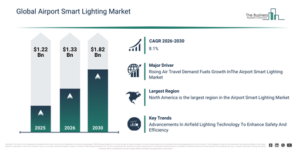
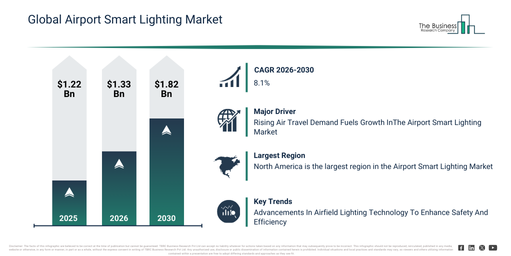
The airport smart lighting market size has shown significant growth in recent years. It is projected to increase from $1.22 billion in 2025 to $1.33 billion in 2026, with a compound annual growth rate (CAGR) of 9.5%. This historical growth can be attributed to factors such as increasing airport modernization initiatives driving the adoption of smart lighting systems, a rising focus on reducing energy consumption and operational costs through automated lighting control, advancements in sensor technologies including motion and ambient light sensors that enhance system performance, the expansion of manufacturer-provided installation and warranty-period maintenance services, and the growing integration of lighting with airport wayfinding and navigation systems.
The airport smart lighting market size is anticipated to undergo significant expansion in the coming years. It is projected to reach $1.82 billion in 2030, demonstrating a compound annual growth rate (CAGR) of 8.1%. This growth during the forecast period can be attributed to several factors: a growing demand for intelligent, adaptive lighting aimed at enhancing passenger experience and operational efficiency; the increasing integration of smart lighting with AI-driven maintenance monitoring platforms; the rising deployment of connected lighting infrastructures that support personalized services and advertising; and the expanding adoption of sustainable lighting technologies to meet environmental compliance goals. Furthermore, the expected growth in bundled lifecycle service packages, which include system upgrades, monitoring, and analytics for smart airport lighting systems, will contribute to this market expansion. Major trends identified for the forecast period encompass an increasing demand for adaptive brightness control systems, a rising use of smart lighting for queue and passenger flow management, the growing integration of lighting with airport security and surveillance, the expansion of energy-saving LED conversion projects within airport infrastructure, and an enhanced utilization of dynamic lighting to improve the passenger experience.
Download A Free Sample For In-Depth Airport Smart Lighting Market Intelligence:
Airport Smart Lighting Market Demand Driver: How It Is Shaping Industry Growth
The increasing demand for air travel is anticipated to fuel the expansion of the airport smart lighting market. Air travel involves the movement of individuals and cargo via aircraft, usually connecting various locations, regions, or nations. The rising demand for air travel stems from flights becoming more affordable and accessible, propelled by technological progress, airline competition, and the proliferation of low-cost carriers. Airport smart lighting improves air travel by boosting visibility, safety, and energy efficiency. This is achieved through dynamic adjustments responding to passenger traffic, weather, and time of day, thereby enhancing the overall airport experience and operational effectiveness. For example, data from December 2024, released by Eurostat, a Luxembourg-based government agency, showed that in 2023, 973 million passengers flew within the EU. This represented a 19.3% increase from the 816 million recorded in 2022. These figures further highlighted that every EU country observed an increase in air passenger volumes compared to the preceding year. Consequently, the escalating demand for air travel is indeed a key factor propelling the expansion of the airport smart lighting market.
Airport Smart Lighting Market Segmentation Overview: Detailed Category Analysis
The airport smart lighting market covered in this report is segmented –
1) By Type: Runway Lightings, Taxiway Lightings, Visual Glide Scope Indicator, Other Types
2) By Offering: Hardware, Services, Software
3) By Light Source: Fluorescent Lighting, Halogen Lighting, Incandescent Lighting, Light Emitting Diode (LED) Lighting
4) By Application: Airside, Airport Terminal, Airport Landside, Other Applications
Subsegments:
1) By Runway Lightings: Runway Edge Lights, Runway Threshold Lights, Runway End Lights, Runway Centerline Lights, Runway Distance Remaining Lights
2) By Taxiway Lightings: Taxiway Edge Lights, Taxiway Centerline Lights, Taxiway Turn-Off Lights, Taxiway Guidance Signs, Lead-In Lights
3) By Visual Glide Scope Indicator: PAPI (Precision Approach Path Indicator) Lights, VASI (Visual Approach Slope Indicator) Lights, Aiming Lights For Glide Path Guidance
4) By Other Types: Apron Lights, Airfield Sign Lights, Approach Lights, Obstacle Lighting, Perimeter And Security Lighting
Top Airport Smart Lighting Market Trends And Recent Industry Developments
Leading companies in the Airport Smart Lighting market are concentrating on creating advanced technologies, such as NVG-compatible runway illumination, to boost pilot visibility in dim light, improve runway security, and facilitate smoother operations during nights and unfavorable weather. This NVG-compatible runway lighting denotes airfield illumination systems engineered to be seen through night vision goggles, enabling pilots to safely maneuver runways and taxiways during nighttime or poor visibility without affecting NVG functionality. An example of this innovation is ADB SAFEGATE, a Belgium-based lighting firm, which introduced AXON High-Intensity Elevated Airfield Lighting in May 2025, aimed at improving runway visibility and overall airfield operational safety. This product offers leading energy efficiency, achieving savings of up to 80% compared to traditional halogen lights, thereby lowering operating expenses and lessening environmental footprint. Its design, which is both modular and sustainable, permits simple upgrades, ensures compatibility with current systems, and provides improved visibility via integrated infrared for night vision capabilities. The ultimate goal is to enhance airport safety, bolster reliability, and increase efficiency, all while future-proofing infrastructure through intelligent, adaptable lighting solutions.
Airport Smart Lighting Market Company Landscape: Key Players To Watch
Major companies operating in the airport smart lighting market are Siemens AG, Honeywell International Inc., Safran S.A., Koninklijke Philips N.V., Signify Holding, Acuity Brands Inc., TKH Airport Solutions, Midstream Ltd, Astronics Corporation, Schreder Group, OCEM Airfield Technology, ADB Safegate, Carmanah Technologies Corp, GMR ENLIGHTS s.r.l, Sealite Pty Ltd, Eaton Corporation, atg airports limited, Delta Obstruction Lighting, Avlite Systems, Cree Inc., Airsafe Airport Equipment Co. Ltd.
Explore The Airport Smart Lighting Global Market Report For Full Insights:
Airport Smart Lighting Market Region-Wise Analysis: Largest Regional Market Identified
North America was the largest region in the airport smart lighting market in 2025. Asia Pacific is expected to be the fastest-growing region in the forecast period. The regions covered in the airport smart lighting market report are Asia-Pacific, South East Asia, Western Europe, Eastern Europe, North America, South America, Middle East, Africa.
Reach Out To Our Team:
The Business Research Company: https://www.thebusinessresearchcompany.com/
Americas: +1 310-496-7795
Asia: +44 7882 955267 & +91 8897263534
Europe: +44 7882 955267
Email us at: marketing@tbrc.info
Follow us on:
LinkedIn: https://in.linkedin.com/company/the-business-research-company
YouTube: https://www.youtube.com/channel/UC24_fI0rV8cR5DxlCpgmyFQ
Global Market Model: https://www.thebusinessresearchcompany.com/global-market-model

Wasay has over a decade of experience in market research, data modelling, and analytics, with prior experience at GlobalData and Decision Tree Consulting Services. At The Business Research Company , he leads research operations across syndicated studies, customized consulting engagements, and the Global Market Model platform. His professional experience includes supporting organizations such as Boston Consulting Group, KPMG, and Ernst & Young. Wasay holds a degree in Electronics and Communications Engineering, postgraduate management qualifications from International Management Institute Belgium and Indian School of Business and Entrepreneurship, and completed the Integrated Program in Business Analytics from Indian Institute of Management Indore.