Designed to make market research more actionable and strategically valuable, The Business Research Company’s 2026 market reports feature market attractiveness scoring, total addressable market sizing, company benchmarking matrices, interactive Excel dashboards, deeper supply chain intelligence, emerging startup tracking, and granular product-level insights.
How Big Is The Anti Umanned Aerial Vehicle (UAV) Defense System Market In 2026, And How Fast Will It Grow?
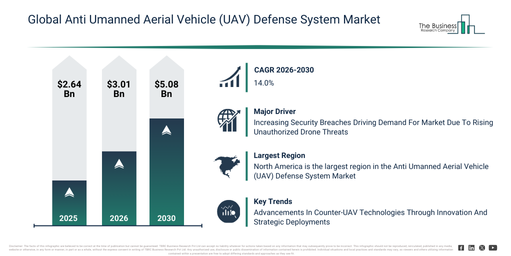
The anti unmanned aerial vehicle (UAV) defense system market size has experienced swift expansion recently. This market is projected to expand from $2.64 billion in 2025 to reach $3.01 billion by 2026, demonstrating a compound annual growth rate (CAGR) of 14.0%. Historically, this growth has stemmed from several factors, including the expanded deployment of radar-based anti-UAV systems for prompt threat detection, the integration of radio frequency (RF) jamming devices to counteract hostile drones, advancements in electro-optical and infrared sensors for tracking targets, increased reliance on acoustic sensors for UAV identification, and the deployment of kinetic interceptors to mitigate physical threats.
The anti unmanned aerial vehicle (UAV) defense system market is projected to experience swift expansion over the coming years. It is anticipated to reach $5.08 billion by 2030, exhibiting a compound annual growth rate (CAGR) of 14.0%. This growth during the forecast period is largely driven by factors such as the increasing requirement for multisensor fusion systems that combine radar, RF, and optical technologies, the development of directed energy solutions for anti-UAV purposes, the growing integration of AI-powered autonomous threat detection and response systems, increased acquisition for safeguarding vital infrastructure and military airspace, and an emphasis on modular and scalable anti-UAV systems for versatile deployment. Key trends foreseen in this period include the surge in demand for counter-UAV measures due to increasing drone threats, higher defense expenditure on comprehensive airspace protection, advancements in long-range detection and tracking capabilities, a greater uptake of multisensor fusion systems, and a move towards compact, quickly deployable neutralization units.
Download A Free Anti Umanned Aerial Vehicle (UAV) Defense System Market Sample Report With Size And Forecast Data:
Anti Umanned Aerial Vehicle (UAV) Defense System Market Growth Driver: The Key Factor Behind Rising Demand
The anti unmanned aerial vehicle (UAV) defense system market is expected to expand moving forward, driven by the increasing frequency of security breaches. These breaches occur when unauthorized individuals gain access to data, networks, or systems, jeopardizing their confidentiality, integrity, or availability. The rise in such incidents is attributed to a growing dependence on interconnected digital systems, which in turn increases the number of vulnerable access points that cybercriminals can exploit. An anti-unmanned aerial vehicle defense system contributes to preventing security breaches by identifying and neutralizing unauthorized drones that pose threats to secure areas and critical infrastructure. For example, in August 2024, ProtectUK, a UK-based government source of free counter terrorism protective security, reported that more than 6000 drone-related incidents were reported to police during 2023. Consequently, the increasing incidences of security breaches are fueling growth in the anti unmanned aerial vehicle (UAV) defense system market.
Anti Umanned Aerial Vehicle (UAV) Defense System Market Segmentation: Key Segments And Subsegments Covered
The anti umanned aerial vehicle (uav) defense system market covered in this report is segmented –
1) By Type: Portable, Vehicle Mounted
2) By Technology: High Energy Laser Systems, Directed Energy Weapons, Electromagnetic Pulse Systems, Radio Frequency Jammers, Traditional Kinetic Interceptors
3) By Platform: Land-Based Systems, Naval Systems, Airborne Systems, Portable Systems, Vehicle-Mounted Systems
4) By Application: Military, Homeland Security, Critical Infrastructure Protection, Commercial Facilities
5) By End User: Government Agencies, Military Organizations, Law Enforcement Agencies, Private Security Firms
Subsegments:
1) By Portable: Handheld Systems, Backpack Systems, Tripod-Mounted Systems
2) By Vehicle Mounted: Armored Vehicle Systems, Tactical Vehicle Systems, Light Utility Vehicle Systems
Anti Umanned Aerial Vehicle (UAV) Defense System Market Trends: Key Developments Shaping 2026 And Beyond
Leading companies operating in the anti-unmanned aerial vehicle (UAV) defense system market are increasingly dedicating resources to advanced solutions, including disruptive and architectural innovations. This effort aims to improve detection accuracy, refine threat classification, and facilitate rapid responses to progressively sophisticated unmanned aerial threats. Such disruptive and architectural innovations entail fundamental advancements in technology and system design, significantly enhancing existing defense capabilities by offering more efficient, scalable, and adaptable solutions against evolving UAV threats. For example, in March 2025, Airbus SE, a Netherlands-based aerospace and defense corporation, introduced the Low Cost Air Defense (LOAD), a missile-launching drone specifically designed for air defense. This system provides a cost-effective and reusable solution, capable of carrying up to three guided missiles per deployment. When combined with radar or intelligence, surveillance, and reconnaissance (ISR) systems, it enables semi-autonomous threat engagement. Developed for strategic adaptability, LOAD is free from international traffic in arms regulations (ITAR) and effectively addresses significant deficiencies in airspace defense.
Leading Companies Operating In The Anti Umanned Aerial Vehicle (UAV) Defense System Market
Major companies operating in the anti umanned aerial vehicle (UAV) defense system market are Raytheon Technologies Corporation, The Boeing Company, Lockheed Martin Corporation, Airbus SE, Northrop Grumman Corporation, BAE Systems plc, Thales S.A., Leonardo S.p.A., Hangzhou Hikvision Digital Technology Co. Ltd., Rheinmetall AG, Battelle Memorial Institute, Elbit Systems Ltd., Israel Aerospace Industries Ltd., Saab AB, DroneShield Ltd., Echodyne Corporation, Liteye Systems Inc., Aaronia AG, DroneSense Inc., OpenWorks Engineering LLC.
Access The Full Anti Umanned Aerial Vehicle (UAV) Defense System Market Research Report:
Anti Umanned Aerial Vehicle (UAV) Defense System Market Regional Analysis: Largest Region And Key Geographies Covered
North America was the largest region in the anti unmanned aerial vehicle (UAV) defense system market in 2025. Asia-Pacific is expected to be the fastest-growing region in the forecast period. The regions covered in the anti umanned aerial vehicle (UAV) defense system market report are Asia-Pacific, South East Asia, Western Europe, Eastern Europe, North America, South America, Middle East, Africa.
Reach Out To Our Team:
The Business Research Company: https://www.thebusinessresearchcompany.com/
Americas: +1 310-496-7795
Asia: +44 7882 955267 & +91 8897263534
Europe: +44 7882 955267
Email us at: marketing@tbrc.info
Follow us on:
LinkedIn: https://in.linkedin.com/company/the-business-research-company
YouTube: https://www.youtube.com/channel/UC24_fI0rV8cR5DxlCpgmyFQ
Global Market Model: https://www.thebusinessresearchcompany.com/global-market-model

Wasay has over a decade of experience in market research, data modelling, and analytics, with prior experience at GlobalData and Decision Tree Consulting Services. At The Business Research Company , he leads research operations across syndicated studies, customized consulting engagements, and the Global Market Model platform. His professional experience includes supporting organizations such as Boston Consulting Group, KPMG, and Ernst & Young. Wasay holds a degree in Electronics and Communications Engineering, postgraduate management qualifications from International Management Institute Belgium and Indian School of Business and Entrepreneurship, and completed the Integrated Program in Business Analytics from Indian Institute of Management Indore.