The Business Research Company’s 2026 market reports are designed to deliver research that is more actionable and strategically valuable. Key offerings include market attractiveness scoring, total addressable market sizing, company benchmarking matrices, interactive Excel dashboards, deeper supply chain intelligence, emerging startup tracking, and granular product-level insights.
Application of Nanotechnology in the Satellite Market Size, Growth Rate And Key Forecast Highlights For 2026–2030
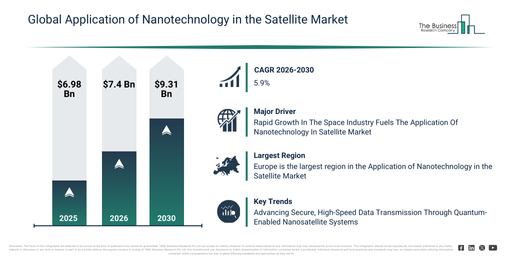
The satellite market size has witnessed strong growth in recent years due to the application of nanotechnology. It is projected to expand from $6.98 billion in 2025 to $7.4 billion in 2026, exhibiting a compound annual growth rate (CAGR) of 6.0%. Historically, this expansion can be attributed to the early integration of nanoscale materials to reduce satellite mass and enhance structural efficiency, the increasing use of nanotechnology-enhanced sensors to improve remote sensing accuracy, and the rising adoption of nanomaterials to extend satellite lifespan and thermal stability. Other contributing factors include the development of nanoscale components enabling miniaturized communication systems and the increased deployment of satellites for earth observation and scientific research, which necessitate advanced nanotechnology solutions.
Nanotechnology’s application within the satellite market is poised for significant expansion in the coming years. This sector is projected to reach $9.31 billion by 2030, demonstrating a compound annual growth rate (CAGR) of 5.9%. This anticipated growth is driven by several factors, including the increasing need for high-performance nanoscale devices to enhance satellite communication, the growing use of nanotechnology to improve navigation and positioning accuracy, a rise in investment in advanced remote sensing platforms utilizing nanomaterial-based detectors, the proliferation of small satellite constellations requiring lightweight and energy-efficient nanotech components, and technological progress that allows for multifunctional nanostructures for superior satellite performance. Prominent trends throughout this forecast period involve the miniaturization of nanoscale components for satellite payloads, sophisticated nanomaterial-based thermal control systems, durable nanocoatings designed for radiation and debris protection, enhancements in propulsion efficiency enabled by nanotechnology, and the greater integration of nanostructured sensors for precise sensing.
See What’s Inside The Application of Nanotechnology in the Satellite Market Report With A Free Sample:
Application of Nanotechnology in the Satellite Market Expansion: The Major Factor Driving Growth
The expanding space industry is projected to accelerate the integration of nanotechnology into the satellite market in the future. This sector encompasses various businesses, organizations, and initiatives dedicated to space exploration, utilization, and commercialization. Nanotechnology facilitates advanced manufacturing and assembly processes for satellite and spacecraft components. For example, in July 2024, the Space Foundation, a US-based advocacy organization, reported that the global space economy reached $570 billion in 2023, representing a 7.4% increase from the revised figure of $531 billion in 2022. Consequently, the rapid expansion of the space industry is fueling the adoption of nanotechnology in the satellite market.
Understanding Application of Nanotechnology in the Satellite Market Segmentation For Strategic Planning
The application of nanotechnology in the satellite market covered in this report is segmented –
1) By Type: Nanosatellite, Microsatellite
2) By Application: Scientific Research, Mapping, Signal Communication, Monitor, National Defense
3) By End User: Space And Defense, Commercial Aviation
Subsegments:
1) By Nanosatellite: CubeSats, PocketQubes, Picosatellites, Nanosatellites For Specific Applications
2) By Microsatellite: Standard Microsatellites, Specialized Microsatellites
Key Application of Nanotechnology in the Satellite Market Trends To Watch In 2026
Leading companies active in applying nanotechnology within the satellite market are concentrating on developing advanced solutions, including nano satellite systems with quantum communication components, to improve secure, rapid data transmission and connectivity. These nano satellite systems, equipped with quantum communication components, are compact, economical satellites that employ quantum technology, such as entanglement, to enable highly secure, quicker, and more dependable data transmission, thereby enhancing encryption and communication even in remote areas with limited infrastructure. For example, in June 2025, the Technical University of Munich (TUM), a research university located in Germany, launched the QUICK³ nanosatellite. This innovative platform was engineered to test quantum communication components in space, measuring no more than a shoebox in size and weighing approximately 4 kg. It features a single-photon source integrated with an optical chip for completely secure communication, while electronic systems from international partners manage experiments and interfaces. This capability facilitates secure, high-speed data transmission over long distances with minimal atmospheric interference and acts as a prototype for future extensive quantum satellite networks.
Key Companies Active In The Application of Nanotechnology in the Satellite Market
Major companies operating in the application of nanotechnology in the satellite market are Raytheon Company, Boeing Company, Lockheed Martin Corporation, Airbus SE, China Aerospace Science and Technology Corporation, Northrop Gruman Corporation, L3Harris Technologies Inc., ViaSat Inc., Thales Alenia Space, Sierra Nevada Corporation, Blue Origin LLC, Planet Labs PBC, Surrey Satellite Technology Ltd., Spire Global Inc., ICEYE, GomSpace Group AB, NanoAvionics Corp., Tyvak International, AAC Clyde Space Ltd., Kepler Communications Inc., ISISPACE BV., Open Cosmos, Axelspace Corporation, NanoRacks LLC, Astro Digital Inc., Dauria Aerospace, Orbital Solutions Monaco, SpacePharma SA., D-Orbit SpA, HPS GmbH
Explore Detailed Application of Nanotechnology in the Satellite Market Research And Forecasts:
Which Geography Dominates The Application of Nanotechnology in the Satellite Market?
Europe was the largest region in the application of nanotechnology in the satellite market in 2025. Asia-Pacific is expected to be the fastest-growing region in the forecast period. The regions covered in the application of nanotechnology in the satellite market report are Asia-Pacific, South East Asia, Western Europe, Eastern Europe, North America, South America, Middle East, Africa.
Reach Out To Our Team:
The Business Research Company: https://www.thebusinessresearchcompany.com/
Americas: +1 310-496-7795
Asia: +44 7882 955267 & +91 8897263534
Europe: +44 7882 955267
Email us at: marketing@tbrc.info
Follow us on:
LinkedIn: https://in.linkedin.com/company/the-business-research-company
YouTube: https://www.youtube.com/channel/UC24_fI0rV8cR5DxlCpgmyFQ
Global Market Model: https://www.thebusinessresearchcompany.com/global-market-model

Wasay has over a decade of experience in market research, data modelling, and analytics, with prior experience at GlobalData and Decision Tree Consulting Services. At The Business Research Company , he leads research operations across syndicated studies, customized consulting engagements, and the Global Market Model platform. His professional experience includes supporting organizations such as Boston Consulting Group, KPMG, and Ernst & Young. Wasay holds a degree in Electronics and Communications Engineering, postgraduate management qualifications from International Management Institute Belgium and Indian School of Business and Entrepreneurship, and completed the Integrated Program in Business Analytics from Indian Institute of Management Indore.