The Business Research Company’s 2026 market reports combine market attractiveness scoring, total addressable market sizing, company benchmarking matrices, interactive Excel dashboards, deeper supply chain intelligence, emerging startup tracking, and granular product-level insights to deliver research that is more actionable and strategically valuable.
Artificial Intelligence (AI) In Satellite Internet Market Size Review: What Shaped Past Growth And What Will Drive Future Expansion?
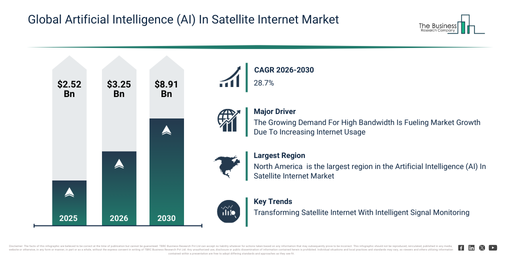
The artificial intelligence (AI) in satellite internet market has experienced rapid expansion in recent years. It will grow from $2.52 billion in 2025 to $3.25 billion in 2026 at a compound annual growth rate (CAGR) of 29.0%. This historical growth can be attributed to several factors, including the increasing adoption of satellite internet in remote and underserved regions, advancements in AI algorithms for network optimization, growing investment in satellite infrastructure, partnerships established between AI technology providers and satellite operators, and the early integration of predictive maintenance and signal enhancement solutions.
The artificial intelligence (AI) in satellite internet market size is projected to experience substantial expansion over the next few years. It will grow to $8.91 billion in 2030 at a compound annual growth rate (CAGR) of 28.7%. This growth during the forecast period is driven by the development of fully autonomous satellite network management systems, a rising demand for AI-powered smart antennas and terminals, the integration of AI for dynamic bandwidth allocation and signal optimization, the expansion of satellite internet services into commercial and enterprise sectors, and an increased emphasis on data analytics platforms for real-time network performance monitoring. Significant trends anticipated in this period include AI-driven bandwidth optimization, the increasing adoption of predictive satellite maintenance, the integration of smart antennas and AI terminals, the expansion of automated ground station systems, and the implementation of onboard AI processors for real-time decision-making.
Access Free Sample Pages From The Artificial Intelligence (AI) In Satellite Internet Market Report 2026:
Understanding The Main Driver Of The Artificial Intelligence (AI) In Satellite Internet Market
The expanding need for high bandwidth is anticipated to drive the advancement of the artificial intelligence (AI) in satellite internet market in the future. High bandwidth describes the capacity of a network or communication channel to transfer substantial data volumes per second. This increasing need stems from the proliferation of data-intensive applications that necessitate quick and dependable data transmission. Within satellite internet, artificial intelligence (AI) facilitates effective network administration and flexible traffic management. It achieves this by intelligently distributing resources, decreasing delays, and foreseeing usage trends, thus guaranteeing that applications requiring high bandwidth benefit from consistent, rapid, and continuous data delivery across various geographical areas. For example, reports from November 2024 by the UK Parliament’s House of Commons Library, a government body in the UK, indicated that by January 2024, gigabit-capable broadband was available to 78% of UK premises, an increase from 72% in January 2023 and 64% in January 2022. Consequently, the escalating requirement for high bandwidth is fostering the expansion of the artificial intelligence (AI) in satellite internet market.
Artificial Intelligence (AI) In Satellite Internet Market Segment Mapping For 2026 And Beyond
The artificial intelligence (AI) in satellite internet market covered in this report is segmented –
1) By Component: Hardware, Software, Services
2) By Deployment Mode: On-Premises, Cloud
3) By Application: Network Optimization, Traffic Management, Predictive Maintenance, Cybersecurity, Customer Experience Management, Other Applications
4) By End-User: Telecommunications, Government And Defense, Maritime, Aviation, Enterprise, Other End-Users
Subsegments:
1) By Hardware: Satellite Terminals, Antennas, Modems, Transceivers, Network Equipment
2) By Software: Network Management Software, Artificial Intelligence Analytics Software, Security And Encryption Software, Bandwidth Optimization Software
3) By Services: Installation And Integration Services, Maintenance And Support Services, Consulting And Training Services, Managed Satellite Connectivity Services
What Key Trend Is Expected To Shape The Artificial Intelligence (AI) In Satellite Internet Market Over The Forecast Period?
Major companies operating in the artificial intelligence (AI) in satellite internet market are focusing on developing innovative solutions such as real-time signal processing to enhance data transmission efficiency, reduce latency, detect and mitigate interference, and optimize network performance for seamless connectivity. Real-time signal processing involves the continuous analysis and manipulation of signals as they are received, helping to improve communication quality, reduce errors, and enable satellites to respond instantly to changing conditions or interference. For instance, in August 2025, Xovian Aerospace Private Limited, an India-based aerospace company, secured $2.5 million in a pre-seed funding round to develop the world’s first AI-native radio frequency (RF) satellite infrastructure. The company aims to embed AI directly into satellites for real-time RF signal analysis, enabling the detection of dynamic threats, covert transmissions, and interference often missed by conventional optical satellites. Equipped with multi-frequency RF payloads, these satellites will simultaneously monitor a wide spectrum of communication signals, delivering continuous situational awareness and intelligence for government and commercial users. Xovian plans to launch its first spacecraft aboard an ISRO rocket by late 2025, followed by the deployment of nanosatellites and expansion of its engineering and operational capabilities.
Artificial Intelligence (AI) In Satellite Internet Market Major Players And Industry Competition Overview
Major companies operating in the artificial intelligence (AI) in satellite internet market are Viasat Inc., SES S.A., Kratos Defense & Security Solutions Inc., Marlink AS, Iridium Communications Inc., Space42 PLC, Comtech Telecommunications Corp., Hughes Network Systems LLC, Telesat Canada, Anuvu Operations LLC, ST Engineering iDirect Inc., Gilat Satellite Networks Ltd., Kymeta Corporation, Avanti Communications Group plc, ThinKom Solutions Inc., Skylo Technologies Inc., Kepler Communications Inc., SpaceBridge Inc., Integrasys S.A., Xovian Aerospace Private Limited.
Full Artificial Intelligence (AI) In Satellite Internet Market Report: Market Size, Trends, Segments And Key Players:
Artificial Intelligence (AI) In Satellite Internet Market Geographic Segmentation: Regions Covered In The Report
North America was the largest region in the artificial intelligence (AI) in satellite internet market in 2025. Asia-Pacific is expected to be the fastest-growing region in the forecast period. The regions covered in the artificial intelligence (AI) in satellite internet market report are Asia-Pacific, South East Asia, Western Europe, Eastern Europe, North America, South America, Middle East, Africa.
Reach Out To Our Team:
The Business Research Company: https://www.thebusinessresearchcompany.com/
Americas: +1 310-496-7795
Asia: +44 7882 955267 & +91 8897263534
Europe: +44 7882 955267
Email us at: marketing@tbrc.info
Follow us on:
LinkedIn: https://in.linkedin.com/company/the-business-research-company
YouTube: https://www.youtube.com/channel/UC24_fI0rV8cR5DxlCpgmyFQ
Global Market Model: https://www.thebusinessresearchcompany.com/global-market-model

Wasay has over a decade of experience in market research, data modelling, and analytics, with prior experience at GlobalData and Decision Tree Consulting Services. At The Business Research Company , he leads research operations across syndicated studies, customized consulting engagements, and the Global Market Model platform. His professional experience includes supporting organizations such as Boston Consulting Group, KPMG, and Ernst & Young. Wasay holds a degree in Electronics and Communications Engineering, postgraduate management qualifications from International Management Institute Belgium and Indian School of Business and Entrepreneurship, and completed the Integrated Program in Business Analytics from Indian Institute of Management Indore.