With a focus on actionable insights and strategic value, The Business Research Company’s 2026 market reports include market attractiveness scoring, total addressable market sizing, company benchmarking matrices, interactive Excel dashboards, deeper supply chain intelligence, emerging startup tracking, and granular product-level insights.
Military Vetronics Market Size Forecast Points To $6.86 Billion In Revenue By 2030
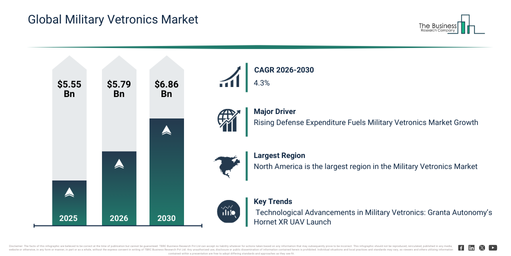
The military vetronics market size has shown steady growth in recent years. It is forecast to increase from $5.55 billion in 2025 to $5.79 billion in 2026, exhibiting a compound annual growth rate (CAGR) of 4.3%. The expansion observed historically can be ascribed to several factors, such as the greater integration of advanced navigation and communication systems enhancing vehicle situational awareness, the increasing adoption of vehicle optronics improving target detection and recognition capabilities, the wider deployment of joint fire support systems strengthening coordinated battlefield operations, the expanded usage of vehicle radar sensors improving threat monitoring and survivability, and the modernization of armored vehicle fleets driving demand for upgraded vetronics architectures.
The military vetronics market is projected to experience consistent expansion over the upcoming years, reaching $6.86 billion in 2030 at a compound annual growth rate (CAGR) of 4.3%. This anticipated expansion during the forecast period is driven by several factors, including the creation of AI-enabled vetronics platforms that boost autonomous decision-making and system interoperability, a growing need for modular and scalable electronic architectures to support future vehicle upgrades, the increasing embrace of sensor fusion technologies to enhance real-time battlefield awareness, the rise in unmanned ground vehicle deployments necessitating advanced vetronics integration, and greater investment in cyber-secure vetronics systems to fortify defenses against electronic warfare threats. Key developments expected during this period involve the incorporation of joint fire support systems, sophisticated vehicle optronics and sensor fusion, real-time radar and situational awareness solutions, adaptable vetronics architectures for swift enhancements, and improved survivability along with electronic countermeasure functionalities.
Get A Free Military Vetronics Market Sample Covering Drivers, Trends And Key Players:
Military Vetronics Market Driver Analysis: Key Factor Supporting Revenue Growth
An increase in defense expenditure is anticipated to drive the expansion of the military vetronics market moving forward. Defense expenditure encompasses all operational and capital spending for armed forces, including peacekeeping contingents of defense ministries and other governmental bodies involved in defense initiatives, as well as paramilitary forces. With larger defense budgets, military organizations can allocate more resources to research, develop, and acquire advanced vetronic systems. This heightened investment allows the military to implement cutting-edge technologies such as sophisticated sensors, communication systems, unmanned systems, and integrated command and control systems. For instance, in April 2024, according to the Stockholm International Peace Research Institute, a Sweden-based international institute, global military spending reached approximately $2.29 trillion in 2022. This amount increased to $2.44 trillion in 2023, reflecting a 6.8% year-over-year growth. Therefore, rising defense expenditure will propel the military vetronics market.
Military Vetronics Market Segmentation Framework: Major Segments At A Glance
The military vetronics market covered in this report is segmented –
1) By Type: Navigation System, Communication System, Power System, Control And Data Distribution System, C4 System, Display System, Other Types
2) By Fit: Line-Fit, Retrofit
3) By Application: Unmanned Ground Vehicles, Light Protected Vehicles, Special Purpose Vehicles, Armored Amphibious Vehicles, Other Applications
4) By End-User: Defense, Homeland Security
Subsegments:
1) By Navigation System: Global Positioning System (GPS), Inertial Navigation System (INS), Terrain Navigation System
2) By Communication System: Tactical Communication Systems, Satellite Communication Systems, Intercom Systems
3) By Power System: Power Generation Systems, Power Distribution Systems, Energy Storage Systems
4) By Control And Data Distribution System: Data Bus Systems, Control Management Systems
5) By C4 System: Command And Control Systems, Computer Systems, Communication Systems For C4
6) By Display System: Multi-Functional Displays (MFD), Head-Up Displays (HUD), Helmet-Mounted Displays (HMD)
7) By Other Types: Sensor Systems, Surveillance Systems, Electronic Warfare Systems
Latest Military Vetronics Market Developments And Emerging Trends
Leading firms within the military vetronics market are concentrating on creating sophisticated products, like non-ITAR vehicular navigation systems, to maintain their market standing. Specifically, a non-ITAR vehicular navigation system denotes a navigation solution built into vehicles that is not subject to the rules and limitations of the International Traffic in Arms Regulations (ITAR). An example of this is when, in June 2024, Granta Autonomy, a defense technology company from Lithuania, launched the Hornet XR, a hand-launched reconnaissance UAV, during Eurosatory 2024. With a weight of only 2.9 kg, the Hornet XR is engineered for clandestine missions, providing silent flight for as long as 3 hours and capable of traversing distances up to 160 km. Its inherent autonomous functions allow it to operate effectively in GNSS-denied and jamming-prone environments, guaranteeing mission completion even when faced with electronic warfare scenarios. The UAV’s modular construction facilitates simple transportation and quick deployment, establishing it as an adaptable instrument for collecting front-line intelligence.
Which Companies Are Shaping The Military Vetronics Market?
Major companies operating in the military vetronics market are General Electric Co, Raytheon Company, The Boeing Company, Lockheed Martin Corporation, Rheinmetall AG, Elbit Systems Ltd., Saab AB, General Dynamics Corporation, Northrop Grumman, Kongsberg Gruppen ASA, Cummins Inc., BAE Systems Inc., Collins Aerospace, Curtiss-Wright Corp, Cobham Limited, Safran SA, Thales SA, L3Harris Technologies Inc., TE Connectivity Ltd., Leonardo-Finmeccanica SPA, Oshkosh Defense LLC, KVH Industries Inc., C4 Advanced Tactical Systems LLC.
Dive Deeper Into The Military Vetronics Market With The Full Report:
Military Vetronics Market Regional Distribution: Where Is Revenue Concentrated?
North America was the largest region in the military vetronics market in 2025. The regions covered in the military vetronics market report are Asia-Pacific, South East Asia, Western Europe, Eastern Europe, North America, South America, Middle East, Africa.
Reach Out To Our Team:
The Business Research Company: https://www.thebusinessresearchcompany.com/
Americas: +1 310-496-7795
Asia: +44 7882 955267 & +91 8897263534
Europe: +44 7882 955267
Email us at: marketing@tbrc.info
Follow us on:
LinkedIn: https://in.linkedin.com/company/the-business-research-company
YouTube: https://www.youtube.com/channel/UC24_fI0rV8cR5DxlCpgmyFQ
Global Market Model: https://www.thebusinessresearchcompany.com/global-market-model

Wasay has over a decade of experience in market research, data modelling, and analytics, with prior experience at GlobalData and Decision Tree Consulting Services. At The Business Research Company , he leads research operations across syndicated studies, customized consulting engagements, and the Global Market Model platform. His professional experience includes supporting organizations such as Boston Consulting Group, KPMG, and Ernst & Young. Wasay holds a degree in Electronics and Communications Engineering, postgraduate management qualifications from International Management Institute Belgium and Indian School of Business and Entrepreneurship, and completed the Integrated Program in Business Analytics from Indian Institute of Management Indore.