The Business Research Company’s 2026 market reports combine market attractiveness scoring, total addressable market sizing, company benchmarking matrices, interactive Excel dashboards, deeper supply chain intelligence, emerging startup tracking, and granular product-level insights to deliver research that is more actionable and strategically valuable.
Next Generation Weapons Technology Market Size Review: What Shaped Past Growth And What Will Drive Future Expansion?
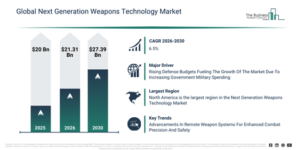
The next generation weapons technology market has experienced robust expansion in recent years. This market is projected to expand from $20 billion in 2025 to $21.31 billion in 2026, demonstrating a compound annual growth rate (CAGR) of 6.6%. Historically, this growth has been driven by factors such as increased global defense expenditure on sophisticated weapon systems, the growing embrace of precision-guided and intelligent munitions, breakthroughs in missile and directed energy technologies, the enhanced incorporation of AI and autonomous systems into military operations, and the broadening of cybersecurity and electronic warfare capacities for defense.
The market for next-generation weapons technology is anticipated to experience substantial growth in the upcoming years. It is projected to reach $27.39 billion by 2030, exhibiting a compound annual growth rate (CAGR) of 6.5%. This expansion during the forecast period can be linked to several factors, including the advancement of hypersonic weapons and advanced missile systems, the growing integration of fully autonomous combat platforms, the incorporation of AI for decision support and precise targeting, an increasing need for energy-based and non-kinetic weapon solutions, and the expansion of emerging defense sectors that are investing in modern and network-centric warfare capabilities. Key trends anticipated in this period encompass the wider deployment of hypersonic weapon systems for strategic long-range operations, a heightened demand for precision-guided munitions to minimize unintended damage, the escalating development of advanced electronic warfare and countermeasure systems, the broader application of directed energy weapons for missile defense and anti-drone purposes, and increased investment in multi-domain warfare integration spanning land, air, and sea platforms.
Access Free Sample Pages From The Next Generation Weapons Technology Market Report 2026:
Understanding The Main Driver Of The Next Generation Weapons Technology Market
The increasing defense budget is anticipated to boost the expansion of the next-generation weapons technology market moving forward. These budgets represent government-allocated money designated for military purposes, covering operations, equipment, personnel, and national security initiatives. The rise in defense spending aims to meet pressing modernization requirements for military capabilities, thereby safeguarding national security and strategic influence amid evolving global power shifts. Elevated defense budgets provide essential funding for the research, development, and procurement of next-generation weapons technologies. Such investment stimulates the creation of sophisticated systems, guaranteeing that military forces are prepared to counter new threats. As an illustration, figures released in April 2024 by the Stockholm International Peace Research Institute (SIPRI), a Sweden-based international research institute, revealed that worldwide military expenditure reached $2.443 trillion in 2023, marking a 6.8% rise from 2022. Consequently, expanding defense budgets are fueling the growth of the next-generation weapons technology market.
Next Generation Weapons Technology Market Segment Mapping For 2026 And Beyond
The next generation weapons technology market covered in this report is segmented –
1) By Product: Missiles, Munitions, Guided Projectiles, Guided Rockets, Guided Firearms, Directed Energy Weapons
2) By Technology: Laser, Infrared, Radar, Global Positioning System (GPS), Other Technologies
3) By Platform: Air, Land, Naval
Subsegments:
1) By Missiles: Hypersonic Missiles, Cruise Missiles, Ballistic Missiles, Anti-Ship Missiles, Surface-to-Air Missiles (SAM)
2) By Munitions: Smart Bombs, Cluster Munitions, Penetrator Munitions, Airburst Munitions, Non-Lethal Munitions
3) By Guided Projectiles: Precision-Guided Artillery Shells, Smart Mortar Rounds, Laser-Guided Tank Shells, Extended-Range Guided Projectiles, Electromagnetic Railgun Projectiles
4) By Guided Rockets: Laser-Guided Rockets, GPS-Guided Rockets, Air-to-Ground Guided Rockets, Multi-Launch Rocket System (MLRS) Rockets, Swarm-Enabled Guided Rockets
5) By Guided Firearms: Smart Rifles, Computerized Sniper Systems, Fire-and-Forget Small Arms, Tracking-Enabled Machine Guns, AI-Assisted Handguns
6) By Directed Energy Weapons: High-Energy Laser (HEL) Weapons, Microwave Weapons, Particle Beam Weapons, Electromagnetic Pulse (EMP) Weapons, Non-Lethal Directed Energy Weapons
What Key Trend Is Expected To Shape The Next Generation Weapons Technology Market Over The Forecast Period?
Major companies operating in the next-generation weapons technology market are focusing on developing advanced remote weapon systems to achieve more precise and effective combat capabilities. Remote weapon systems (RWS) are advanced technologies that enable weapons to be operated from a distance, removing the need for a human operator at the weapon’s location. They enhance military safety and efficiency by allowing target engagement without direct exposure to danger. For instance, in February 2025, Electro Optic Systems, an Australia-based defense technology company, launched the R500, a cutting-edge remote weapon system (RWS). It improves precision and adaptability in complex combat environments by integrating AI-driven targeting, high-elevation counter-UAS capabilities, and multi-weapon adaptability. This system offers increased lethality, enhanced situational awareness, and greater survivability, making it ideal for armored vehicles and tactical platforms. The system features a high-resolution sensor unit, expanded ammunition capacity, and compatibility with unmanned ground vehicles, reflecting EOS’ commitment to equipping defense forces with state-of-the-art technology.
Next Generation Weapons Technology Market Major Players And Industry Competition Overview
Major companies operating in the next generation weapons technology market are Raytheon Company, The Boeing Company, Lockheed Martin, General Dynamics Mission Systems, Northrop Grumman Corporation, Mitsubishi Heavy Industries Ltd., BAE Systems, Thales Group, Leidos Holdings Inc., Rheinmetall AG, Elbit Systems, Israel Aerospace Industries (IAI), Naval Group, MBDA, General Atomics, AeroVironment Inc., Bharat Dynamics Limited, Electro Optic Systems, Zen Technologies, Hanwha Defense
Full Next Generation Weapons Technology Market Report: Market Size, Trends, Segments And Key Players:
Next Generation Weapons Technology Market Geographic Segmentation: Regions Covered In The Report
North America was the largest region in the next generation weapons technology market in 2025. Asia-Pacific is expected to be the fastest-growing region in the forecast period. The regions covered in the next generation weapons technology market report are Asia-Pacific, South East Asia, Western Europe, Eastern Europe, North America, South America, Middle East, Africa.
Reach Out To Our Team:
The Business Research Company: https://www.thebusinessresearchcompany.com/
Americas: +1 310-496-7795
Asia: +44 7882 955267 & +91 8897263534
Europe: +44 7882 955267
Email us at: marketing@tbrc.info
Follow us on:
LinkedIn: https://in.linkedin.com/company/the-business-research-company
YouTube: https://www.youtube.com/channel/UC24_fI0rV8cR5DxlCpgmyFQ
Global Market Model: https://www.thebusinessresearchcompany.com/global-market-model

Wasay has over a decade of experience in market research, data modelling, and analytics, with prior experience at GlobalData and Decision Tree Consulting Services. At The Business Research Company , he leads research operations across syndicated studies, customized consulting engagements, and the Global Market Model platform. His professional experience includes supporting organizations such as Boston Consulting Group, KPMG, and Ernst & Young. Wasay holds a degree in Electronics and Communications Engineering, postgraduate management qualifications from International Management Institute Belgium and Indian School of Business and Entrepreneurship, and completed the Integrated Program in Business Analytics from Indian Institute of Management Indore.