The Business Research Company’s 2026 market reports are designed to deliver research that is more actionable and strategically valuable. Key offerings include market attractiveness scoring, total addressable market sizing, company benchmarking matrices, interactive Excel dashboards, deeper supply chain intelligence, emerging startup tracking, and granular product-level insights.
Rose Wine Market Size, Growth Rate And Key Forecast Highlights For 2026–2030
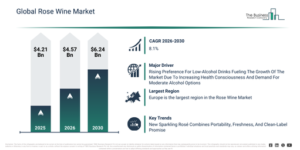
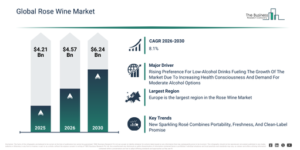
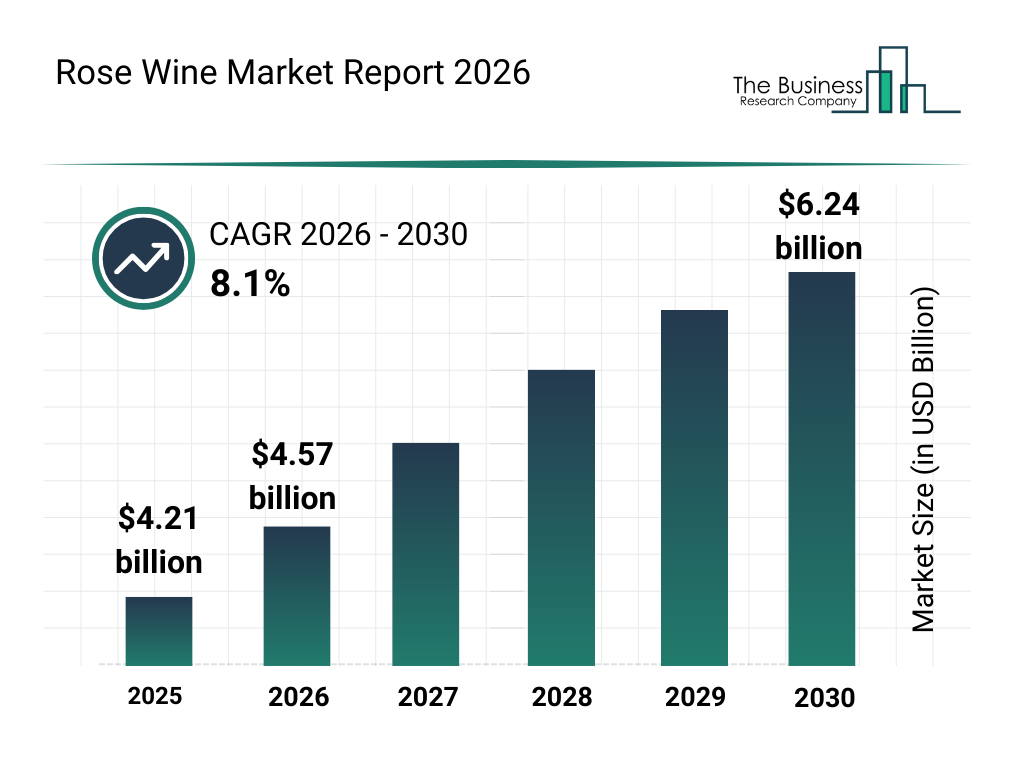
The rose wine market size has experienced significant expansion over the last few years. It is anticipated to grow from $4.21 billion in 2025 to $4.57 billion in 2026, registering a compound annual growth rate (CAGR) of 8.6%. This historical growth can be attributed to several factors, including a rising consumer preference for lighter and more refreshing wine styles, which has boosted rosé adoption. The expansion of wine tourism has also enhanced global awareness of various regional rosé varieties. Additionally, the introduction of canned blush wine has improved portability and attracted a younger consumer base, while the increasing production of organic and biodynamic rosé aligns with current health and sustainability trends. The growing popularity of rosé champagne in premium and celebratory occasions has also played a role in this market’s development.
The rose wine market is projected to experience substantial expansion over the coming years. It is forecast to reach $6.24 billion by 2030, exhibiting a compound annual growth rate (CAGR) of 8.1%. This anticipated growth is driven by several factors, including the continuous rise in demand for convenient packaging options, which is fueling the expansion of canned rosé wines, alongside advancements in sustainable viticulture practices that promote the wider availability of organic and biodynamic rosé varieties. Additionally, increasing consumer interest in low-alcohol and semi-sparkling rosé choices is appealing to health-aware individuals, while the proliferation of e-commerce channels is extending the market reach for unique rosé varieties. The growing trend of premiumization is also boosting demand for high-quality maceration rosé and cabernet sauvignon rosé products. Key developments anticipated during this period encompass the premiumization of rosé wines, the increasing popularity of canned and portable rosé formats, consumption patterns influenced by seasons and specific occasions, the emergence of rosé from unconventional regions, and ongoing innovation in low-alcohol and alcohol-free rosé options.
See What’s Inside The Rose Wine Market Report With A Free Sample:
Rose Wine Market Expansion: The Major Factor Driving Growth
The growing consumer inclination towards low-alcohol beverages is expected to significantly boost the expansion of the rosé wine market. These low-alcohol options are defined as drinks with a reduced alcohol content by volume, typically below 3.5%, providing a lighter alternative to standard alcoholic drinks. This increasing preference is driven by rising health consciousness and evolving social perspectives on moderation and well-being. Rosé wine contributes to the low-alcohol category by offering flavorful and refreshing choices that appeal to a wide spectrum of consumers. It serves as a versatile selection for social gatherings, combining appealing taste with a moderate alcohol level to suit both health-aware individuals and casual drinkers. For instance, in January 2024, Fentimans, a UK-based botanical drinks company, reported that 50% of consumers bought mocktails or virgin alternatives (non-alcoholic versions of traditional cocktails) in 2024, an increase from 35% in 2023. Therefore, the increasing preference for low-alcohol drinks is a key factor driving the growth of the rosé wine market.
Understanding Rose Wine Market Segmentation For Strategic Planning
The rose wine market covered in this report is segmented –
1) By Type: Fortified Wine And Vermouth, Sparkling Wine, Still Wine
2) By Grape Variety: Grenache, Merlot, Pinot Noir, Malbec
3) By Body Type: Full-Bodied, Medium-Bodied, Light-Bodied
4) By Color: Red Wine, Rose Wine, White Wine
5) By Distribution Channel: Hypermarket, Supermarket, Specialty Stores, Online Retail
Subsegments:
1) By Fortified Wine And Vermouth: Aromatized Rose Vermouth, Sweet Fortified Rose Wine, Dry Fortified Rose Wine, Herbal-Infused Rose Aperitifs
2) By Sparkling Wine: Traditional Method Sparkling Rose, Charmat Method Sparkling Rose, Rose Prosecco, Sparkling Muscat Rosé
3) By Still Wine: Dry Still Rosé, Off-Dry Still Rosé, Sweet Still Rosé, Organic Still Rosé, Biodynamic Still Rosé
Key Rose Wine Market Trends To Watch In 2026
Leading businesses within the rose wine market are concentrating on creating novel items, such as health-aware wine, to meet the increasing consumer need for healthier living options without sacrificing flavor or standard. Health-aware wine denotes wines specifically produced or promoted to attract individuals who prioritize their well-being. Such wines commonly feature decreased alcohol content, reduced sugar, fewer additional substances, grapes grown organically or sustainably, and are occasionally fortified with antioxidants or natural components. As an illustration, in May 2025, FitVine Wine, a US-based craft wine enterprise, introduced a new sparkling rose in a resealable 750-milliliter aluminum bottle, broadening its range of health-conscious, low-sugar wines intended for active and wellness-oriented consumers. This introduction combines ease of transport and sustained freshness with the brand’s commitment to clean labeling and sustainable packaging, providing a practical, portable choice for wine enthusiasts who appreciate both fitness and taste.
Key Companies Active In The Rose Wine Market
Major companies operating in the rose wine market are Pernod Ricard, Constellation Brands, E. & J. Gallo Winery, Treasury Wine Estates, Château Miraval, Sula Vineyards Private Limited, Gérard Bertrand Wines, Wölffer Estate Vineyard Inc., Bodegas Muga, Moët Hennessy, Domaines Ott, Lynfred Winery Inc., Château la Tour de l’Évêque, Domaine de la Sanglière, Domaine Tempier, Arianna Occhipinti Azienda Agricola, Château de Pibarnon, Château Sainte Roseline, Domaine de la Mordorée, Fattoria Sardi Giustiniani, Jean-Luc Colombo Wines, La Vieille Ferme, Lasseter Family Winery LLC, Maison Saint Aix (AIX Rosé), Mas de Cadenet, Sacha Lichine Wines, Vini Sassara di Bertaiola Stefano
Explore Detailed Rose Wine Market Research And Forecasts:
Which Geography Dominates The Rose Wine Market?
Europe was the largest region in the rose wine market in 2025. Asia-Pacific is expected to be the fastest-growing region in the forecast period. The regions covered in the rose wine market report are Asia-Pacific, South East Asia, Western Europe, Eastern Europe, North America, South America, Middle East, Africa.
Reach Out To Our Team:
The Business Research Company: https://www.thebusinessresearchcompany.com/
Americas: +1 310-496-7795
Asia: +44 7882 955267 & +91 8897263534
Europe: +44 7882 955267
Email us at: marketing@tbrc.info
Follow us on:
LinkedIn: https://in.linkedin.com/company/the-business-research-company
YouTube: https://www.youtube.com/channel/UC24_fI0rV8cR5DxlCpgmyFQ
Global Market Model: https://www.thebusinessresearchcompany.com/global-market-model

Wasay has over a decade of experience in market research, data modelling, and analytics, with prior experience at GlobalData and Decision Tree Consulting Services. At The Business Research Company , he leads research operations across syndicated studies, customized consulting engagements, and the Global Market Model platform. His professional experience includes supporting organizations such as Boston Consulting Group, KPMG, and Ernst & Young. Wasay holds a degree in Electronics and Communications Engineering, postgraduate management qualifications from International Management Institute Belgium and Indian School of Business and Entrepreneurship, and completed the Integrated Program in Business Analytics from Indian Institute of Management Indore.