Designed to make market research more actionable and strategically valuable, The Business Research Company’s 2026 market reports feature market attractiveness scoring, total addressable market sizing, company benchmarking matrices, interactive Excel dashboards, deeper supply chain intelligence, emerging startup tracking, and granular product-level insights.
Rubber Tracks For Defense And Security Market To Expand At A 6.4% CAGR: Size And Growth Projections Through 2030
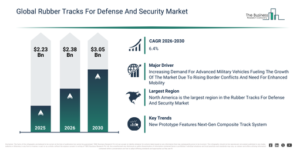
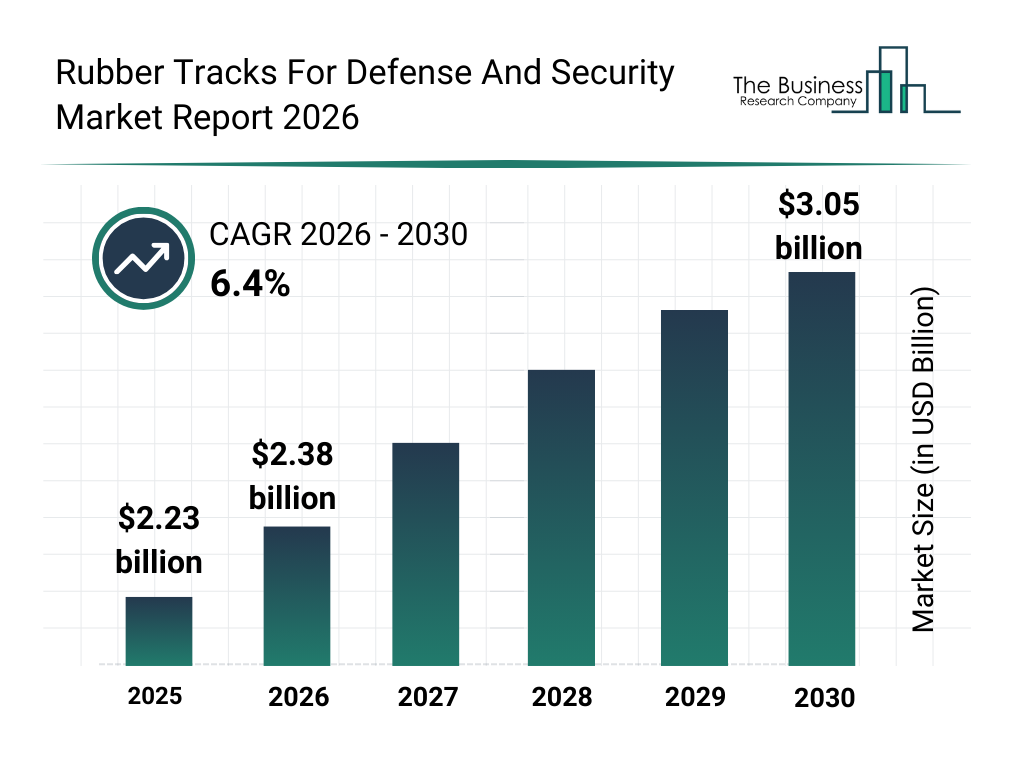
The market for rubber tracks in defense and security has experienced significant growth in recent years. It will grow from $2.23 billion in 2025 to $2.38 billion in 2026 at a compound annual growth rate (CAGR) of 6.7%. The expansion observed during the historic period can be linked to several factors: an increasing demand for reduced vehicle noise signatures that spurred the early adoption of rubber track systems, the advancement of multi-terrain traction designs improving mobility across soft and urban surfaces, a rising requirement to minimize ground damage during peacekeeping and urban security operations, the introduction of corrosion-resistant rubber track assemblies that extend their operational lifespan, and the initial integration of modular track conversion kits enabling swift upgrades for legacy defense vehicles.
The rubber tracks for defense and security market is anticipated to experience robust expansion in the coming years, reaching $3.05 billion in 2030 at a compound annual growth rate (CAGR) of 6.4%. This projected growth throughout the forecast period can be attributed to several factors, such as the increasing modernization programs within defense forces, which are elevating the demand for lightweight and adaptive rubber tracks. Additionally, advancements in composite reinforcement materials are enhancing durability and load capacity, while the rising adoption of unmanned ground vehicles is creating a need for quieter and terrain-flexible track systems. The expansion of urban and asymmetric warfare scenarios is further boosting the requirement for low-vibration mobility solutions, and innovations in suspension-compatible track technologies are improving performance across diverse mission environments. Key trends expected during this forecast period include a growing emphasis on low-noise stealth track designs, an increase in the adoption of modular track conversion kits for multi-vehicle compatibility, advancements in anti-slip and multi-terrain rubber tread technologies, the broader implementation of lightweight composite-reinforced rubber track architectures, and an expanding use of adaptive suspension-compatible rubber tracks.
Get Your Free Rubber Tracks For Defense And Security Market Report Sample Today:
Which Factor Is Expected To Drive The Rubber Tracks For Defense And Security Market Over The Forecast Period?
The rising need for sophisticated military vehicles is projected to boost the expansion of the rubber tracks for defense and security market in the future. These cutting-edge military vehicles are contemporary ground-based platforms engineered with superior armor, greater mobility, and embedded combat systems. Growing border disputes are escalating the requirement for advanced military vehicles, as countries aim for improved agility, safeguarding, and combat readiness in challenging terrains. Rubber tracks designed for defense and security applications improve advanced military vehicles by offering light yet robust mobility options, perfectly suited for difficult and unpredictable landscapes. They contribute to lower noise and less vibration, simultaneously boosting speed and operational effectiveness, thereby enhancing performance during combat and tactical missions. A notable example is a report from October 2025 by Reuters, a UK-based news agency company, detailing that the primary part of the Bundeswehr deal entails a framework agreement with defense firm General Dynamics (GD.N) for the development and acquisition of 274 scout vehicles, with an approximate worth of $4.1 billion (€3.5 billion), and initial deliveries set for 2028. Consequently, the heightened demand for advanced military vehicles is propelling the expansion of the rubber tracks for defense and security market.
Rubber Tracks For Defense And Security Market Segmentation Insights: How Is The Industry Categorized?
The rubber tracks for defense and security market covered in this report is segmented –
1) By Product Type: Rubber Pin Track, Single Pin Track, Double Pin Track
2) By Material Type: Natural Rubber, Synthetic Rubber, Recycled Rubber
3) By Vehicle Type: Tracked Vehicles, Wheeled Vehicles, Hybrid Vehicles
4) By Application: Armored Vehicles, Heavy Machinery, Unmanned Ground Vehicles, Tactical Platforms
5) By End Use: Military, Civil Security, Paramilitary
Subsegments:
1) By Rubber Pin Track: Internal Rubber Pin Track, External Rubber Pin Track, Embedded Steel Core Rubber Track
2) By Single Pin Track: Bolt-On Single Pin Track, Clip-On Single Pin Track, Bar-Type Single Pin Track
3) By Double Pin Track: Dual-Bolt Double Pin Track, Interlocking Lug Double Pin Track, Heavy-Duty Double Pin Track
Rubber Tracks For Defense And Security Market Trends Explained: What Is Changing And Why It Matters
Leading firms within the rubber tracks for defense and security market are concentrating on creating sophisticated products, like composite rubber tracks, aiming to improve performance across diverse weather conditions and challenging landscapes. These composite rubber tracks represent lightweight, robust track systems constructed from rubber, metal, and composite substances, which provide greater mobility, decreased sound levels, and superior functionality for military and tactical transport. As an illustration, in September 2023, Hanwha Aerospace, a defense and aerospace manufacturer based in South Korea, unveiled the prototype of its K9A2 Thunder howitzer. This prototype incorporates Soucy Defense’s advanced composite rubber track system, which serves to diminish vibration and noise, augment maneuverability over tough terrain, and cut down on lifelong maintenance costs. The K9A2 self-propelled howitzer prototype is intended to succeed the older K9 and K9A1 models, engineered to boost mobility, velocity, and operational effectiveness, concurrently integrating advanced automation and offensive power features.
Rubber Tracks For Defense And Security Market Competitor Landscape: Who Are The Major Companies?
Major companies operating in the rubber tracks for defense and security market are Bridgestone Corporation, Trelleborg AB, Balkrishna Industries Limited, LS Mtron Ltd., Soucy International Inc., Astrak Group Limited, KNDS Deutschland Tracks GmbH, Flensburger Fahrzeugbau Gesellschaft mbH, Roshel Intelligence Solutions Inc., Hutchinson Industries Inc., Maxam Tire International, TGL SP Industries Ltd., William Cook Holding Limited, Hanwha Defense Co. Ltd, DST Defence Service Tracks Ltd, Arquus SAS, Martin’s Rubber Company Ltd., STREIT Group, ATL Rubber Tracks, VTS Track Solutions
See The Full Rubber Tracks For Defense And Security Market Report For Complete Market Sizing And Trends:
Rubber Tracks For Defense And Security Market Regional Demand Analysis And Leading Geography
North America was the largest region in the rubber tracks for defense and security market in 2025. Asia-Pacific is expected to be the fastest-growing region in the forecast period. The regions covered in the rubber tracks for defense and security market report are Asia-Pacific, South East Asia, Western Europe, Eastern Europe, North America, South America, Middle East, Africa.
Reach Out To Our Team:
The Business Research Company: https://www.thebusinessresearchcompany.com/
Americas: +1 310-496-7795
Asia: +44 7882 955267 & +91 8897263534
Europe: +44 7882 955267
Email us at: marketing@tbrc.info
Follow us on:
LinkedIn: https://in.linkedin.com/company/the-business-research-company
YouTube: https://www.youtube.com/channel/UC24_fI0rV8cR5DxlCpgmyFQ
Global Market Model: https://www.thebusinessresearchcompany.com/global-market-model

Wasay has over a decade of experience in market research, data modelling, and analytics, with prior experience at GlobalData and Decision Tree Consulting Services. At The Business Research Company , he leads research operations across syndicated studies, customized consulting engagements, and the Global Market Model platform. His professional experience includes supporting organizations such as Boston Consulting Group, KPMG, and Ernst & Young. Wasay holds a degree in Electronics and Communications Engineering, postgraduate management qualifications from International Management Institute Belgium and Indian School of Business and Entrepreneurship, and completed the Integrated Program in Business Analytics from Indian Institute of Management Indore.