Designed to make market research more actionable and strategically valuable, The Business Research Company’s 2026 market reports feature market attractiveness scoring, total addressable market sizing, company benchmarking matrices, interactive Excel dashboards, deeper supply chain intelligence, emerging startup tracking, and granular product-level insights.
How Fast Is The Satellite Component Market Growing? Market Size, CAGR And Forecast Insights
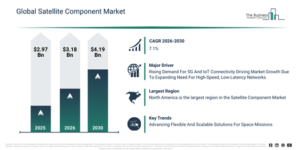
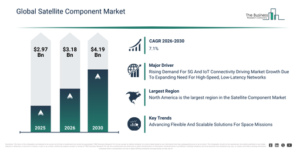
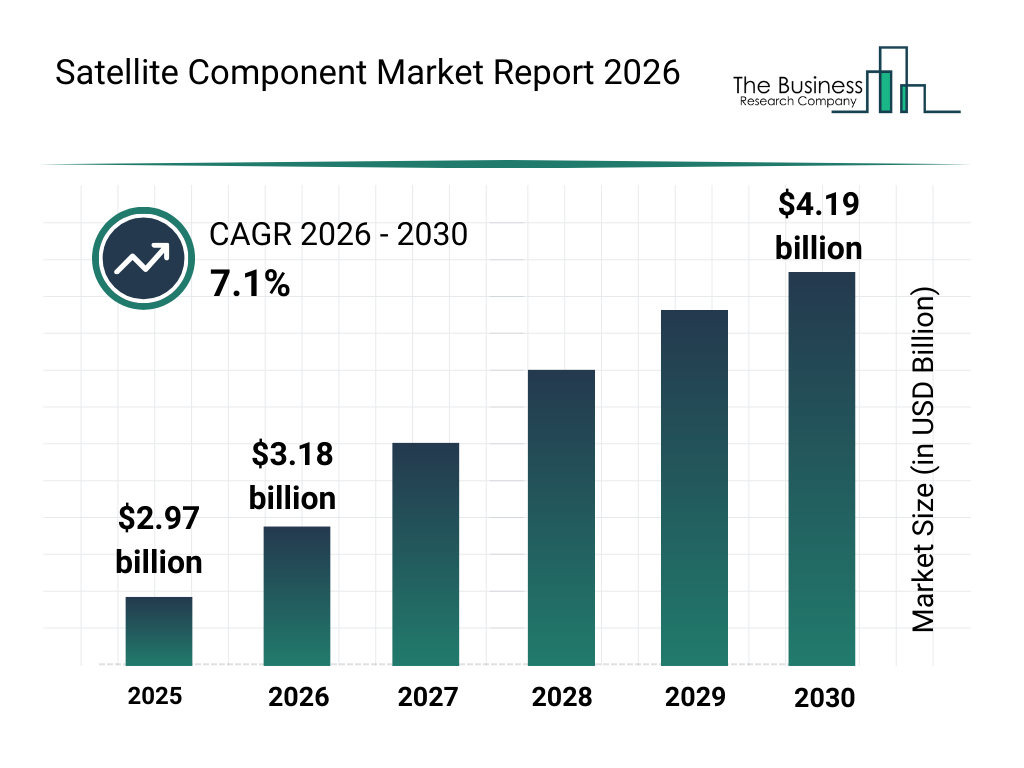
The satellite component market size has seen strong growth in recent years. It is projected to increase from $2.97 billion in 2025 to $3.18 billion in 2026, achieving a compound annual growth rate (CAGR) of 7.1%. The expansion observed historically can be attributed to factors such as a rising global need for communication and earth observation satellites, advancements in solar panel and battery technologies for space applications, increased adoption of high-precision sensors and onboard computers, growing investments in satellite manufacturing and deployment, and the expansion of satellite constellations for navigation and data services.
The satellite component market is projected to experience robust growth in the coming years, with its size expected to reach $4.19 billion by 2030, reflecting a compound annual growth rate (CAGR) of 7.1%. This anticipated expansion stems from factors such as the creation of smaller, more efficient satellite components; the increasing use of AI-driven onboard systems for autonomous operations; the rise of reusable satellite platforms and modular parts; growing demand from developing markets for space communication and monitoring; and the integration of advanced materials to enhance durability and extend satellite lifespan. Significant trends anticipated during this period include a heightened demand for lightweight and compact satellite components, the expanding adoption of modular satellite architectures for more rapid assembly, an increasing reliance on radiation-hardened materials to boost component resilience, greater production of small satellites leading to component standardization, and the broader expansion of satellite missions dedicated to communication, imaging, and navigation.
Unlock Satellite Component Market Insights With A Free Sample Report:
Satellite Component Market Momentum: Key Driver Expected To Boost Growth Through 2030
The increasing need for 5G and Internet of Things connectivity is anticipated to fuel the expansion of the satellite component market in the future. 5G and the Internet of Things represent advanced wireless networks that link smart devices, enabling immediate data exchange, and facilitating more efficient and seamless cooperation among everyday gadgets, machinery, and systems. The requirement for 5G connectivity stems from growing data usage and the necessity for quicker internet speeds to accommodate high-bandwidth applications like streaming, gaming, and cloud computing. Additionally, the expanding integration of smart devices across homes, cities, and industries is propelling the demand for IoT, since these devices depend on uninterrupted, low-latency communication for optimal functionality. With the increasing global demand for 5G and IoT coverage, satellites will be essential in broadening connectivity beyond conventional land-based infrastructure, thereby increasing the requirement for satellite components. For example, the IoT Business News, an independent online media platform based in France, reported in September 2024 that the overall count of connected IoT devices is projected to increase by 13%, rising from 18.8 billion in 2024 to 40 billion by 2030. Consequently, the escalating need for 5G and Internet of Things connectivity is propelling the expansion of the satellite component market.
Satellite Component Market Segments: A Category-By-Category Overview
The satellite component market covered in this report is segmented –
1) By Component: Antennas, Power Systems, Propulsion Systems, Transponders, Other Components
2) By Satellite Type: Small Satellite, Medium Satellite, Large Satellite
3) By Orbits: Geostationary Orbit, Low Earth Orbit, Medium Earth Orbit, Polar Orbit
4) By Application: Communication, Earth Observation, Technology Development, Navigation, Space Science, Other Applications
5) By End Use: Commercial, Government And Military, Scientific And Research Institutions
Subsegments:
1) By Antennas: Parabolic Antennas, Phased Array Antennas, Reflector Antennas, Flat Panel Antennas
2) By Power Systems: Solar Panels, Battery Systems, Power Distribution Units, Power Conversion Units
3) By Propulsion Systems: Chemical Propulsion Systems, Electric Propulsion Systems, Hybrid Propulsion Systems, Ions and Hall Effect Thrusters
4) By Transponders: C-band Transponders, Ku-band Transponders, Ka-band Transponders, L-band Transponders
5) By Other Components: Thermal Systems, Structural Systems, Communication Systems, On-board Data Handling Systems
Which Emerging Trends Are Gaining Traction In The Satellite Component Market?
Leading companies within the satellite component market are concentrating on developing innovative products, such as satellite buses, to enhance satellite performance, reduce costs, improve payload capacity, and facilitate faster deployment. A satellite bus fundamentally serves as the core structure of a satellite, housing and supporting various subsidiary components like power systems, propulsion, thermal control, and communication systems. It furnishes the essential framework and infrastructure necessary for the satellite’s operations, thereby ensuring that the payload, such as sensors or communication equipment, can function effectively. For instance, in September 2024, Apex Space Systems, a US-based private aerospace and satellite manufacturing company, introduced its Nova satellite bus. This offering provides a flexible and scalable platform suitable for a variety of space missions. The base version of Nova weighs 250 kilograms and is engineered to carry up to 300 kilograms of payloads, making it appropriate for applications including Earth observation, scientific research, and technology demonstrations. For missions requiring increased capacity, Apex has also developed a heavy version of Nova, which weighs 400 kilograms and is capable of supporting up to 500 kilograms of payloads.
Satellite Component Market Key Participants: Prominent Companies At A Glance
Major companies operating in the satellite component market are RTX Corporation, Lockheed Martin Corporation, General Dynamics Corporation, Mitsubishi Electric Corporation, Northrop Grumman Corporation, Honeywell International Inc., BAE Systems plc, Boeing Defense Space & Security, Thales Group, L3Harris Technologies Inc., IHI Corporation, Teledyne Technologies Incorporated, Space Exploration Technologies Corp. (SpaceX), Leonardo S.p.A., QinetiQ Group plc, Maxar Technologies Inc., Airbus Defence and Space, Sierra Nevada Corporation, OHB SE, Cobham Limited, JONSA TECHNOLOGIES CO. LTD., Sat-Lite Technologies LLC, Challenger Communications LLC
Get Detailed Satellite Component Market Forecasts In The Complete Report:
Top Region In The Satellite Component Market: A Global Perspective
North America was the largest region in the satellite component market in 2025. Asia-Pacific is expected to be the fastest-growing region in the forecast period. The regions covered in the satellite component market report are Asia-Pacific, South East Asia, Western Europe, Eastern Europe, North America, South America, Middle East, Africa.
Reach Out To Our Team:
The Business Research Company: https://www.thebusinessresearchcompany.com/
Americas: +1 310-496-7795
Asia: +44 7882 955267 & +91 8897263534
Europe: +44 7882 955267
Email us at: marketing@tbrc.info
Follow us on:
LinkedIn: https://in.linkedin.com/company/the-business-research-company
YouTube: https://www.youtube.com/channel/UC24_fI0rV8cR5DxlCpgmyFQ
Global Market Model: https://www.thebusinessresearchcompany.com/global-market-model

Wasay has over a decade of experience in market research, data modelling, and analytics, with prior experience at GlobalData and Decision Tree Consulting Services. At The Business Research Company , he leads research operations across syndicated studies, customized consulting engagements, and the Global Market Model platform. His professional experience includes supporting organizations such as Boston Consulting Group, KPMG, and Ernst & Young. Wasay holds a degree in Electronics and Communications Engineering, postgraduate management qualifications from International Management Institute Belgium and Indian School of Business and Entrepreneurship, and completed the Integrated Program in Business Analytics from Indian Institute of Management Indore.