Market attractiveness scoring, total addressable market sizing, company benchmarking matrices, interactive Excel dashboards, deeper supply chain intelligence, emerging startup tracking, and granular product-level insights are among the key offerings featured in The Business Research Company’s 2026 market reports, designed to deliver more actionable and strategically valuable research.
Satellite Connectivity Market Size Estimate For 2026 And Revenue Forecast Through 2030
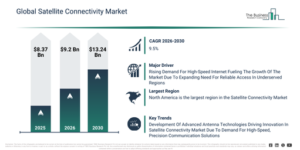
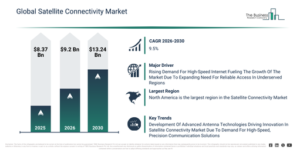
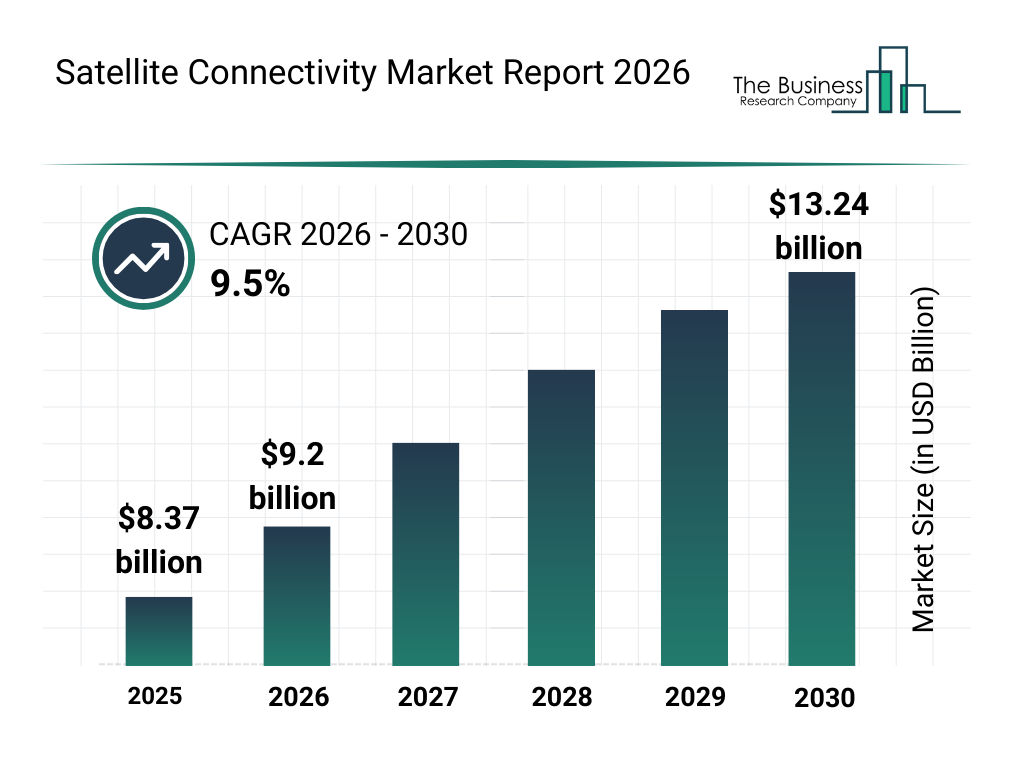
The satellite connectivity market has observed significant expansion in recent years. Its size is anticipated to grow from $8.37 billion in 2025 to $9.2 billion in 2026, exhibiting a compound annual growth rate (CAGR) of 9.9%. The market’s past growth can be attributed to several factors, including the increasing necessity for connectivity in isolated and underserved regions, which has driven the uptake of satellite communication services; the extension of television broadcasting networks utilizing satellite distribution infrastructure; the development of satellite phones, enabling vital communication in mission-critical and disaster situations; the early deployment of mobility connectivity solutions for the maritime and aviation sectors; and improvements in satellite modems and routers, enhancing data transmission reliability.
The satellite connectivity market size is anticipated to experience substantial growth in the upcoming years. It is forecast to reach $13.24 billion in 2030, demonstrating a compound annual growth rate (CAGR) of 9.5%. This projected growth is driven by several factors, including the swift expansion of low Earth orbit satellite constellations, which enhances the availability of high-speed satellite internet. There is also an increasing demand for mobility services across aviation, maritime, and connected vehicle sectors. Innovations in user terminals and consumer communication devices are improving accessibility and affordability. Furthermore, the rising frequency of climate-related disasters is boosting the need for emergency and resilience-based satellite services, and the growing integration of satellite connectivity with 5G and hybrid networks is expanding service capabilities. Key trends for this period include an increasing need for connectivity in remote and underserved regions, the development of satellite-based mobility services, the continued expansion of low Earth orbit constellations, higher adoption of satellite backhaul by telecom operators, and the integration of satellite connectivity into consumer electronics.
Free Satellite Connectivity Market Report Sample Available For Download:
Why Is Demand In The Satellite Connectivity Market Expected To Keep Rising?
The escalating requirement for rapid internet access is anticipated to propel the expansion of the satellite connectivity market. High-speed internet connectivity denotes internet access that enables quick data transmission and reception, with its rise attributed to people’s preference for swifter, more reliable, and continuously available digital experiences. Satellite connectivity supports high-speed internet by providing access in remote, rural, or underserved areas where conventional wired infrastructure, such as fiber or cable, is either unavailable or too expensive to install. For instance, in June 2024, according to the National Telecommunications and Information Administration, a US-based government agency, the proportion of individuals residing in homes with access to both fixed and mobile internet connections increased to 72% by 2023, compared to 69% in 2021. Therefore, the growing demand for high-speed internet connectivity is a primary force driving the growth of the satellite connectivity market.
How Is The Satellite Connectivity Market Divided Across Segments And Subsegments?
The satellite connectivity market covered in this report is segmented –
1) By Component: Video, Fixed, Mobility
2) By Orbit: Elliptical, Geostationary Earth Orbit, Low Earth Orbit, Medium Earth Orbit
3) By Application: Earth Observation, Communication, Navigation Or Surveillance
4) By End User: Civil And Earth Observation, Government And Military, Commercial
Subsegments:
1) By Video: Broadcast Video, Video Contribution And Distribution, Direct-To-Home (DTH)
2) By Fixed: Consumer Broadband, Enterprise And Government Networks, Backhaul And Trunking
3) By Mobility: Maritime, Aeronautical, Land-Mobile
Satellite Connectivity Market Trends Reshaping Customer Demand And Business Strategies
Leading companies in the satellite connectivity market are prioritizing the creation of sophisticated solutions, including phased array antennas. These antennas facilitate instantaneous electronic beam steering and multi-target tracking without requiring physical movement, thereby enabling high-speed, high-precision communication and radar systems. Phased array antennas themselves are advanced systems that utilize an arrangement of numerous small antenna elements, which collaborate to generate a focused beam of radio waves. For example, in 2025, Amazon, a US-based company known for e-commerce, cloud computing, and satellite communications, is scheduled to launch Kuiper internet satellites. This network of low Earth orbit (LEO) satellites is being deployed under its Project Kuiper initiative, with the objective to offer global broadband internet access, specifically connecting underserved and remote areas worldwide with high-speed, low-latency internet. Furthermore, this initiative also provides improved connectivity solutions for Internet of Things (IoT) devices, ensuring seamless communication in distant areas lacking conventional infrastructure.
Satellite Connectivity Market Major Players: Companies At The Forefront Of The Industry
Major companies operating in the satellite connectivity market are General Dynamics, Honeywell International Inc., Thales Group, L3Harris Technologies Inc., Leonardo S.p.A, SpaceX Corp., Viasat Inc., SES, Aselasan AS, Inmarsat Global Ltc., Intelsat LLC, Marlink SAS, Iridium Communications Inc., Telesat, Hughes Network Systems LLC, Globalstar Inc., Astranis Space Technologies, Norsat International Inc., Telemar Group, OneWeb Technologies Inc.
Read More About The Satellite Connectivity Market In The Full Report:
Satellite Connectivity Market Regional Share Analysis For 2025
North America was the largest region in the satellite connectivity market in 2025. North America is expected to be the fastest-growing region in the forecast period. The regions covered in the satellite connectivity market report are Asia-Pacific, South East Asia, Western Europe, Eastern Europe, North America, South America, Middle East, Africa.
Reach Out To Our Team:
The Business Research Company: https://www.thebusinessresearchcompany.com/
Americas: +1 310-496-7795
Asia: +44 7882 955267 & +91 8897263534
Europe: +44 7882 955267
Email us at: marketing@tbrc.info
Follow us on:
LinkedIn: https://in.linkedin.com/company/the-business-research-company
YouTube: https://www.youtube.com/channel/UC24_fI0rV8cR5DxlCpgmyFQ
Global Market Model: https://www.thebusinessresearchcompany.com/global-market-model

Wasay has over a decade of experience in market research, data modelling, and analytics, with prior experience at GlobalData and Decision Tree Consulting Services. At The Business Research Company , he leads research operations across syndicated studies, customized consulting engagements, and the Global Market Model platform. His professional experience includes supporting organizations such as Boston Consulting Group, KPMG, and Ernst & Young. Wasay holds a degree in Electronics and Communications Engineering, postgraduate management qualifications from International Management Institute Belgium and Indian School of Business and Entrepreneurship, and completed the Integrated Program in Business Analytics from Indian Institute of Management Indore.