The Business Research Company’s 2026 market reports are designed to deliver research that is more actionable and strategically valuable. Key offerings include market attractiveness scoring, total addressable market sizing, company benchmarking matrices, interactive Excel dashboards, deeper supply chain intelligence, emerging startup tracking, and granular product-level insights.
Which Factors Will Shape The Satellite IoT Market Size Through 2030?
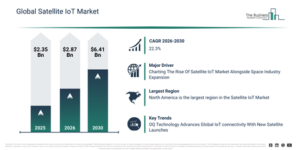
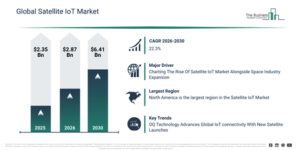
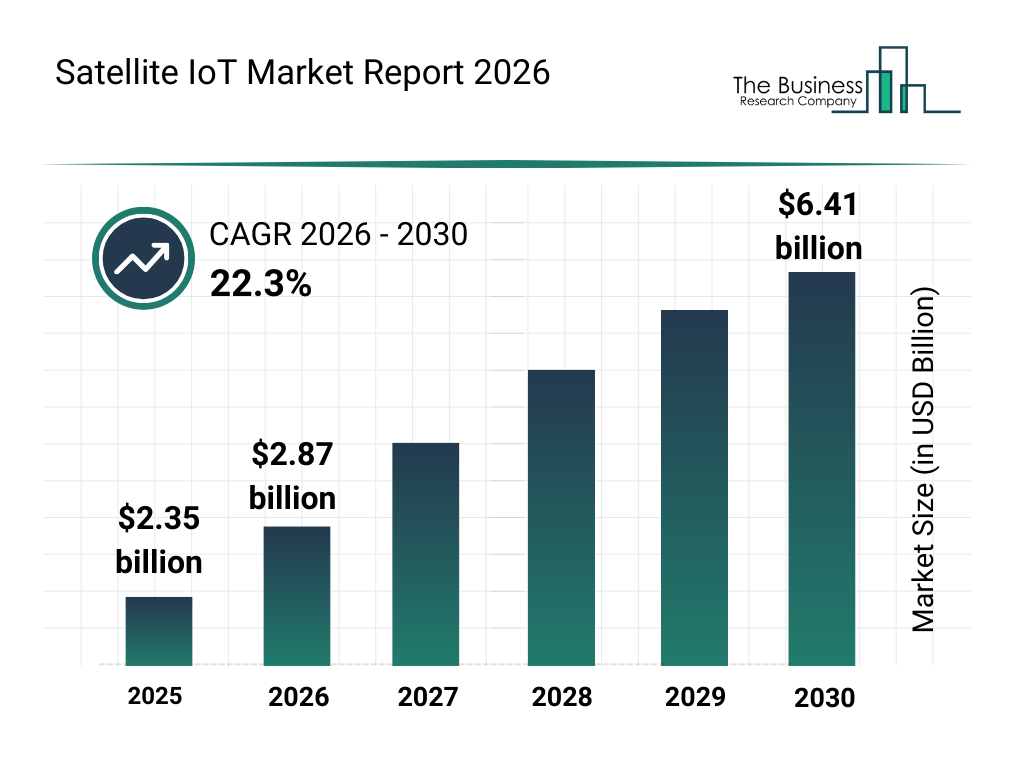
The satellite iot market has experienced significant expansion recently. It is projected to increase from $2.35 billion in 2025 to $2.87 billion in 2026, demonstrating a compound annual growth rate (CAGR) of 22.0%. Historically, this growth can be attributed to several factors: a rising demand for global asset tracking and monitoring within logistics and transportation, the integration of satellite connectivity for agriculture and environmental monitoring, advancements in small satellites, modems, and smart sensors, the increasing utilization of satellite IoT for remote and offshore operations, and the expansion of disaster response and emergency communication services through satellite networks.
The satellite IoT market is projected to experience significant expansion in the coming years. This market is set to reach a value of $6.41 billion by 2030, showing a compound annual growth rate (CAGR) of 22.3%. This anticipated growth is driven by several factors, including the expanded deployment of CubeSats and nanosatellites to improve IoT coverage, the incorporation of AI and analytics for prompt data processing and informed decisions, the growing uptake of satellite IoT in the maritime and aviation industries, the creation of low-power, long-range IoT communication technologies, and the broadening of global connectivity services for industrial and smart city uses. Key trends anticipated during this period encompass the development of low-power wide-area networks (LPWAN) for IoT via satellite, an increase in solutions for maritime and remote asset monitoring, the increasing deployment of CubeSats and small satellite constellations, a greater application of IoT for environmental and agricultural analysis, and the integration of satellite IoT with emergency response and safety protocols.
Request A Free Satellite IoT Market Sample To Support Your Strategic Planning:
What Is Propelling The Satellite IoT Market Toward $6.41 Billion By 2030?
The expanding space industry is projected to boost the future development of the satellite IoT market. This sector encompasses economic endeavors such as producing components for space use, transporting them to orbit, and offering associated services. It aids the enhancement and growth of satellite IoT through affordable and scalable solutions, worldwide connectivity, advanced technological capabilities, and by meeting the distinct requirements of IoT applications across diverse sectors. An example of this expansion is seen in July 2024, when the United Kingdom Space Agency, a government entity in the UK, reported that 175 new UK organizations were involved in space-related activities, marking an 11% rise since 2022. Consequently, the expansion of the space industry is a key factor propelling the satellite IoT market’s growth.
What Are The Key Segments And Subsegments In The Satellite IoT Market?
The satellite iot market covered in this report is segmented –
1) By Service Type: Direct-To-Satellite, Satellite IoT Backhaul
2) By Frequency Band: L-Band, Ku And Ka-Band, S-Band, Other Band Frequency
3) By Enterprise Size: Large Enterprise, Small And Medium-Sized Enterprise
4) By Industry Vertical: Oil And Gas, Transportation And Logistics, Energy And Utilities, Agriculture, Maritime, Healthcare, Military And Defense, Other Industry Verticals
Subsegments:
1) By Direct-To-Satellite: Low-Power Wide Area Network (LPWAN), Global Tracking And Monitoring, Remote Asset Management
2) By Satellite IoT Backhaul: Data Offloading Services, Connectivity Solutions For Remote Areas, Integration With Terrestrial Networks
Satellite IoT Market Trends Behind The 22.3% CAGR Forecast
Major companies operating in the satellite IoT market are concentrating on developing innovative products with technologies such as TIGER-5 and TIGER-6 satellites to improve financial performance in the market. These satellites are expanding the boundaries of 5G connectivity by incorporating the 5G NTN IoT satellite constellation. For instance, in November 2023, OQ Technology, a Luxembourg-based satellite telecom operator, launched TIGER-5 and TIGER-6 satellites on SpaceX’s Falcon 9 during the Transporter-9 rideshare mission. These 6U nanosatellites, which feature NB-IoT cell tower payloads, were deployed into the Low Earth Orbit. The satellites were separated and positioned into orbit 75 minutes after launch, with contact established on the same day.
Major Companies Profiled In The Satellite IoT Market Report
Major companies operating in the satellite iot market are Airbus SE, Northrop Grumman Corporation, Space Exploration Technologies Corp., EchoStar Corporation, Inmarsat Limited, Iridium Communications Inc., Orbcomm, Globalstar Inc., Spire Global Inc., Kepler Communications Inc., Ligado Networks, NanoAvionics Corp., Fleet Space Technologies Pty. Ltd., Skylo Technologies, Actility S.A., Alén Space, Leaf Space, Kineis, Myriota Pty. Ltd., Sateliot, Xona Space Systems Inc., OQ Technology, Hiber AB, Fossa Systems S.L., Sky and Space Global Ltd.
Explore The Business Research Company’s Complete Satellite IoT Market Report:
Where Does The Satellite IoT Market Generate The Most Revenue?
North America was the largest region in the satellite IoT market in 2025. Asia-Pacific is expected to be the fastest-growing region in the forecast period. The regions covered in the satellite iot market report are Asia-Pacific, South East Asia, Western Europe, Eastern Europe, North America, South America, Middle East, Africa.
Reach Out To Our Team:
The Business Research Company: https://www.thebusinessresearchcompany.com/
Americas: +1 310-496-7795
Asia: +44 7882 955267 & +91 8897263534
Europe: +44 7882 955267
Email us at: marketing@tbrc.info
Follow us on:
LinkedIn: https://in.linkedin.com/company/the-business-research-company
YouTube: https://www.youtube.com/channel/UC24_fI0rV8cR5DxlCpgmyFQ
Global Market Model: https://www.thebusinessresearchcompany.com/global-market-model

Wasay has over a decade of experience in market research, data modelling, and analytics, with prior experience at GlobalData and Decision Tree Consulting Services. At The Business Research Company , he leads research operations across syndicated studies, customized consulting engagements, and the Global Market Model platform. His professional experience includes supporting organizations such as Boston Consulting Group, KPMG, and Ernst & Young. Wasay holds a degree in Electronics and Communications Engineering, postgraduate management qualifications from International Management Institute Belgium and Indian School of Business and Entrepreneurship, and completed the Integrated Program in Business Analytics from Indian Institute of Management Indore.