The Business Research Company’s 2026 market reports combine market attractiveness scoring, total addressable market sizing, company benchmarking matrices, interactive Excel dashboards, deeper supply chain intelligence, emerging startup tracking, and granular product-level insights to deliver research that is more actionable and strategically valuable.
Satellite Life-Extension Tug Market Size Review: What Shaped Past Growth And What Will Drive Future Expansion?
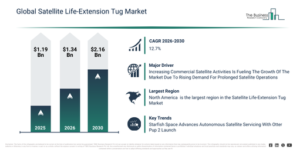
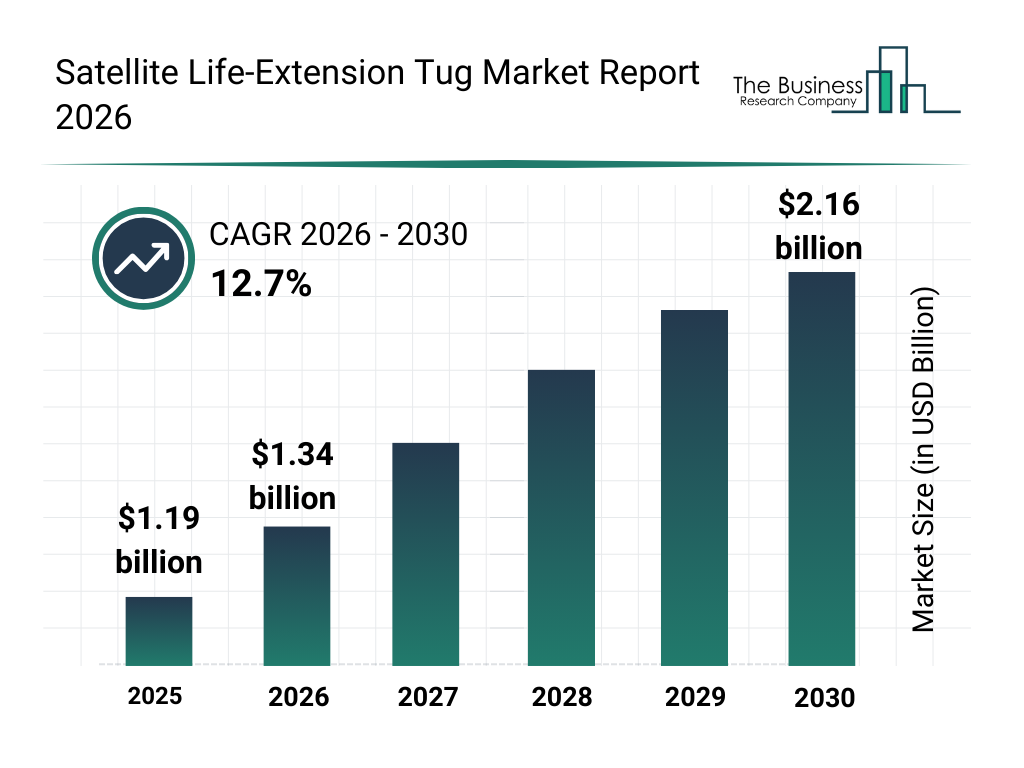
The satellite life-extension tug market size has expanded swiftly in recent years. It is projected to grow from $1.19 billion in 2025 to $1.34 billion in 2026, at a compound annual growth rate (CAGR) of 12.6%. The market’s historic growth is attributable to increasing demand for geostationary satellite services, rising satellite replacement costs, advancements in rendezvous and docking technology, the early adoption of in-space refueling concepts, and government-funded space sustainability initiatives.
The satellite life-extension tug market is poised for significant expansion in the foreseeable future. It is projected to achieve a size of $2.16 billion by 2030, demonstrating a compound annual growth rate (CAGR) of 12.7%. This projected growth is largely due to an increasing population of aging satellites in orbit, the continuous expansion of commercial satellite constellations, advancements in standardized docking interfaces, a growing emphasis on space debris reduction, and strategic alliances formed between satellite operators and tug service providers. Prominent trends expected during this forecast period include the implementation of in-orbit refueling capabilities, the provision of robotic repair and maintenance services, innovations in rendezvous and docking technologies, upgrades to propulsion and power modules, and the adoption of standardized client docking interfaces.
Access Free Sample Pages From The Satellite Life-Extension Tug Market Report 2026:
Understanding The Main Driver Of The Satellite Life-Extension Tug Market
Growing commercial satellite operations are anticipated to fuel the expansion of the satellite life-extension tug market in the future. These activities encompass the deployment, management, and use of satellites by private firms for various services, including communication, earth observation, navigation, and broadcasting. The surge in commercial satellite activities is attributed to a growing number of satellites being launched to provide global connectivity and data-centric services, driven by increasing worldwide demand for internet access, remote monitoring, and space applications. Satellite life-extension tugs support commercial satellite endeavors by providing solutions that prolong the operational duration of satellites, thereby decreasing replacement expenditures and guaranteeing continuous service provision. As an illustration, in January 2024, a report from the US-based non-profit Space Foundation indicated that global launch activity reached unprecedented levels for the third year running in 2023, featuring 223 launch attempts and 212 successful missions. Commercial launches experienced a significant increase, rising by 50% over 2022 figures. This commercial sector growth has spurred substantial demand for new launch vehicles, with 14 planned for their inaugural flights in 2024. Consequently, the expanding commercial satellite activities are a key factor propelling the growth of the satellite life-extension tug market.
Satellite Life-Extension Tug Market Segment Mapping For 2026 And Beyond
The satellite life-extension tug market covered in this report is segmented –
1) By Service Type: Docking, Refueling, Repair And Maintenance
2) By Satellite Type: Low Earth Orbit (LEO), Medium Earth Orbit (MEO), Geostationary Earth Orbit (GEO), Other Types
3) By Application: Commercial, Military, Civil, Other Applications
4) By End-User: Satellite Operators, Satellite Manufacturers, Space Agencies, Other End-Users
Subsegments:
1) By Docking: Direct Docking Systems, Robotic Arm Docking Systems, Magnetic Capture Docking Systems, Grappling Mechanism Docking Systems
2) By Refueling: Propellant Transfer Systems, Cryogenic Fuel Transfer Systems, Electric Propulsion Fuel Transfer Systems, Chemical Propulsion Fuel Transfer Systems
3) By Repair And Maintenance: Satellite Component Replacement, Solar Array Repair, Communication Antenna Adjustment, Thermal System Restoration, Structural Reinforcement
What Key Trend Is Expected To Shape The Satellite Life-Extension Tug Market Over The Forecast Period?
Leading firms within the satellite life-extension tug market are prioritizing the creation of advanced technologies, including autonomous rendezvous, proximity operations, and docking (RPOD) systems, to enhance the safety and dependability of in-orbit servicing. This autonomous RPOD technology encompasses sophisticated computer vision, guidance mechanisms, and universal docking systems, enabling servicing spacecraft to autonomously approach, align with, and connect to client satellites, even when they lack prior preparation for such services. An example of this innovation is Starfish Space, a US-based satellite servicing firm, which introduced Otter Pup 2 in May 2025. This new product incorporates CETACEAN vision-based navigation software, CEPHALOPOD autonomous guidance and control, and the Nautilus universal electrostatic docking mechanism. These integrated features facilitate fully autonomous satellite capture operations in low Earth orbit, thereby lessening reliance on client satellites that require prior preparation. The system’s advantages include increased flexibility, reduced mission expenses, and the potential to expand satellite servicing throughout the commercial space sector. Otter Pup 2 aims to validate these autonomous servicing technologies, setting the stage for comprehensive Otter life-extension missions in collaboration with partners like NASA, Intelsat, and the U.S. Space Force.
Satellite Life-Extension Tug Market Major Players And Industry Competition Overview
Major companies operating in the satellite life-extension tug market are Northrop Grumman Corporation, Thales Alenia Space SAS, Momentus Inc., Astroscale Holdings Inc., Impulse Space Inc., Blue Origin Federation LLC, Orbit Fab, ClearSpace, D-Orbit, Starfish Space, Exotrail, InspeCity, Katalyst Space Technologies, PIAP Space, Infinite Orbits, Rogue Space Systems, Kurs Orbital, Obruta Space Solutions, Atomos Space, OrbitAID Aerospace
Full Satellite Life-Extension Tug Market Report: Market Size, Trends, Segments And Key Players:
Satellite Life-Extension Tug Market Geographic Segmentation: Regions Covered In The Report
North America was the largest region in the satellite life-extension tug market in 2025. Asia-Pacific is expected to be the fastest growing region in the forecast period. The regions covered in the satellite life-extension tug market report are Asia-Pacific, South East Asia, Western Europe, Eastern Europe, North America, South America, Middle East, Africa.
Reach Out To Our Team:
The Business Research Company: https://www.thebusinessresearchcompany.com/
Americas: +1 310-496-7795
Asia: +44 7882 955267 & +91 8897263534
Europe: +44 7882 955267
Email us at: marketing@tbrc.info
Follow us on:
LinkedIn: https://in.linkedin.com/company/the-business-research-company
YouTube: https://www.youtube.com/channel/UC24_fI0rV8cR5DxlCpgmyFQ
Global Market Model: https://www.thebusinessresearchcompany.com/global-market-model

Wasay has over a decade of experience in market research, data modelling, and analytics, with prior experience at GlobalData and Decision Tree Consulting Services. At The Business Research Company , he leads research operations across syndicated studies, customized consulting engagements, and the Global Market Model platform. His professional experience includes supporting organizations such as Boston Consulting Group, KPMG, and Ernst & Young. Wasay holds a degree in Electronics and Communications Engineering, postgraduate management qualifications from International Management Institute Belgium and Indian School of Business and Entrepreneurship, and completed the Integrated Program in Business Analytics from Indian Institute of Management Indore.