With a focus on actionable insights and strategic value, The Business Research Company’s 2026 market reports include market attractiveness scoring, total addressable market sizing, company benchmarking matrices, interactive Excel dashboards, deeper supply chain intelligence, emerging startup tracking, and granular product-level insights.
How Large Could The Satellite Manufacturing And Launch Systems Market Become By 2030 At A 8% CAGR?
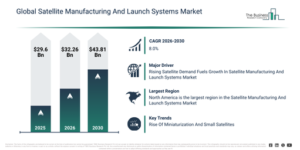
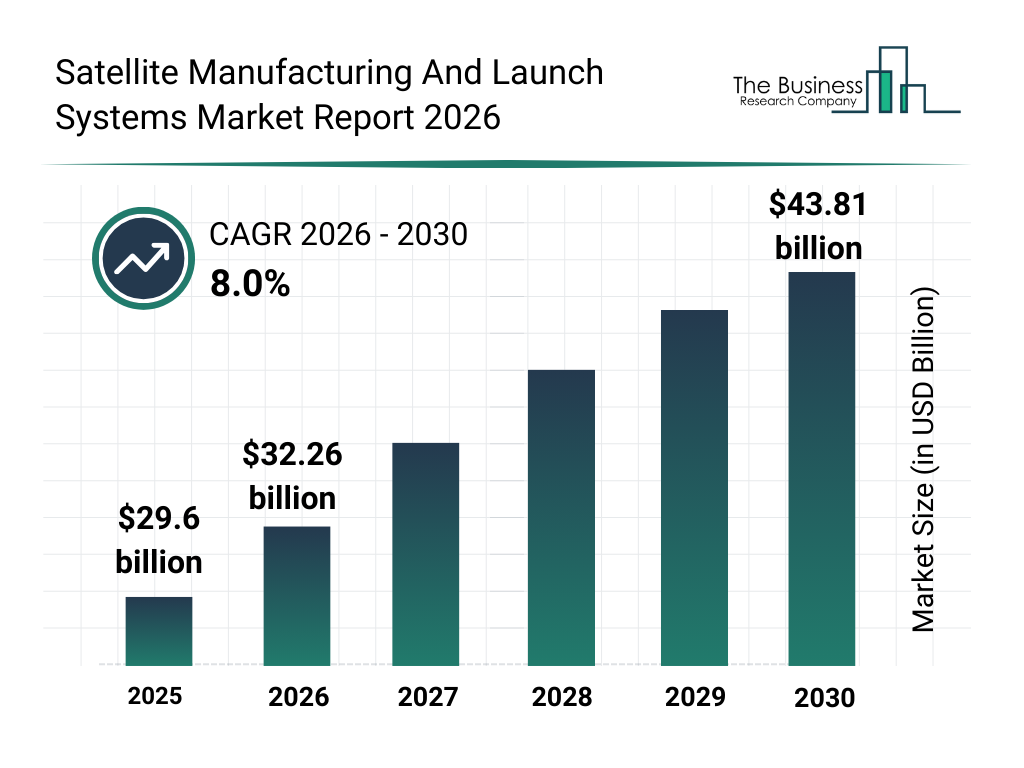
The market for satellite manufacturing and launch systems has experienced robust expansion in recent years, with projections indicating growth from $29.6 billion in 2025 to $32.26 billion in 2026, demonstrating a compound annual growth rate (CAGR) of 9.0%. Historically, this growth is a result of several factors, including the widening of global satellite communication and earth-observation initiatives, a rise in satellite deployments across Low Earth Orbit (LEO), Medium Earth Orbit (MEO), and Geostationary Earth Orbit (GEO), innovations in lightweight satellite components and integration of subsystems, an increase in government-funded space missions boosting demand for launch systems, and the creation of standardized launch capabilities for both highly elliptical and sun-synchronous orbits.
The satellite manufacturing and launch systems market is projected to experience substantial expansion over the coming years, reaching $43.81 billion by 2030, demonstrating an 8.0% compound annual growth rate (CAGR). This expansion during the forecast period is driven by several factors, including the increasing need for small satellite constellations that necessitate frequent launches, the broader commercialization of launch services across various orbital classes, progress in modular satellite manufacturing aimed at lowering costs and accelerating production, the development of multi-orbit mission planning through enhanced transfer-orbit technologies, and the expansion of public-private collaborations to bolster global launch infrastructure. Key trends anticipated in this period encompass the miniaturization of satellite components, the creation of high-performance reusable launch vehicles, the adoption of modular satellite designs for swift deployment, the growth of multi-orbit satellite constellations, and improvements in telemetry and remote monitoring systems.
Get A Free Satellite Manufacturing And Launch Systems Market Sample With 2030 Forecast Insights:
Satellite Manufacturing And Launch Systems Market Outlook: Key Driver Supporting Long-Term Growth
The rising demand for satellites from the civil/government, commercial, and military sectors is a significant factor contributing to the expansion of the satellite manufacturing and launch market. Military forces globally are rapidly employing satellite technologies to enhance their defense capabilities. Various tests and experiments are being conducted worldwide by government organizations and defense forces to develop space-attacking facilities. Space warfare encompasses several forms, such as ground-to-space war (e.g., attacking satellites from earth), space-to-space war (e.g., satellites attacking satellites), and space-to-earth war (e.g., satellites targeting earth-based objects). For instance, in June 2024, SpaceNews, a US-based non-governmental organization, reported that in 2023, U.S. manufacturers were responsible for approximately 85% of commercially procured satellites, with satellite manufacturing revenue increasing by 9% to $17.2 billion, driven by flexible software-defined payloads and advanced small satellites. A record 190 commercially procured launches took place, marking an 18% increase from 2022. These launches deployed 2,781 commercial satellites, up 20% year-over-year, largely propelled by SpaceX. Therefore, the increased demand for satellites from the civil/government, commercial, and military sectors is anticipated to drive the growth of the satellite manufacturing and launch market.
Segmentation Of The Satellite Manufacturing And Launch Systems Market: Key Categories Explained
The satellite manufacturing and launch systems market covered in this report is segmented –
1) By Technology Type: Satellite Manufacturing, Satellite Launch System
2) By Satellite Type: Lower Earth Orbit (LEO) Satellites, Medium Earth Orbit (MEO) Satellites, Geosynchronous Equatorial Orbit (GEO) Satellites, Beyond GEO Satellites
3) By Application: Commercial Communications, Government Communications, Earth Observation Services, Research and Development, Navigation, Military Surveillance, Scientific Applications, Other Applications
4) By End-User: Military and Government, Commercial, Other End-Users
Subsegments:
1) By Satellite Manufacturing: Small Satellites, Medium Satellites, Large Satellites, Satellite Components
2) By Satellite Launch System: Expendable Launch Vehicles (ELVs), Reusable Launch Vehicles (RLVs), Hybrid Launch Vehicles
Satellite Manufacturing And Launch Systems Market Evolving Trends: What Businesses Should Know
Leading enterprises within the satellite manufacturing and launch systems market are focusing on the creation of miniature and small satellites to secure a competitive advantage. These miniaturized satellites, including types like CubeSats and SmallSats, present economical choices for diverse applications such as Earth observation, communication, and scientific investigations. As an example, in May 2023, Rocket Lab, Inc., an aerospace manufacturing firm located in the US, deployed two NASA CubeSats specifically engineered to monitor tropical storms. The TROPICS (Time-Resolved Observations of Precipitation structure and storm Intensity with a Constellation of Smallsats) CubeSats were positioned into a 550-kilometer orbit, furnishing vital information for observing tropical storm progression. An additional launch, utilizing an Electron vehicle, is slated to transport two more TROPICS CubeSats, which will finalize the four-satellite system. This comprehensive constellation is expected to provide hourly updates on temperature and water vapor profiles, leading to a substantial enhancement in the comprehension of storm formation and intensification, and boosting the accuracy of hurricane and tropical weather system forecasts.
Who Competes In The Satellite Manufacturing And Launch Systems Market? Major Companies Listed
Major companies operating in the satellite manufacturing and launch systems market are Northrop Grumman Corporation, ArianeGroup, Space Exploration Technologies Corp., Blue Origin LLC, Lockheed Martin Corporation, The Boeing Company, Sierra Nevada Corporation, Thales Group, Maxar Technologies Inc., Dynetics Inc., NanoAvionics UAB, Israel Aerospace Industries Ltd., OHB SE, Airbus SE, China Aerospace Science and Technology Corporation, Mitsubishi Heavy Industries Ltd., SpaceQuest Ltd, GomSpace Group AB, Planet Labs Inc., United Launch Alliance LLC, Rocket Lab USA Inc., GeoOptics Inc., Honeywell International Inc., BAE Systems plc, Safran S.A., Parker Hannifin Corporation, Cobham plc., Kratos Defense & Security Solutions Inc.
Read The Complete Satellite Manufacturing And Launch Systems Market Forecast Report Through 2030:
Satellite Manufacturing And Launch Systems Market Regional Ranking: Which Geography Comes First?
North America was the largest region in the satellite manufacturing and launch systems market in 2025. The Asia-Pacific is expected to be the fastest-growing region in the forecast period. The regions covered in the satellite manufacturing and launch systems market report are Asia-Pacific, South East Asia, Western Europe, Eastern Europe, North America, South America, Middle East, Africa.
Reach Out To Our Team:
The Business Research Company: https://www.thebusinessresearchcompany.com/
Americas: +1 310-496-7795
Asia: +44 7882 955267 & +91 8897263534
Europe: +44 7882 955267
Email us at: marketing@tbrc.info
Follow us on:
LinkedIn: https://in.linkedin.com/company/the-business-research-company
YouTube: https://www.youtube.com/channel/UC24_fI0rV8cR5DxlCpgmyFQ
Global Market Model: https://www.thebusinessresearchcompany.com/global-market-model

Wasay has over a decade of experience in market research, data modelling, and analytics, with prior experience at GlobalData and Decision Tree Consulting Services. At The Business Research Company , he leads research operations across syndicated studies, customized consulting engagements, and the Global Market Model platform. His professional experience includes supporting organizations such as Boston Consulting Group, KPMG, and Ernst & Young. Wasay holds a degree in Electronics and Communications Engineering, postgraduate management qualifications from International Management Institute Belgium and Indian School of Business and Entrepreneurship, and completed the Integrated Program in Business Analytics from Indian Institute of Management Indore.