
The Business Research Company’s 2026 market reports combine market attractiveness scoring, total addressable market sizing, company benchmarking matrices, interactive Excel dashboards, deeper supply chain intelligence, emerging startup tracking, and granular product-level insights to deliver research that is more actionable and strategically valuable.
#Solid Rocket Propellant Market Size Review: What Shaped Past Growth And What Will Drive Future Expansion?#_x000D_
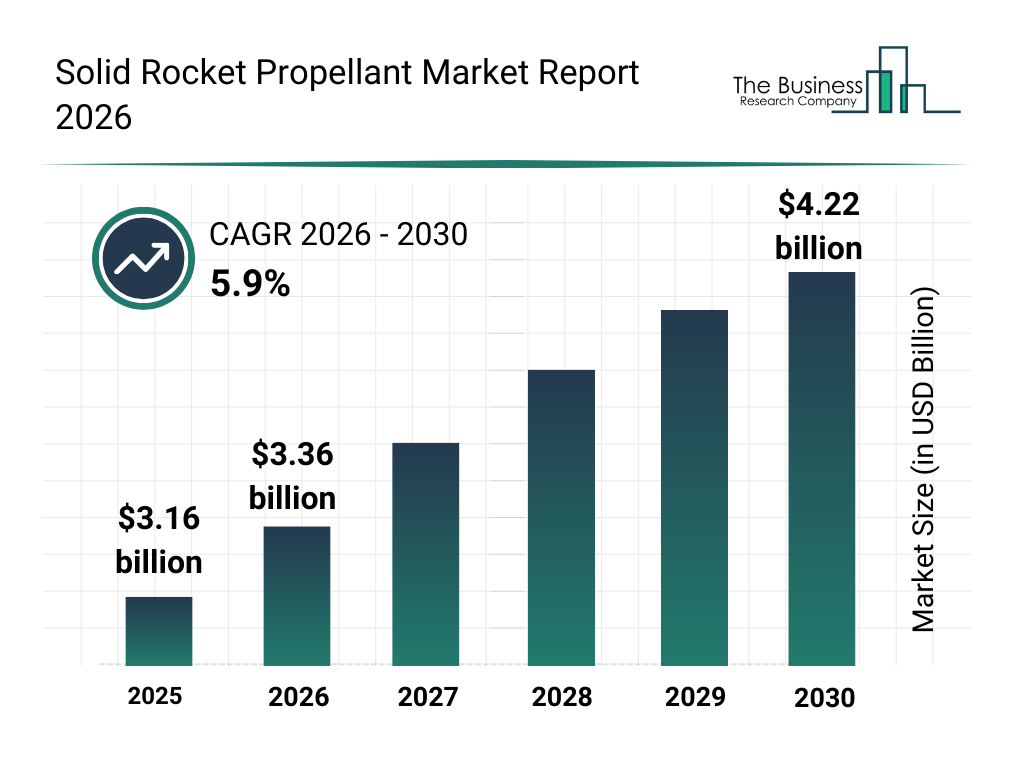
The solid rocket propellant market has experienced significant expansion recently. Its valuation is projected to increase from $3.16 billion in 2025 to $3.36 billion in 2026, exhibiting a compound annual growth rate (CAGR) of 6.3%. Historically, this expansion has been driven by several factors, including the greater application of double-base propellants in early missile and launch systems due to their simpler production, the creation of high-energy propellants for enhanced thrust in defense and space missions, the growing preference for low-smoke formulations to boost visibility and decrease detection during launches, enhancements in propellant processing that improve burn consistency and dependability, and the proliferation of government and defense initiatives which stimulate continuous demand for solid propulsion substances._x000D_
_x000D_
The solid rocket propellant market size is projected to experience robust growth in the coming years, reaching $4.22 billion by 2030 with a compound annual growth rate (CAGR) of 5.9%. This anticipated growth is fueled by several factors, including a growing interest in green propellants to meet environmental and regulatory compliance, innovations in nano-composite formulations that enhance energy density and thermal stability, increased investment in energetic thermoplastic elastomer propellants for improved safety and recyclability, a heightened demand for high-performance missiles and launch vehicles driving the adoption of next-generation solid propellants, and advancements in automated manufacturing that improve the consistency and scalability of solid propellant production. Key trends expected during this forecast period include progress in high-energy propellant chemistry, a shift towards low-smoke and green propellant formulations, expanded use of nano-composites for enhanced performance, a rising demand for reliable solid boosters in defense programs, and the expansion of commercial space launch activities._x000D_
_x000D_
#Access Free Sample Pages From The Solid Rocket Propellant Market Report 2026:#_x000D_
_x000D_
#Understanding The Main Driver Of The Solid Rocket Propellant Market#_x000D_
The solid rocket propellant market is anticipated to expand due to the escalating demand for satellite launches. Satellite launches involve sending artificial satellites into space via rockets or other launch vehicles. This surge in demand stems from a growing global need for connectivity, as more areas require dependable internet access through satellite broadband services. Solid rocket propellant supports satellite launches by offering dependable, high-thrust propulsion, which is perfect for carrying payloads into orbit. It streamlines launch systems by removing intricate fuel setups, facilitating quicker response times and economical mission execution. For example, in June 2024, the US-based Satellite Industry Association reported that the commercial satellite industry experienced unprecedented growth in 2023, deploying 2,781 satellites, representing a 20% increase from 2022. The broader space industry also hit a new record with 190 total launches, the highest number ever documented. By year-end, the count of operational satellites stood at 9,691, indicating a 361% rise over the last five years. Consequently, the rising need for satellite launches is fueling the expansion of the solid rocket propellant market._x000D_
_x000D_
#Solid Rocket Propellant Market Segment Mapping For 2026 And Beyond#_x000D_
The solid rocket propellant market covered in this report is segmented – _x000D_
_x000D_
1) By Type: Composite Propellants, Homogeneous Propellants, Heterogeneous Propellants_x000D_
2) By Propellant Composition: Ammonium Perchlorate, Potassium Nitrate, Hydroxy-Terminated Polybutadiene (HTPB), Aluminum Powder_x000D_
3) By End-Use Industry: Military, Aerospace, Commercial_x000D_
_x000D_
Subsegments:_x000D_
1) By Composite Propellants: Hydroxyl-Terminated Polybutadiene (HTPB) Based, Ammonium Perchlorate (AP) Based, Aluminum Fuel Based_x000D_
2) By Homogeneous Propellants, Double-Base Propellants, Triple-Base Propellants_x000D_
3) By Heterogeneous Propellants: Fuel-Rich Propellants, Oxidizer-Rich Propellants_x000D_
_x000D_
#What Key Trend Is Expected To Shape The Solid Rocket Propellant Market Over The Forecast Period?#_x000D_
Major companies in the solid rocket propellant market are focusing on developing advanced products, such as medium-lift rockets, to boost payload capacity and mission versatility. Medium-lift rockets are launch vehicles designed to carry payloads typically between 2,000 and 20,000 kilograms into low Earth orbit, bridging the gap between small- and heavy-lift rockets for a wide array of satellite and mission requirements. For instance, in January 2024, Orienspace Technology Co. Ltd., a China-based space technology company, launched the Gravity-1 rocket, an advanced solid propellant rocket. This medium-lift rocket marked a new milestone in the commercial space sector by achieving an approximate payload capacity of 6,500 kilograms to low Earth orbit. The Gravity-1 rocket is equipped with a three-stage core and four solid-fuel side boosters, generating approximately 600 tons of thrust at liftoff and capable of transporting up to 6.5 tons to low Earth orbit._x000D_
_x000D_
#Solid Rocket Propellant Market Major Players And Industry Competition Overview#_x000D_
Major companies operating in the solid rocket propellant market are Northrop Grumman Corporation, BAE Systems plc, L3Harris Technologies Inc., IHI Corporation, Rheinmetall AG, Elbit Systems Ltd., Hanwha Aerospace Co. Ltd., ArianeGroup SAS, Roketsan A.S., Nammo AS, General Dynamics Ordnance And Tactical Systems, Eurenco S.A., TNO Defence Safety and Security, Roxel Group, Avibras Industria Aeroespacial S/A, Avio S.p.A., Black Sky Industries, Ursa Major Technologies Inc., Indian Space Research Organisation, Rafael Advanced Defense Systems Ltd. _x000D_
_x000D_
#Full Solid Rocket Propellant Market Report: Market Size, Trends, Segments And Key Players:#_x000D_
_x000D_
#Solid Rocket Propellant Market Geographic Segmentation: Regions Covered In The Report#_x000D_
North America was the largest region in the solid rocket propellant market in 2025. Asia-Pacific is expected to be the fastest-growing region in the forecast period. The regions covered in the solid rocket propellant market report are Asia-Pacific, South East Asia, Western Europe, Eastern Europe, North America, South America, Middle East, Africa._x000D_
_x000D_
#Reach Out To Our Team:#_x000D_
_x000D_
The Business Research Company: https://www.thebusinessresearchcompany.com/_x000D_
Americas: +1 310-496-7795_x000D_
Asia: +44 7882 955267 & +91 8897263534_x000D_
Europe: +44 7882 955267_x000D_
Email us at: marketing@tbrc.info_x000D_
_x000D_
#Follow us on:#_x000D_
_x000D_
LinkedIn: https://in.linkedin.com/company/the-business-research-company_x000D_
YouTube: https://www.youtube.com/channel/UC24_fI0rV8cR5DxlCpgmyFQ_x000D_
Global Market Model: https://www.thebusinessresearchcompany.com/global-market-model

Wasay has over a decade of experience in market research, data modelling, and analytics, with prior experience at GlobalData and Decision Tree Consulting Services. At The Business Research Company , he leads research operations across syndicated studies, customized consulting engagements, and the Global Market Model platform. His professional experience includes supporting organizations such as Boston Consulting Group, KPMG, and Ernst & Young. Wasay holds a degree in Electronics and Communications Engineering, postgraduate management qualifications from International Management Institute Belgium and Indian School of Business and Entrepreneurship, and completed the Integrated Program in Business Analytics from Indian Institute of Management Indore.

