
Market attractiveness scoring, total addressable market sizing, company benchmarking matrices, interactive Excel dashboards, deeper supply chain intelligence, emerging startup tracking, and granular product-level insights are among the key offerings featured in The Business Research Company’s 2026 market reports, designed to deliver more actionable and strategically valuable research.
#Space Based Fuel Management System Market Growth Outlook: How Much Bigger Will The Market Be By 2030?#_x000D_
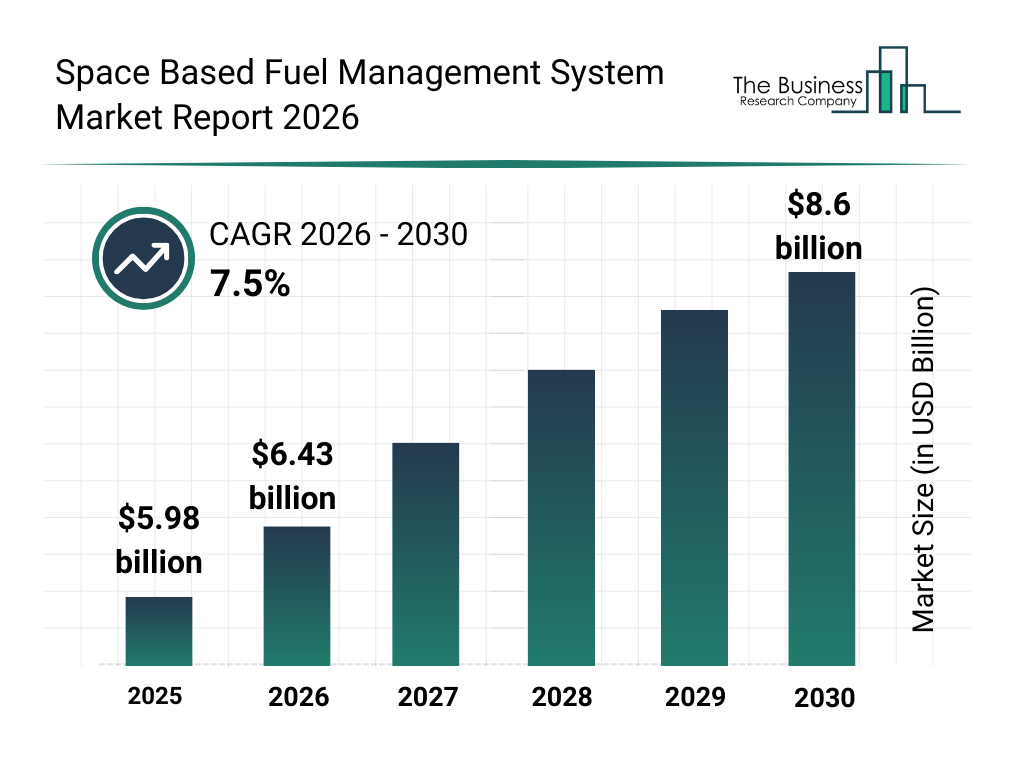
The space based fuel management system market has experienced robust growth in recent years. It is forecast to grow from $5.98 billion in 2025 to $6.43 billion in 2026, achieving a compound annual growth rate (CAGR) of 7.7%. The expansion witnessed in the historic period can be attributed to several factors, including the increased deployment of satellites driving demand for accurate fuel tank management systems, a rising need for orbital maneuvering efficiency boosting the adoption of advanced fuel monitoring sensors, the growth in remote spacecraft operations requiring reliable remote fuel management interfaces, advancements in valve fuel monitoring software improving mission control precision, and the expansion of satellite lifetime extension initiatives increasing reliance on fuel efficiency analytics._x000D_
_x000D_
The space based fuel management system market is projected to experience substantial expansion in the coming years. It is forecasted to reach $8.6 billion by 2030, exhibiting a compound annual growth rate (CAGR) of 7.5%. This anticipated growth over the forecast period stems from several factors, including the evolution of orbital refueling innovations that facilitate extended satellite mission durations, the increasing uptake of AI-powered fuel optimization instruments to enhance spacecraft operational effectiveness, the expanding deployment of extensive satellite constellations necessitating adaptable fuel management solutions, the rise in in-orbit servicing operations elevating the requirement for accurate fuel status insights, and improvements in miniaturized fuel sensors and digital twin technology for better predictive fuel management and mission planning. Key developments expected during this period involve advancements in micro-propulsion and fuel-efficient thruster systems, a growing need for real-time fuel data and automated monitoring platforms, the creation of lightweight composite fuel tanks and highly durable materials, a surge in the adoption of on-orbit refueling and servicing missions, and the incorporation of multi-fuel system designs for prolonged deep-space endeavors._x000D_
_x000D_
#Request A Free Space Based Fuel Management System Market Sample From The Business Research Company:#_x000D_
_x000D_
#How Is The Key Growth Driver Influencing The Space Based Fuel Management System Market?#_x000D_
The expanding number of satellite launches is anticipated to drive the future expansion of the space-based fuel management systems market. Satellite launches involve deploying satellites into orbit via launch vehicles. As more satellites populate orbit, space-based fuel management systems will become crucial for optimizing fuel usage, enhancing mission effectiveness, and extending operational lifespan. An illustrative example comes from January 2024, when the Space Foundation, a US-based nonprofit organization fostering space education, innovation, and collaboration worldwide, reported that global launch activity reached an unprecedented high for the third consecutive year. This included 223 launch attempts and 212 successful missions, with commercial launches increasing by 50% compared to 2022. Consequently, the rise in satellite launches fuels the space-based fuel management systems market._x000D_
_x000D_
#Space Based Fuel Management System Market Segmentation By Category: What Does The 2026 Report Cover?#_x000D_
The space based fuel management system market covered in this report is segmented – _x000D_
_x000D_
1) By Component: Engine, Tank, Pumps, Flow Control Components, Heat Exchanger, Engine Control Unit, Other Components_x000D_
2) By Fuel Type: Solid, Liquid_x000D_
3) By Application: Satellite, Deep Space Vehicle, Launch Vehicle_x000D_
_x000D_
Subsegments:_x000D_
1) By Engine: Rocket Engines, Auxiliary Engines _x000D_
2) By Tank: Fuel Tanks, Oxidizer Tanks _x000D_
3) By Pumps: Fuel Pumps, Oxidizer Pumps, Flow Control Components _x000D_
4) By Flow Control Components: Valves, Flow Meters _x000D_
5) By Heat Exchanger: Regenerative Heat Exchangers, Recuperative Heat Exchangers _x000D_
6) By Engine Control Unit: Digital Control Units, Analog Control Units _x000D_
7) By Other Components: Sensors, Piping And Fittings_x000D_
_x000D_
#How Are Industry Players Changing The Space Based Fuel Management System Market Landscape?#_x000D_
Major companies operating in the space-based fuel management system market are prioritizing advanced spacecraft agreements to satisfy the growing demand for efficient satellite propulsion and mission capabilities. These advanced spacecraft contracts encompass intricate understandings between space agencies, private sector firms, and international collaborators, outlining technical specifications, operational parameters, and financial commitments for cutting-edge space exploration endeavors. For instance, in July 2023, Lockheed Martin, a US-based dynamic software engineering company, was awarded a contract from the Defense Advanced Research Projects Agency (DARPA) to develop and demonstrate a nuclear-powered spacecraft under a project named Demonstration Rocket for Agile Cislunar Operations (DRACO). This project is poised to represent a significant advancement in propulsion technology, benefiting both exploration and national defense._x000D_
_x000D_
#Space Based Fuel Management System Market Global Key Players And Competitive Overview#_x000D_
Major companies operating in the space based fuel management system market are The Boeing Company, Lockheed Martin Corporation, Airbus SE, Northrop Grumman Corporation, Safran S.A., L3Harris Technologies Inc., TE Connectivity Ltd, Ball Aerospace & Technologies Corp., AMETEK.Inc., Teledyne Technologies Incorporated, Raytheon Technologies Corp, Moog Inc., Cobham Limited, Space Exploration Technologies Corp., Maxar Technologies Inc, Rocket Lab USA Inc, Firefly Aerospace Inc, NanoAvionics Corp, Reaction Engines Limited, Exotrail SA, Accion System Inc, Virgin Galactic Holdings Inc., Orbion Space Technology Inc, Benchmark Space System Inc, IHI Aerospace Co. Ltd, Microcosm Inc., Thales Alenia Space SAS, ThrustMe _x000D_
_x000D_
#Explore Comprehensive Space Based Fuel Management System Market Coverage In The Full Report:#_x000D_
_x000D_
#Regional Analysis Of The Space Based Fuel Management System Market: Where Is The Industry Concentrated?#_x000D_
Europe was the largest region in the space based fuel management system market in 2025. The regions covered in the space based fuel management system market report are Asia-Pacific, South East Asia, Western Europe, Eastern Europe, North America, South America, Middle East, Africa._x000D_
_x000D_
#Reach Out To Our Team:#_x000D_
_x000D_
The Business Research Company: https://www.thebusinessresearchcompany.com/_x000D_
Americas: +1 310-496-7795_x000D_
Asia: +44 7882 955267 & +91 8897263534_x000D_
Europe: +44 7882 955267_x000D_
Email us at: marketing@tbrc.info_x000D_
_x000D_
#Follow us on:#_x000D_
_x000D_
LinkedIn: https://in.linkedin.com/company/the-business-research-company_x000D_
YouTube: https://www.youtube.com/channel/UC24_fI0rV8cR5DxlCpgmyFQ_x000D_
Global Market Model: https://www.thebusinessresearchcompany.com/global-market-model

Wasay has over a decade of experience in market research, data modelling, and analytics, with prior experience at GlobalData and Decision Tree Consulting Services. At The Business Research Company , he leads research operations across syndicated studies, customized consulting engagements, and the Global Market Model platform. His professional experience includes supporting organizations such as Boston Consulting Group, KPMG, and Ernst & Young. Wasay holds a degree in Electronics and Communications Engineering, postgraduate management qualifications from International Management Institute Belgium and Indian School of Business and Entrepreneurship, and completed the Integrated Program in Business Analytics from Indian Institute of Management Indore.

