The Business Research Company’s 2026 market reports combine market attractiveness scoring, total addressable market sizing, company benchmarking matrices, interactive Excel dashboards, deeper supply chain intelligence, emerging startup tracking, and granular product-level insights to deliver research that is more actionable and strategically valuable.
#Space Debris Removal Satellite Electronics Market Revenue Forecast: $1.69 Billion In 2026 Rising To $3.2 Billion In 2030#_x000D_
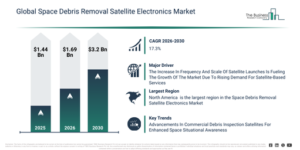
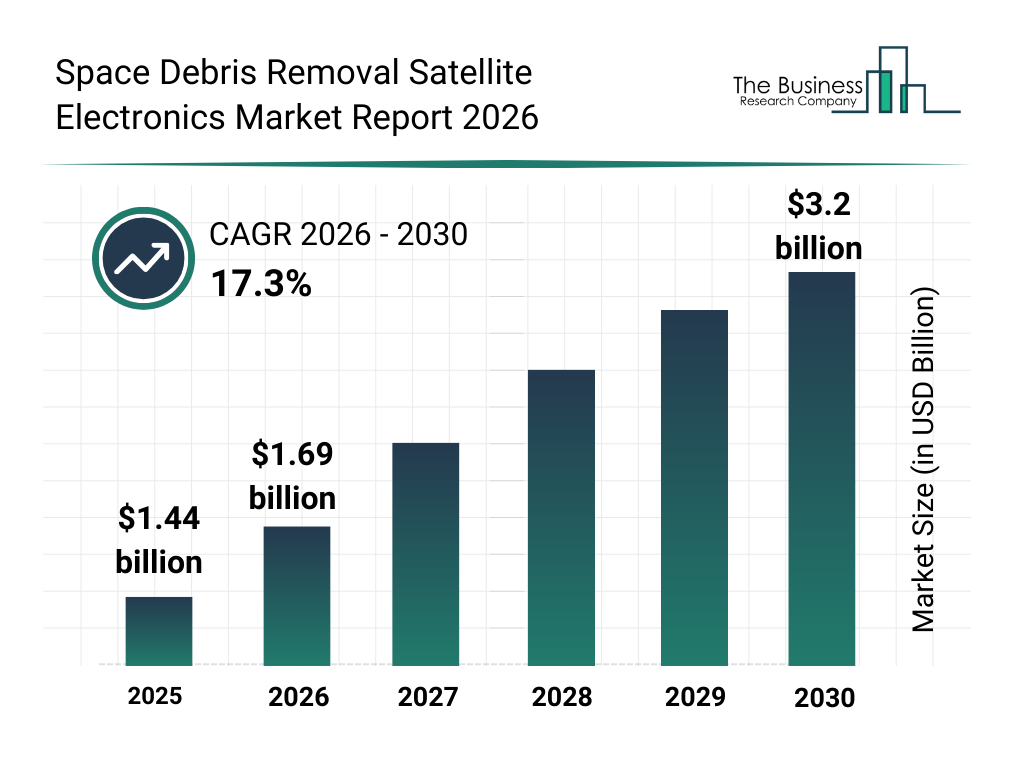
The space debris removal satellite electronics market has seen substantial expansion in recent years. Its value is expected to increase from $1.44 billion in 2025 to $1.69 billion in 2026, demonstrating a compound annual growth rate (CAGR) of 17.4%. This growth observed historically stems from various factors, such as an uptick in orbital debris incidents, advancements in radar and optical sensors, increased investment in space situational awareness, the initial adoption of autonomous guidance systems, and government-funded debris tracking programs._x000D_
_x000D_
The space debris removal satellite electronics market is projected to experience significant expansion in the coming years. This market is forecast to reach $3.2 billion in 2030, exhibiting a compound annual growth rate (CAGR) of 17.3%. This anticipated growth is driven by factors such as an increase in commercial satellite launches, the creation of sophisticated autonomous debris capture systems, the incorporation of AI-based navigation, the broadening of international space debris regulations, and a rise in collaborations between space agencies and private entities. Key trends expected during this period involve AI-driven autonomous navigation for tracking debris, the development of cybersecure communication electronics for debris removal satellites, IoT-enabled multisensor fusion electronics, robotics-assisted electronics for debris interaction, and advanced automated manufacturing processes for satellite electronics._x000D_
_x000D_
#Free Sample Report: Space Debris Removal Satellite Electronics Market Size, Trends And Forecast To 2030:#_x000D_
_x000D_
#Space Debris Removal Satellite Electronics Market Growth Catalyst: What Is Creating New Demand?#_x000D_
The space debris removal satellite electronics market is anticipated to grow due to the rising frequency and expanding scale of satellite launches. Satellite launch frequency denotes the number of deployments, while scale refers to the extent of launch campaigns. This increase is primarily driven by the escalating demand for global broadband and data connectivity, which has led to the greater deployment of extensive low-Earth orbit (LEO) satellite constellations. Consequently, the growing number of inactive or defunct satellites in orbit necessitates advanced systems for tracking, capturing, and safely eliminating debris, thereby boosting demand for space debris removal satellite electronics. For example, according to the Satellite Industry Association (SIA), a US-based trade association, their May 2025 report indicated that a total of 259 launches (including 224 commercially procured) occurred in 2024, with worldwide commercial launch revenues climbing to $9.3 billion, representing a 30 percent increase from 2023. This demonstrates how the increasing frequency and scale of satellite launches are propelling the growth of the space debris removal satellite electronics market._x000D_
_x000D_
#Space Debris Removal Satellite Electronics Market Segment Overview: Categories Covered In The 2026 Report#_x000D_
The space debris removal satellite electronics market covered in this report is segmented – _x000D_
_x000D_
1) By Component: Power Systems, Communication Systems, Onboard Computers, Sensors, Actuators, Other Components_x000D_
2) By Orbit Type: Low Earth Orbit (LEO), Medium Earth Orbit (MEO), Geostationary Orbit (GEO), Other Orbit Types_x000D_
3) By Technology: Active Debris Removal, Passive Debris Removal_x000D_
4) By Application: Commercial, Government, Military_x000D_
_x000D_
Subsegments:_x000D_
1) By Power Systems: Solar Panels, Batteries, Power Management And Distribution Units (PMAD), Fuel Cells, Capacitors_x000D_
2) By Communication Systems: Antennas, Transceivers, Modulators Or Demodulators, Radio Frequency Front-End Modules, Optical Communication Devices_x000D_
3) By Onboard Computers: Flight Computers, Data Handling Units, Avionics Control Units, Embedded Processors, Memory Modules_x000D_
4) By Sensors: Optical Sensors, Lidar Sensors, Radar Sensors, Thermal Sensors, Gyroscopes And Accelerometers_x000D_
5) By Actuators: Reaction Wheels, Thrusters, Magnetic Torquers, Servo Motors, Piezoelectric Actuators_x000D_
6) By Other Components: Thermal Control Units, Mechanical Structures And Frames, Shielding And Protective Devices, Microelectronics, Cabling And Connectors_x000D_
_x000D_
#How Are Leading Companies Shaping Space Debris Removal Satellite Electronics Market Trends?#_x000D_
Companies operating within the space debris removal satellite electronics market are concentrating on developing technological advancements, such as commercial debris inspection demonstration satellites, to enhance situational awareness and promote sustainable space operations. A commercial debris inspection demonstration satellite is defined as a spacecraft created by private (commercial) companies specifically to inspect and monitor space debris in orbit. For instance, in February 2024, Astroscale Japan Inc., a Japan-based orbital services company, launched the Active Debris Removal by Astroscale-Japan (ADRAS-J), which is a commercial debris inspection demonstration satellite. The mission aimed to showcase Rendezvous and Proximity Operations (RPO) by approaching a non-cooperative target, specifically the upper stage of a Japanese H-IIA rocket. As this object lacked onboard positioning systems, the operation necessitated innovative navigation techniques. To achieve this, Astroscale successfully guided ADRAS-J toward the target by integrating ground-based tracking data with advanced onboard sensors._x000D_
_x000D_
#Space Debris Removal Satellite Electronics Market Players: Key Companies Shaping Competition#_x000D_
Major companies operating in the space debris removal satellite electronics market are Sierra Space Corporation, Japan Aerospace Exploration Agency, Redwire Corporation, Astroscale Holdings Inc., GomSpace Group AB, Surrey Satellite Technology Limited, LeoLabs Inc., ClearSpace SA, ExoAnalytic Solutions Inc., Exotrail Inc., ThrustMe Inc., HPS GmbH, Astro Digital Inc., Rogue Space Systems Corporation, Sky Perfect JSAT Corporation, Indian Space Research Organisation, Lumi Space SA, Neuraspace Pte Ltd, Kayhan Space Inc., Momentus Inc. _x000D_
_x000D_
#Access Complete Space Debris Removal Satellite Electronics Market Data, Forecasts And Competitive Insights:#_x000D_
_x000D_
#Space Debris Removal Satellite Electronics Market Regional Performance And Geographic Coverage#_x000D_
North America was the largest region in the space debris removal satellite electronics market in 2025. Asia-Pacific is expected to be the fastest-growing region in the forecast period. The regions covered in the space debris removal satellite electronics market report are Asia-Pacific, South East Asia, Western Europe, Eastern Europe, North America, South America, Middle East, Africa._x000D_
_x000D_
#Reach Out To Our Team:#_x000D_
_x000D_
The Business Research Company: https://www.thebusinessresearchcompany.com/_x000D_
Americas: +1 310-496-7795_x000D_
Asia: +44 7882 955267 & +91 8897263534_x000D_
Europe: +44 7882 955267_x000D_
Email us at: marketing@tbrc.info_x000D_
_x000D_
#Follow us on:#_x000D_
_x000D_
LinkedIn: https://in.linkedin.com/company/the-business-research-company_x000D_
YouTube: https://www.youtube.com/channel/UC24_fI0rV8cR5DxlCpgmyFQ_x000D_
Global Market Model: https://www.thebusinessresearchcompany.com/global-market-model

Wasay has over a decade of experience in market research, data modelling, and analytics, with prior experience at GlobalData and Decision Tree Consulting Services. At The Business Research Company , he leads research operations across syndicated studies, customized consulting engagements, and the Global Market Model platform. His professional experience includes supporting organizations such as Boston Consulting Group, KPMG, and Ernst & Young. Wasay holds a degree in Electronics and Communications Engineering, postgraduate management qualifications from International Management Institute Belgium and Indian School of Business and Entrepreneurship, and completed the Integrated Program in Business Analytics from Indian Institute of Management Indore.