With a focus on actionable insights and strategic value, The Business Research Company’s 2026 market reports include market attractiveness scoring, total addressable market sizing, company benchmarking matrices, interactive Excel dashboards, deeper supply chain intelligence, emerging startup tracking, and granular product-level insights.
Reusable Launch Vehicle Market Size Analysis: Historical Growth And Future Revenue Projections
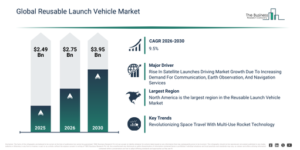
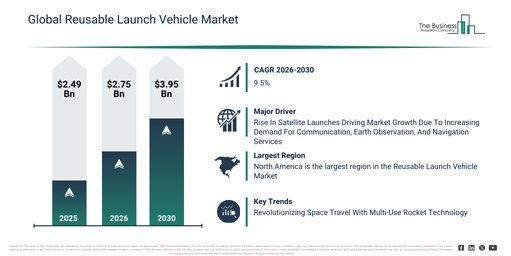
The reusable launch vehicle market has experienced substantial growth over the past few years. It is projected to expand from $2.49 billion in 2025 to $2.75 billion in 2026, at a compound annual growth rate (CAGR) of 10.2%. This historical growth can be attributed to factors such as early demonstrations of reusable rocket stages by private launch providers, increasing demand for more affordable access to space fueling interest in reusability, the development of advanced thermal protection systems facilitating safe vehicle return, rising satellite deployment requirements necessitating frequent launch cycles, and improvements in propulsion reliability that enhance reflight capability.
The reusable launch vehicle market is projected to experience substantial expansion in the coming years, reaching a size of $3.95 billion by 2030, driven by a compound annual growth rate (CAGR) of 9.5%. This anticipated growth during the forecast period is primarily due to factors such as the increasing commercialization of space, which necessitates frequent reusable launches; ongoing advancements in fully reusable spacecraft and booster designs; a rising need for reusable small-lift and medium-lift vehicles to support satellite constellations; the expansion of refurbishment and quick-turnaround services from launch providers; and increasing collaborations between government and industry to enhance reusable launch infrastructure. Key trends expected during this period involve the development of reusable rocket stage recovery systems, advanced heat shield technologies, capabilities for rapid launch turnarounds, modular and scalable designs for launch vehicles, and the integration of systems for deploying small satellites.
Preview The Reusable Launch Vehicle Market Report With A Free Sample:
Reusable Launch Vehicle Market Drivers: What Is Fueling Demand Through 2030?
An anticipated increase in satellite launches is projected to fuel the expansion of the reusable launch vehicle market in the future. These launches involve placing spacecraft into orbit via launch vehicles for various applications such as communication, navigation, Earth observation, and scientific inquiry. The growing regularity of satellite deployments is primarily due to the proliferation of commercial satellite constellations, where companies establish extensive satellite networks to deliver worldwide internet access and improved telecommunications. This surge in satellite activity generates significant demand for economical and highly reusable launch systems capable of supporting the frequent launch schedule necessary for constellation deployment. Illustratively, in January 2024, the Space Foundation, a nonprofit organization, reported that global launch activity reached unprecedented heights for the third consecutive year, recording a total of 223 launch attempts and 212 successful missions. Commercial launches witnessed a substantial 50% increase compared to 2022. The United States saw a 33% uptick in launch attempts, with China, India, and Japan similarly reporting heightened activity. Consequently, the increased volume of satellite launches is a key factor driving the expansion of the reusable launch vehicle market.
Reusable Launch Vehicle Market Segmentation Analysis: Core Categories And Subcategories
The reusable launch vehicle market covered in this report is segmented –
1) By Type: Partially Reusable Launch Vehicle, Fully Reusable Launch Vehicle
2) By Orbit Type: Low Earth Orbit (LEO), Geosynchronous Transfer Orbit (GTO)
3) By Vehicle Weight: Up to 6,000 lbs, 6,000 to 10,000 lbs, Over 10,000 lbs
4) By Configuration: Single Stage, Multi Stage
5) By Application: Commercial, Defense
Subsegments:
1) By Partially Reusable Launch Vehicle: First Stage Reusable Vehicles, Second Stage Reusable Vehicles, Solid Rocket Boosters
2) By Fully Reusable Launch Vehicle: Vertical Takeoff, Vertical Landing (VTVL), Horizontal Takeoff, Horizontal Landing (HTHL), Single-Stage to Orbit (SSTO), Multi-Stage Reusable Vehicles
Which Trends Will Define The Reusable Launch Vehicle Market Through 2030?
Major companies operating in the reusable launch vehicle market are focusing on developing innovative products such as reusable rockets to reduce launch costs and increase launch frequency. A reusable rocket is designed to be launched, landed, and used multiple times instead of being discarded after a single flight, significantly reducing launch costs, saving resources, and increasing the frequency of space missions. For instance, in June 2025, Honda R&D Co. Ltd., a Japan-based manufacturing company, successfully conducted a launch and landing test of an experimental reusable rocket. Measuring 6.3 meters in length and weighing 1,312 kg at launch, the rocket reached an altitude of 271.4 meters and landed within 37 centimeters of its target. The test demonstrated key technologies for rocket reusability, including flight stability, precise landing capability, and robust safety systems, highlighting Honda’s application of its core expertise in combustion, control systems, and robotics to advance space technology. This initiative reflects Honda’s long-term vision to leverage its technological strengths beyond traditional automotive and mobility sectors, exploring space as a platform for innovation.
Reusable Launch Vehicle Market Major Companies And Industry Participants
Major companies operating in the reusable launch vehicle market are LinkSpace Aerospace Technology Group, Blue Origin LLC, National Aeronautics and Space Administration, Indian Space Research Organisation, Space Exploration Technologies Corp., The Boeing Company, European Space Agency, Ariane Group, German Aerospace Center, Relativity Space, Galactic Energy Aerospace Technology, Beijing Interstellar Glory Space Technology Co. Ltd., Payload Aerospace S.L., Bellatrix Aerospace Pvt. Ltd., Lockheed Martin Corporation, Rocket Labs USA Inc., The Spaceship Company, Virgin Galactic Holdings Inc., Sierra Nevada Corporation, Reaction Engines Ltd., Boeing HorizonX Ventures, Firefly Aerospace Inc., Astra Space Inc., Vector Space Systems Inc., Rocket Crafters Inc., Generation Orbit Launch Services, Orbital Sciences Corporation, XCOR Aerospace Inc., Blue Canyon Technologies Inc., Masten Space Systems, Stratolaunch Systems Corp., Interorbital Systems, Exos Aerospace Systems & Technologies Inc., Space Tango Inc., Spaceflight Industries Inc., NanoRacks LLC, Made In Space Inc., Planetary Resources Inc.
Buy The Full Reusable Launch Vehicle Global Market Report 2026:
Reusable Launch Vehicle Market Geographic Analysis: Which Region Accounts For The Biggest Share?
North America was the largest region in the reusable launch vehicle market in 2025. North America is expected to be the fastest growing region in the forecast period. The regions covered in the reusable launch vehicle market report are Asia-Pacific, South East Asia, Western Europe, Eastern Europe, North America, South America, Middle East, Africa.
Reach Out To Our Team:
The Business Research Company: https://www.thebusinessresearchcompany.com/
Americas: +1 310-496-7795
Asia: +44 7882 955267 & +91 8897263534
Europe: +44 7882 955267
Email us at: marketing@tbrc.info
Follow us on:
LinkedIn: https://in.linkedin.com/company/the-business-research-company
YouTube: https://www.youtube.com/channel/UC24_fI0rV8cR5DxlCpgmyFQ
Global Market Model: https://www.thebusinessresearchcompany.com/global-market-model

Wasay has over a decade of experience in market research, data modelling, and analytics, with prior experience at GlobalData and Decision Tree Consulting Services. At The Business Research Company , he leads research operations across syndicated studies, customized consulting engagements, and the Global Market Model platform. His professional experience includes supporting organizations such as Boston Consulting Group, KPMG, and Ernst & Young. Wasay holds a degree in Electronics and Communications Engineering, postgraduate management qualifications from International Management Institute Belgium and Indian School of Business and Entrepreneurship, and completed the Integrated Program in Business Analytics from Indian Institute of Management Indore.