The Business Research Company’s 2026 market reports combine market attractiveness scoring, total addressable market sizing, company benchmarking matrices, interactive Excel dashboards, deeper supply chain intelligence, emerging startup tracking, and granular product-level insights to deliver research that is more actionable and strategically valuable.
Is The UAV Flight Training And Simulation Market Expanding? Latest Size Estimates And 2030 Projections
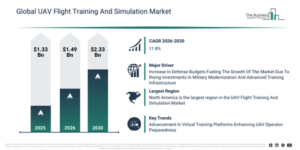
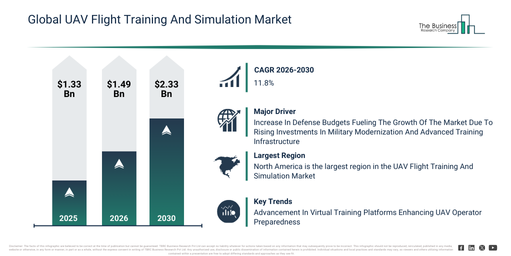
The uav flight training and simulation market size has seen rapid growth in recent years. It will grow from $1.33 billion in 2025 to $1.49 billion in 2026 at a compound annual growth rate (CAGR) of 12.0%. This historic expansion can be attributed to the early development of UAV flight simulators and training programs, the integration of basic flight training for remotely piloted systems, government and military funding for UAV operator skill development, advancements in scenario-based mission training technologies, and the initial deployment of control stations and visual display systems for training purposes.
The uav flight training and simulation market size is expected to show significant expansion in the coming years. It is forecast to grow to $2.33 billion in 2030, achieving a compound annual growth rate (CAGR) of 11.8%. This growth during the forecast period can be attributed to an increasing demand for immersive and scenario-driven uav flight training solutions, the expansion of training programs for commercial and defense uav operations, the adoption of advanced tools for performance assessment and systems diagnostics, the development of next-generation training drones and simulators, and increased collaboration between training providers and uav manufacturers to improve operator preparedness. Key trends foreseen in this period include a greater uptake of scenario-based mission training, the integration of real-time data analytics into training, the proliferation of modular and scalable flight simulators, the broadening of commercial and civil uav training programs, and the creation of training programs focused on multi-vehicle operations.
Free UAV Flight Training And Simulation Market Sample: Market Size, Growth Drivers And Competitive Landscape:
UAV Flight Training And Simulation Market Drivers Explained: What Is Supporting A 11.8% CAGR?
A growing defense budget is anticipated to drive the expansion of the UAV flight training and simulation market in the coming years. A defense budget represents the monetary funds allocated by a government exclusively for the advancement, upkeep, and deployment of its military forces and associated defense operations. The increase in defense spending stems from the escalating requirement to upgrade military capabilities with cutting-edge technologies like artificial intelligence, cyber security, and autonomous platforms, in order to confront more intricate and shifting global challenges. Elevated defense allocations facilitate larger investments in sophisticated training facilities, thereby enabling military entities to acquire realistic UAV simulators and extend extensive training curricula, ultimately improving operator preparedness and ensuring successful missions. For example, as reported by the Stockholm International Peace Research Institute, a Sweden-based global institution, worldwide military expenditures hit 2,718 billion dollars in 2024 by April 2025, marking a 9.4% real-term rise from the prior year. Consequently, an augmented defense budget will stimulate the expansion of the UAV flight training and simulation market.
UAV Flight Training And Simulation Market Segment Guide: Main Divisions And Subsegments
The uav flight training and simulation market covered in this report is segmented –
1) By Type: High Altitude Long Endurance, Medium Altitude Long Endurance UAV, Small Unmanned Aerial Vehicle
2) By Technique: Live, Virtual, Game Based, Constructive
3) By Application: Civil And Commercial, Defense And Military, Homeland Security
Subsegments:
1) By High Altitude Long Endurance: Strategic Reconnaissance UAV Simulators, Surveillance And Intelligence UAV Simulators, Combat-Ready UAV Training Systems
2) By Medium Altitude Long Endurance UAV: Tactical UAV Flight Simulators, Multi-Mission UAV Simulators, Navigation And Payload Operation Simulators
3) By Small Unmanned Aerial Vehicle: Micro UAV Simulators, Mini UAV Simulators, Consumer Or Commercial Drone Simulators
UAV Flight Training And Simulation Market Trends And Opportunities For 2026–2030
Companies within the UAV flight training and simulation market are prioritizing the creation of sophisticated tools, including small unmanned aerial system (sUAS) flight simulators, to enable repetitive practice of intricate maneuvers and critical emergency protocols. These small unmanned aerial system (sUAS) flight simulators function as virtual training platforms, engineered to emulate the handling and operation of small unmanned aircraft, thereby assisting users in developing piloting competencies securely and effectively without requiring actual flight. An illustration of this is Performance Drone Works (PDW), a US-based producer of autonomous drones, which introduced the PDW SIM, a small unmanned aerial system (sUAS) flight simulator, in April 2025. The PDW SIM software equips sUAS operators with authentic training conditions that replicate diverse terrains, weather conditions, and mission challenges. It incorporates 3D maps derived from genuine geospatial data, integrated with simulated elements and lifelike flight characteristics. This platform facilitates completely customizable training settings, eliminating the necessity for real-world airspace or elaborate logistical arrangements. Furthermore, it aids operators in practicing responses to vital mission problems like signal interruption, interference, and power constraints, thus enhancing their capacity for swift and impactful decision-making.
Which Major Players Are Active In The UAV Flight Training And Simulation Market?
Major companies operating in the uav flight training and simulation market are Boeing Co., Lockheed Martin Corporation, Northrop Grumman Corporation, Collins Aerospace Companies, BAE Systems Plc, Thales Group, L3Harris Technologies Inc., Leonardo S.p.A, Textron Inc., Elbit Systems Ltd., AXIS Flight Training Systems GmbH, Saab AB, CAE Inc., General Atomics Aeronautical Systems Inc., FlightSafety International Inc., Kratos Defense & Security Solutions Inc., HAVELSAN Inc., Zen Technologies Ltd., FAAC Incorporated, Crew Training International Inc.
Unlock The Complete UAV Flight Training And Simulation Market Report With Company Benchmarking:
UAV Flight Training And Simulation Market World Regions Compared: Which Leads In Revenue?
North America was the largest region in the UAV flight training and simulation market in 2025. Asia-Pacific is expected to be the fastest-growing region in the forecast period. The regions covered in the uav flight training and simulation market report are Asia-Pacific, South East Asia, Western Europe, Eastern Europe, North America, South America, Middle East, Africa.
Reach Out To Our Team:
The Business Research Company: https://www.thebusinessresearchcompany.com/
Americas: +1 310-496-7795
Asia: +44 7882 955267 & +91 8897263534
Europe: +44 7882 955267
Email us at: marketing@tbrc.info
Follow us on:
LinkedIn: https://in.linkedin.com/company/the-business-research-company
YouTube: https://www.youtube.com/channel/UC24_fI0rV8cR5DxlCpgmyFQ
Global Market Model: https://www.thebusinessresearchcompany.com/global-market-model

Wasay has over a decade of experience in market research, data modelling, and analytics, with prior experience at GlobalData and Decision Tree Consulting Services. At The Business Research Company , he leads research operations across syndicated studies, customized consulting engagements, and the Global Market Model platform. His professional experience includes supporting organizations such as Boston Consulting Group, KPMG, and Ernst & Young. Wasay holds a degree in Electronics and Communications Engineering, postgraduate management qualifications from International Management Institute Belgium and Indian School of Business and Entrepreneurship, and completed the Integrated Program in Business Analytics from Indian Institute of Management Indore.