Designed to make market research more actionable and strategically valuable, The Business Research Company’s 2026 market reports feature market attractiveness scoring, total addressable market sizing, company benchmarking matrices, interactive Excel dashboards, deeper supply chain intelligence, emerging startup tracking, and granular product-level insights.
How Fast Is The Rocket Acoustic Suppression Systems Market Growing? Market Size, CAGR And Forecast Insights
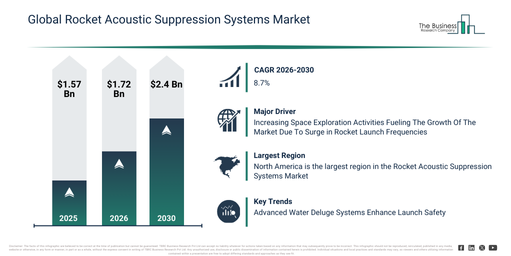
The market for rocket acoustic suppression systems has experienced substantial growth recently. This market is projected to expand from $1.57 billion in 2025 to $1.72 billion in 2026, demonstrating a compound annual growth rate (CAGR) of 9.6%. Historically, this expansion has been driven by several factors, including the increasing application of water deluge systems to mitigate acoustic loads during high-thrust rocket launches, the broader implementation of flame deflectors and sound suppression nozzles for safeguarding launch infrastructure, a rising need for acoustic modeling and simulation to refine launch pad configurations, the early adoption of thermal insulation materials to shield equipment from heat and vibration damage, and the growth of maintenance and retrofitting services as older launch facilities are upgraded.
The market for rocket acoustic suppression systems is projected to experience substantial expansion in the coming years, reaching $2.4 billion by 2030, demonstrating a compound annual growth rate (CAGR) of 8.7%. This anticipated growth is driven by several factors, including an increasing need for sophisticated acoustic suppression solutions for reusable and more powerful launch vehicles, the greater integration of engineered sound-absorbing materials to enhance noise reduction, significant investments in new commercial launch facilities demanding tailored suppression designs, the proliferation of automated and sensor-based monitoring systems for real-time acoustic optimization, and technological progress leading to more compact, efficient, and sustainable suppression systems. Key trends expected during this period involve the wider implementation of high-capacity water deluge systems, the broadening of launch infrastructure modernization initiatives, increased application of thermal and acoustic insulation materials, a rising need for advanced acoustic modeling and simulation services, and the creation of modular acoustic suppression system designs.
Unlock Rocket Acoustic Suppression Systems Market Insights With A Free Sample Report:
Rocket Acoustic Suppression Systems Market Momentum: Key Driver Expected To Boost Growth Through 2030
The expansion of space exploration endeavors is anticipated to drive the rocket acoustic suppression systems market forward. Space exploration encompasses the pursuit of scientific understanding, technological progress, and commercial ventures beyond Earth through various missions, research initiatives, and orbital operations. These activities are on the rise, primarily driven by the increasing need for sophisticated communication and Earth observation satellites, which facilitate worldwide connectivity, environmental oversight, and improved security. Rocket acoustic suppression systems play a crucial role in enhancing space exploration by mitigating intense sound pressure during liftoff, thereby safeguarding launch vehicles and ground infrastructure. They also bolster mission safety by minimizing structural oscillations, leading to more dependable and effective rocket launches. For example, Novaspace, a France-based space consulting firm, reported in September 2023 that government expenditure on space exploration amounted to $27 billion in 2024, with projections indicating it will climb to almost $31 billion by 2034. Consequently, the growing volume of space exploration initiatives is propelling the rocket acoustic suppression systems market.
Rocket Acoustic Suppression Systems Market Segments: A Category-By-Category Overview
The rocket acoustic suppression systems market covered in this report is segmented –
1) By Product Type: Water-Based Systems, Foam-Based Systems, Hybrid Systems
2) By Application: Launch Pads, Test Facilities, Spaceports
3) By End-User: Commercial Space Agencies, Government Space Agencies, Defense Organizations
Subsegments:
1) By Water-Based Systems: Deluge Systems, Rainbird Systems, Water Spray Nozzles
2) By Foam-Based Systems: High-Expansion Foam, Aqueous Film Forming Foam (AFFF), Compressed Air Foam Systems (CAFS)
3) By Hybrid Systems: Water-Foam Combination Units, Water Mist Systems, Dual-Agent Systems
Which Emerging Trends Are Gaining Traction In The Rocket Acoustic Suppression Systems Market?
Key companies operating in the rocket acoustic suppression systems market are concentrating on developing sophisticated solutions, including water deluge systems, to mitigate extreme sound pressure levels, safeguard launch infrastructure, and guarantee mission success. Water deluge systems are high-capacity water injection mechanisms that effectively suppress acoustic energy and reduce vibrations during a rocket’s ignition and liftoff phases. For example, in January 2024, Salas O’Brien, a US-based engineering consultancy firm, collaborated with United Launch Alliance (ULA), a US-based aerospace and defense services company, to upgrade Space Launch Complex 41 (SLC-41) at Cape Canaveral Space Force Station for its next-generation Vulcan Centaur rocket. This project encompassed improvements to the acoustic suppression system, featuring a cutting-edge water deluge system specifically designed to manage the intense noise and heat generated by ULA’s Vulcan Centaur rocket. The system rapidly releases thousands of gallons of water in seconds, dampening shockwaves and preventing damage to both the launch pad and its payload. This innovation enhances launch reliability while simultaneously minimizing structural stress on both the rocket vehicle and the ground support equipment.
Rocket Acoustic Suppression Systems Market Key Participants: Prominent Companies At A Glance
Major companies operating in the rocket acoustic suppression systems market are The Boeing Company, Lockheed Martin Corporation, Northrop Grumman Innovation Systems , Honeywell International Inc., Bechtel Corporation, Parker Hannifin Corporation, Jacobs Engineering Group Inc., Space Exploration Technologies Corp., Blue Origin LLC, Moog Inc., United Launch Alliance LLC, Woodward Inc, Sierra Nevada Corporation, Salas O’Brien, Arianespace SA, Sierra Lobo Inc., NASA Kennedy Space Center, Vinyl Technology Inc., Dynetics Inc., Applied Flow Technology LLC
Get Detailed Rocket Acoustic Suppression Systems Market Forecasts In The Complete Report:
Top Region In The Rocket Acoustic Suppression Systems Market: A Global Perspective
North America was the largest region in the rocket acoustic suppression systems market in 2025. The regions covered in the rocket acoustic suppression systems market report are Asia-Pacific, South East Asia, Western Europe, Eastern Europe, North America, South America, Middle East, Africa.
Reach Out To Our Team:
The Business Research Company: https://www.thebusinessresearchcompany.com/
Americas: +1 310-496-7795
Asia: +44 7882 955267 & +91 8897263534
Europe: +44 7882 955267
Email us at: marketing@tbrc.info
Follow us on:
LinkedIn: https://in.linkedin.com/company/the-business-research-company
YouTube: https://www.youtube.com/channel/UC24_fI0rV8cR5DxlCpgmyFQ
Global Market Model: https://www.thebusinessresearchcompany.com/global-market-model

Wasay has over a decade of experience in market research, data modelling, and analytics, with prior experience at GlobalData and Decision Tree Consulting Services. At The Business Research Company , he leads research operations across syndicated studies, customized consulting engagements, and the Global Market Model platform. His professional experience includes supporting organizations such as Boston Consulting Group, KPMG, and Ernst & Young. Wasay holds a degree in Electronics and Communications Engineering, postgraduate management qualifications from International Management Institute Belgium and Indian School of Business and Entrepreneurship, and completed the Integrated Program in Business Analytics from Indian Institute of Management Indore.