With a focus on actionable insights and strategic value, The Business Research Company’s 2026 market reports include market attractiveness scoring, total addressable market sizing, company benchmarking matrices, interactive Excel dashboards, deeper supply chain intelligence, emerging startup tracking, and granular product-level insights.
How Much Will The Rocket Grid Fin Market Be Worth By 2030?
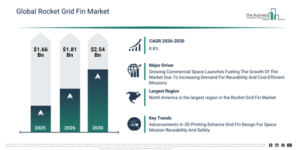
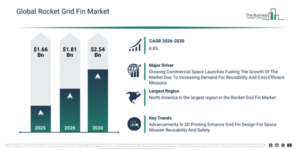
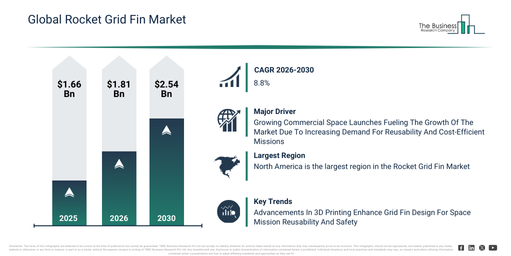
The rocket grid fin market size has shown robust growth recently. It is forecast to expand from $1.66 billion in 2025 to $1.81 billion in 2026, achieving a compound annual growth rate (CAGR) of 9.0%. The expansion observed in previous periods is attributable to the increasing uptake of booster recovery programs necessitating better aerodynamic control surfaces, the development of rectangular grid fins to enable stable descent guidance, initial experiments with curved and tapered grid fin designs to improve maneuverability, the incorporation of fixed grid fins into reusable launch systems to ensure consistent reentry performance, and advancements in high-temperature materials enhancing grid fin durability during atmospheric reentry.
The rocket grid fin market is projected to demonstrate significant growth over the next few years, expanding to $2.54 billion by 2030, with a compound annual growth rate (CAGR) of 8.8%. This anticipated growth is primarily fueled by the expansion of reusable rocket fleets, which drives demand for precise landing control components, alongside innovations in adaptive grid fin technologies that enable real-time aerodynamic optimization. Other contributing factors include a rising commercial launch cadence requiring efficient and scalable grid fin manufacturing, advancements in lightweight composites that reduce mass while preserving structural strength, and increasing investment in autonomous landing technologies necessitating more responsive grid fin control systems. Key trends expected in this period encompass a greater adoption of heat-resistant materials for reentry fins, the development of adaptive and morphing grid fin designs, increased use of reusable booster control surfaces, progress in precision machining for high-load fin structures, and enhanced aerodynamic optimization aimed at improving landing accuracy.
Get Access To A Free Rocket Grid Fin Market Report Sample:
The Key Driver Behind The Rocket Grid Fin Market’s 8.8% CAGR
The increasing volume of commercial space launches is anticipated to drive the expansion of the rocket grid fin market in the future. Commercial space launches involve rockets launched by private entities for tasks such as satellite deployment, space tourism, or research missions. The growth in commercial space launches is attributed to rising private sector investment in satellite-based communication and Earth observation, which prompts companies to schedule more frequent missions. Rocket grid fins are integral to commercial space launches as they facilitate controlled descent and landing of rocket boosters, thereby improving reusability and mission efficiency. Their ability to enable safe recovery helps reduce launch costs, contributing to the growing demand for regular and sustainable space missions. For instance, in November 2024, the Federal Aviation Administration, a US-based federal agency, reported that commercial space operations increased by over 30% in 2023, reaching 148 launches, with projections indicating they will more than double by 2028. Consequently, the rising number of commercial space launches is a key factor propelling the growth of the rocket grid fin market.
Rocket Grid Fin Market Classification: Main Segments And Detailed Subsegments
The rocket grid fin market covered in this report is segmented –
1) By Material Type: Aluminum, Titanium, Composite Materials, Other Material Types
2) By Application: Commercial Space Launch, Military Defense, Research And Development, Other Applications
3) By End-User: Space Agencies, Private Space Companies, Defense Organizations, Other End-Users
Subsegments:
1) By Aluminum: 6061 Aluminum Alloy, 7075 Aluminum Alloy, Cast Aluminum, Anodized Aluminum
2) By Titanium: Grade 5, Grade 2, Titanium Beta Alloys, Forged Titanium
3) By Composite Materials: Carbon Fiber Reinforced Polymer (CFRP), Glass Fiber Reinforced Polymer (GFRP), Aramid Fiber Composites, Hybrid Composites
4) By Other Material Types: Stainless Steel, Inconel Alloys, Magnesium Alloys, Ceramic Matrix Composites (CMC)
Rocket Grid Fin Market Strategic Shifts: What Leading Players Are Prioritizing
Leading companies in the rocket grid fin market are concentrating on developing advanced solutions, such as 3D printing technology, to produce lightweight yet robust grid fin structures optimized for high-performance reusability in space missions. 3D printing technology involves using additive manufacturing to create the complex lattice structure of grid fins with high precision. For instance, in February 2023, Ankit Aerospace Pvt. Ltd., an India-based aerospace and defense company, introduced 3D-printed grid fins. These grid fins are fabricated using advanced metal additive manufacturing techniques, including 3D printing technology, ensuring superior strength-to-weight ratios and thermal resistance during high-speed re-entry. This design enables precise aerodynamic control while reducing production costs and lead times compared to traditional machining methods. This innovation improves the reusability and efficiency of launch vehicles, aligning with the increasing demand for sustainable space exploration technologies.
Rocket Grid Fin Market Company Analysis: Major Industry Participants
Major companies operating in the rocket grid fin market are Lockheed Martin Corporation, The Boeing Company, China Aerospace Science and Technology Corporation, Northrop Grumman Corporation, Space Exploration Technologies Corp., Blue Origin LLC, ArianeGroup SAS, Indian Space Research Organisation (ISRO), United Launch Alliance LLC (ULA), Arianespace SA, Relativity Space Inc., Rocket Lab USA Inc., Firefly Aerospace Inc., Avio S.p.A., Vector Launch Inc., Roscosmos, Virgin Orbit LLC, Ankit Aerospace Pvt. Ltd., Kronshtadt Group JSC, United SAR Inc.
Get Full Access To The Rocket Grid Fin Market Report 2026:
Rocket Grid Fin Market Global Regional Breakdown: Key Regions Analyzed
North America was the largest region in the rocket grid fin market in 2025. The regions covered in the rocket grid fin market report are Asia-Pacific, South East Asia, Western Europe, Eastern Europe, North America, South America, Middle East, Africa.
Reach Out To Our Team:
The Business Research Company: https://www.thebusinessresearchcompany.com/
Americas: +1 310-496-7795
Asia: +44 7882 955267 & +91 8897263534
Europe: +44 7882 955267
Email us at: marketing@tbrc.info
Follow us on:
LinkedIn: https://in.linkedin.com/company/the-business-research-company
YouTube: https://www.youtube.com/channel/UC24_fI0rV8cR5DxlCpgmyFQ
Global Market Model: https://www.thebusinessresearchcompany.com/global-market-model

Wasay has over a decade of experience in market research, data modelling, and analytics, with prior experience at GlobalData and Decision Tree Consulting Services. At The Business Research Company , he leads research operations across syndicated studies, customized consulting engagements, and the Global Market Model platform. His professional experience includes supporting organizations such as Boston Consulting Group, KPMG, and Ernst & Young. Wasay holds a degree in Electronics and Communications Engineering, postgraduate management qualifications from International Management Institute Belgium and Indian School of Business and Entrepreneurship, and completed the Integrated Program in Business Analytics from Indian Institute of Management Indore.