The Business Research Company’s 2026 market reports are designed to deliver research that is more actionable and strategically valuable. Key offerings include market attractiveness scoring, total addressable market sizing, company benchmarking matrices, interactive Excel dashboards, deeper supply chain intelligence, emerging startup tracking, and granular product-level insights.
Rocket Launch Energy Recovery Market Historical Growth Vs. Forecast Growth: How Do The Numbers Compare?
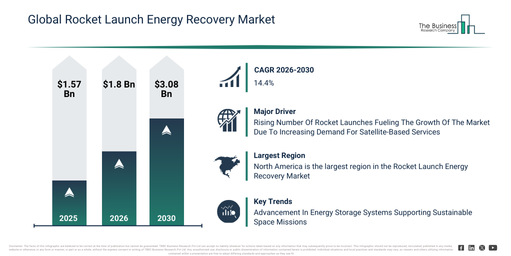
The rocket launch energy recovery market has experienced swift expansion over recent years. This market is projected to expand from $1.57 billion in 2025 to $1.8 billion in 2026, exhibiting a compound annual growth rate (CAGR) of 14.6%. Historic growth in this sector stems from several factors, including an increased focus on enhancing launch efficiency, which has spurred initial investigations into energy capture ideas. Additionally, the development of power conversion units capable of utilizing leftover thermal or mechanical energy, along with the growing implementation of sensors and control modules for tracking energy movement during launches, has contributed significantly. The early integration of regenerative power supply systems into ground operations, coupled with an increasing prioritization of sustainability within government space programs, has further fueled interest in energy recovery technologies.
The rocket launch energy recovery market is poised for significant expansion in the coming years. It is projected to reach $3.08 billion in 2030, exhibiting a compound annual growth rate (CAGR) of 14.4%. This anticipated growth during the forecast period stems from several factors. These include the expanding use of reusable rocket operations, which boosts the need for advanced energy recovery systems; breakthroughs in high-capacity energy storage that allow for more efficient use of salvaged energy; an increase in commercial launch frequency, prompting the adoption of recovery technologies that reduce costs; improvements in exhaust energy capture systems that enhance overall propulsion efficiency; and a growing emphasis by regulators and the industry on sustainable launch methods, which promotes wider implementation of energy recovery solutions. Key developments expected during this period involve the creation of highly efficient exhaust heat recovery systems, a greater reliance on turbine-based units for energy extraction, the uptake of sophisticated high-density energy storage solutions, the broadening of regenerative power systems for reusable launch vehicles, and the incorporation of precisely controlled energy flow and management modules.
Start With A Free Sample Of The Rocket Launch Energy Recovery Market Research Report:
The Leading Growth Driver In The Rocket Launch Energy Recovery Market Explained
An anticipated increase in rocket launches is projected to fuel the expansion of the rocket launch energy recovery market. Rocket launches involve propelling rockets into space by generating thrust sufficient to overcome Earth’s gravitational pull. This surge in launch frequency stems largely from the growing need for satellite-based services, including communication, navigation, Earth observation, and internet access. The concept of rocket launch energy recovery improves space launch systems by capturing and repurposing energy from these launches, thereby fostering more efficient and sustainable missions. This approach lessens energy wastage through the adoption of reusable technologies, leading to enhanced cost-effectiveness and a diminished environmental footprint. As an illustration, the Space Foundation, a US non-profit, reported in January 2025 that orbital launch attempts rose by 16% in 2024, totaling 259 launches, which occurred approximately once every 34 hours—five hours more frequently than in 2023. Consequently, the escalating volume of rocket launches is a key driver for the expansion of the rocket launch energy recovery market.
Key Segments Shaping The Rocket Launch Energy Recovery Market Landscape
The rocket launch energy recovery market covered in this report is segmented –
1) By Component: Energy Recovery Systems, Energy Storage Systems, Control Systems
2) By Technology: Thermal Energy Recovery, Kinetic Energy Recovery, Electrical Energy Recovery
3) By Application: Commercial Space Launch, Military Space Launch, Scientific Space Exploration
Subsegments:
1) By Energy Recovery Systems: Thermal Energy Recovery Units, Kinetic Energy Recovery Systems, Exhaust Heat Recovery Systems, Turbine-Based Recovery Units, Regenerative Braking Systems
2) By Energy Storage Systems: Battery Storage Units, Supercapacitors, Flywheel Energy Storage, Thermal Energy Storage, Cryogenic Energy Storage
3) By Control Systems: Power Management Units (PMUs), Energy Flow Control Modules, Data Acquisition And Monitoring Systems, Real-Time Feedback Systems, Automation And Regulation Controllers
Rocket Launch Energy Recovery Market Trend Spotlight: Key Shifts Shaping Future Demand
Leading companies active in the rocket launch energy recovery market are prioritizing the development of sophisticated solutions, such as energy storage systems, to effectively collect, store, and reuse power generated during launches. Energy storage systems are technologies designed to retain energy for later consumption, ensuring a stable and reliable power supply. For example, in October 2024, EnerSys, a US-based battery manufacturing firm, introduced the ABSL lithium-ion space battery on NASA’s Europa Clipper spacecraft. It was launched using a SpaceX Falcon Heavy rocket from Kennedy Space Center. This battery, serving as an energy storage system, will energize the spacecraft’s journey and scientific instruments during nearly 50 flybys of Jupiter’s moon Europa to assess its potential for supporting life, representing a significant accomplishment in EnerSys’ partnership with NASA and emphasizing its advanced space battery engineering.
Rocket Launch Energy Recovery Market Competitive Analysis: Who Are The Main Competitors?
Major companies operating in the rocket launch energy recovery market are SpaceX Inc., Blue Origin LLC, United Launch Alliance LLC, Arianespace SA, Relativity Space Inc., ispace Inc., Rocket Lab USA Inc., Firefly Aerospace Inc., Orbex Limited, Stoke Space Technologies Inc., Virgin Orbit LLC, Galactic Energy Space Technology Co. Ltd., Isar Aerospace Technologies GmbH, SpinLaunch Inc., LandSpace Technology Corporation Ltd., Skyrora Limited, PLD Space S.L., Phantom Space Corporation, Astra Space Inc., Space Epoch Co. Ltd.
Find The Complete Rocket Launch Energy Recovery Market Outlook In The Full Report:
Mapping The Rocket Launch Energy Recovery Market: Regional Leadership And Global Reach
North America was the largest region in the rocket launch energy recovery market in 2025. The regions covered in the rocket launch energy recovery market report are Asia-Pacific, South East Asia, Western Europe, Eastern Europe, North America, South America, Middle East, Africa.
Reach Out To Our Team:
The Business Research Company: https://www.thebusinessresearchcompany.com/
Americas: +1 310-496-7795
Asia: +44 7882 955267 & +91 8897263534
Europe: +44 7882 955267
Email us at: marketing@tbrc.info
Follow us on:
LinkedIn: https://in.linkedin.com/company/the-business-research-company
YouTube: https://www.youtube.com/channel/UC24_fI0rV8cR5DxlCpgmyFQ
Global Market Model: https://www.thebusinessresearchcompany.com/global-market-model

Wasay has over a decade of experience in market research, data modelling, and analytics, with prior experience at GlobalData and Decision Tree Consulting Services. At The Business Research Company , he leads research operations across syndicated studies, customized consulting engagements, and the Global Market Model platform. His professional experience includes supporting organizations such as Boston Consulting Group, KPMG, and Ernst & Young. Wasay holds a degree in Electronics and Communications Engineering, postgraduate management qualifications from International Management Institute Belgium and Indian School of Business and Entrepreneurship, and completed the Integrated Program in Business Analytics from Indian Institute of Management Indore.